“Names were destiny, I said. So, why pick one with a history of suffering?”
“Our pasts were littered with heartbreak’s debris. Were our fates a family curse? Or were we lucky to have known passion at all?”
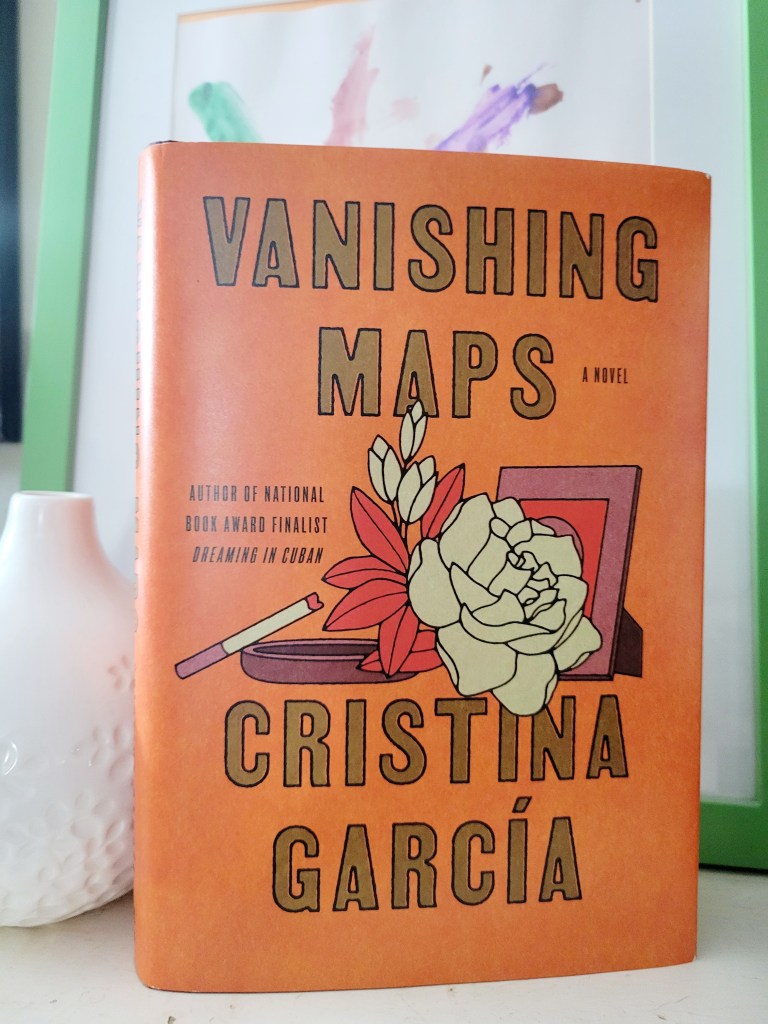
In 1992, Cristina García’s debut novel, Dreaming in Cuban, was published. The novel focused primarily on the del Pino women – Celia, Lourdes, Felicia, and Pilar and their fractured borders within a volatile Cuba – and it provided a crash course in the Cuban revolution while also translating any non-English words. It was a very polite novel for its readers, despite covering very harsh realities. Over 30 years and several novels later, García returns to the del Pino family with Vanishing Maps (Knopf 2023). The novel globe trots from Havana to the States, to Berlin, and to Moscow. This time, it’s a sink or swim approach for the reader – smatterings of Spanish, German and Russian are not translated, and the scars of the Revolution are loudly present but the impact and resulting diaspora are not really explained. I like the firm, chin up and steely eyes approach of the novel – the one that says, “you should know these things already.” I would recommend reading Dreaming in Cuban first to get a better understanding of these women, their scars, and the paths they choose.
Dreaming in Cuban opens with Celia scanning the ocean for adversaries. Twenty years have passed since we last saw this family, and Vanishing Maps opens with Celia’s grandson, Ivanito, performing as La Ivanita to her adoring fans in Berlin. It’s a different world, but much remains the same. Celia is still a staunch supporter of the Revolution and El Lider. Lourdes, now living in Miami, has involved herself in politics; involving herself in the matter of a young Cuban boy whose custody battle is modeled after that of Elián González. Pilar is in her 40s and a mom, but she’s still as angry and punk as she’d been in her youth – it’s just redirected; she’s still trying to find where she belongs.
The heart of this novel, however, is with Ivanito. As a young boy, Ivanito was whisked away from Cuba against Celia’s wishes – Cuba was going to eat him whole or his mother was going to kill him – she’d already tried once. His mother’s ghost is now haunting him, trying to convince him to join her in the afterlife – the smell of cigarettes and gardenias an assault on his senses as he wonders if her madness is now his. When Pilar arrives with Azul, it couldn’t have been at a better time. She saves him twice – once in her involvement in getting him out of Cuba and again in Berlin when the walls are closing in.
Vanishing Maps is a story of the children of the diaspora. Of Ivanito, Pilar, Luz, Milagro, Irina and Tereza. It’s a world where “the boys became men who lost their way while the women soldiered on.” And while we see Ivanito losing his way, we also see how La Ivanita soldiers on. It’s a story of family without borders, of motherhood, of loss, and of blood, separated by secrets and circumstance, becoming a found family.
Read this book.
* A huge thanks to Knopf for sending me this finished copy!
 A Girl Named Tommi