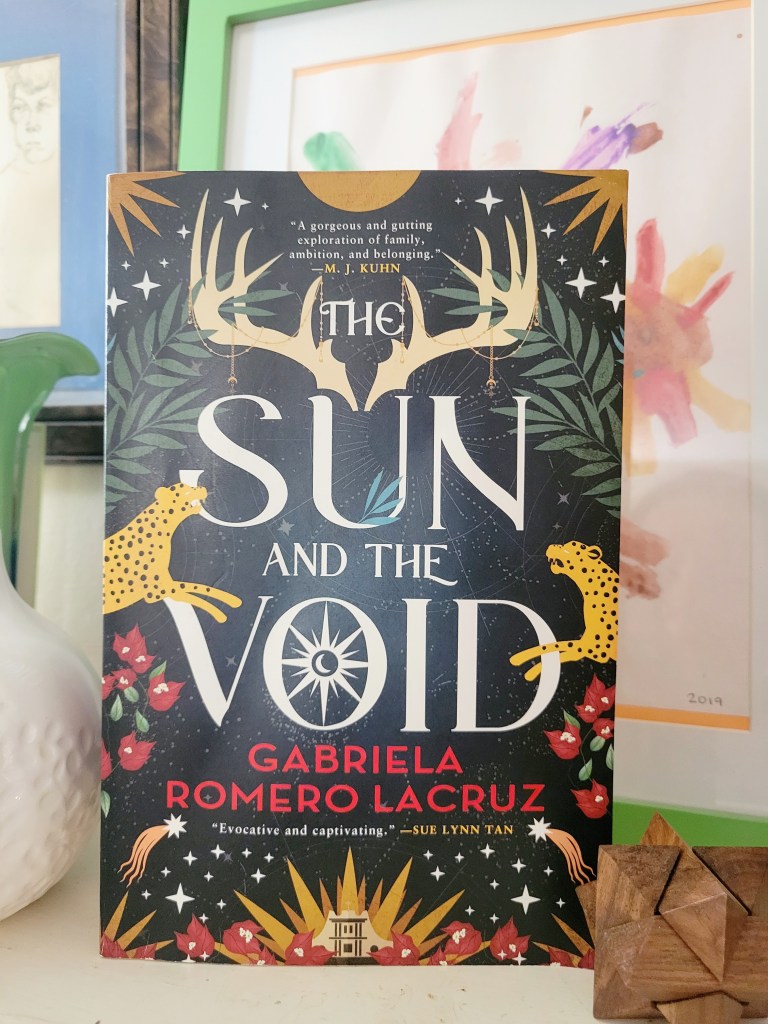
Gabriela Romero Lacruz’s The Sun and the Void, Book One of The Warring Gods (Orbit 2023) boasts one of my most favorite covers and a premise that had me chomping at the bit to get lost in this magical world inspired by the history and folklore of South America – a world where two young women become vessels for warring gods as they seek a soft place to land and a place they can call home. Reina is an orphaned half-nozariel – her only hope for happiness and belonging rests with her grandmother, a witch in the employ of an extremely powerful caudillo family in a land where nozariels are banned. Reina begins to prepare as her grandmother’s successor and studies Rahmagut’s, the god of the void, deadly magic. Eva is from an affluent family in a land where magic is banned, but her father was a valco and magic runs in her blood. When placed in an impossible position, she makes a choice that will forever alter her life.
With an astrological event nearing, the seal keeping Rahmagut from the world (a seal put in place by the sun god, Ches) will weaken temporarily and the dark god may be brought forth – an abundance of favor on whomever breaks the seal. Reina needs to break the seal to secure her place within the caudillo and to break her reliance on iridio, a magical substance she needs to survive. Eva’s desire to break the seal is tied to the man who is both her savior and her destruction. After quite a bit of bloodshed, a choice will be made that will bring the warring gods new life.
There’s a lot to love in this novel. It’s reminiscent of Shannon’s The Priory books and Roanhorse’s Black Sun, especially with the importance and use of astrology, there’s a flavor and lyricism to the writing at times, the world and the magic is intriguing, and again – the cover is gorgeous. But as much as I wanted to love it, I couldn’t. The novel needed a stronger editor to weed out unnecessary bits as well as highly repetitive sections and phrases. (The use of pallbearer and descriptions of someone following someone like a puppy are used far too many times. Some dialogue is almost word for word repeated, and between different characters.) The characters seem to flail about, running quickly hot and cold in their thoughts, actions and emotions with no clear explanation or justification. They are indecisive not as a personality traits but rather as a way to drive the plot, and it reads far too jarring and flat. The only character I felt any connection to was Maior, who was a secondary character in this novel but there is potential she’ll take a more leading role in the second. Also, the fact that Eva’s mentor is burned alive for practicing magic is only given two lines had me aghast. In short, there are too many words for things that didn’t need them and not enough to build the characters and their motivations.
I’m not sure if I’ll read the second book.
*A big thanks to Orbit Books for the gifted novel.
 A Girl Named Tommi