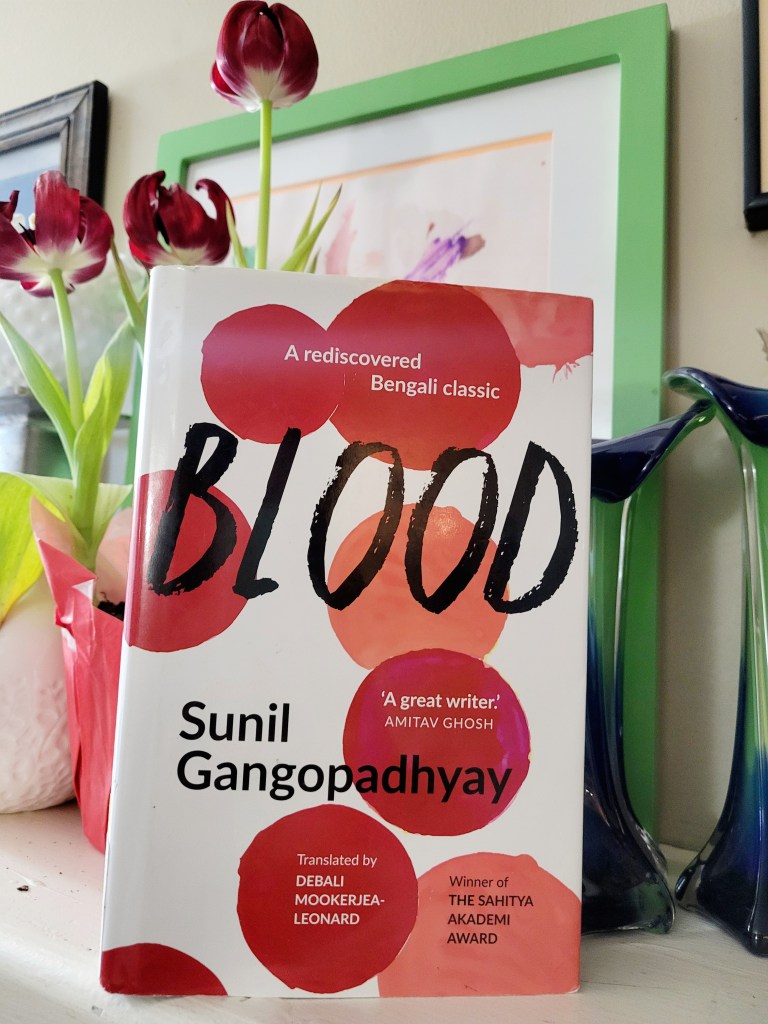
Next installment of Tommi Reads the World – we’re in the Bs.
Country: Bangladesh
Title: Blood
Author: Sunil Gangopadhyay
Language: Bengali
Translator: Debali Mookerjea-Leonard
Publisher: First published in Begali as Rakta by Biswabani Prakashani 1973, translation first published by Juggernaut Books 2020
Sunil Gangopadhyay’s Blood could have served as either my selection from Bangladesh or India. As Gangopadhyay was born in what is now Bangladesh and wrote in Bengali, I’m counting Blood as the selection for Bangladesh.
Blood wasn’t translated into English until decades after it was written, and that is a bit of a shame because it is an extremely captivating post-colonial novel.
Tapan grew up under British imperialism. When he was a small child, his father killed a British colonial official. Whether an act of personal revenge for what had happened to Tapan’s uncle or an act of revolution, the murder of the British official forever altered Tapan’s life. His father did not survive the events and his family was forced to flee. Tapan spent all of his time, energy and resources trying to claw his way out of India and into a better life. He finds success in America and is determined to never return.
Tapan has a rootless existence that is commonly seen in post-colonial lit and children of the diaspora. This rootlessness is making him physically ill. While in England for a brief layover before heading to India for a wedding, he begins seeing Alice. He selected her over her friend because Alice was a prettier name than Barbara. (He’s not a good guy.) He didn’t know at the time that she’d not only spent a portion of her childhood in the hometown he’d fled, but that her father was the official his father had murdered. A picture of both men, prior to the attack of course, hung in her flat. Tapan becomes consumed with a rage he cannot define and redirects it toward Alice. (I disliked both Tapan and Alice pretty equally.)
A small volume that packs a punch, it’s a novel of the scars of colonization, the ties to the land we call home, racism, and guilt. It’s a novel of blood – that which is shed and that which runs through our veins.
Read this book.
 A Girl Named Tommi