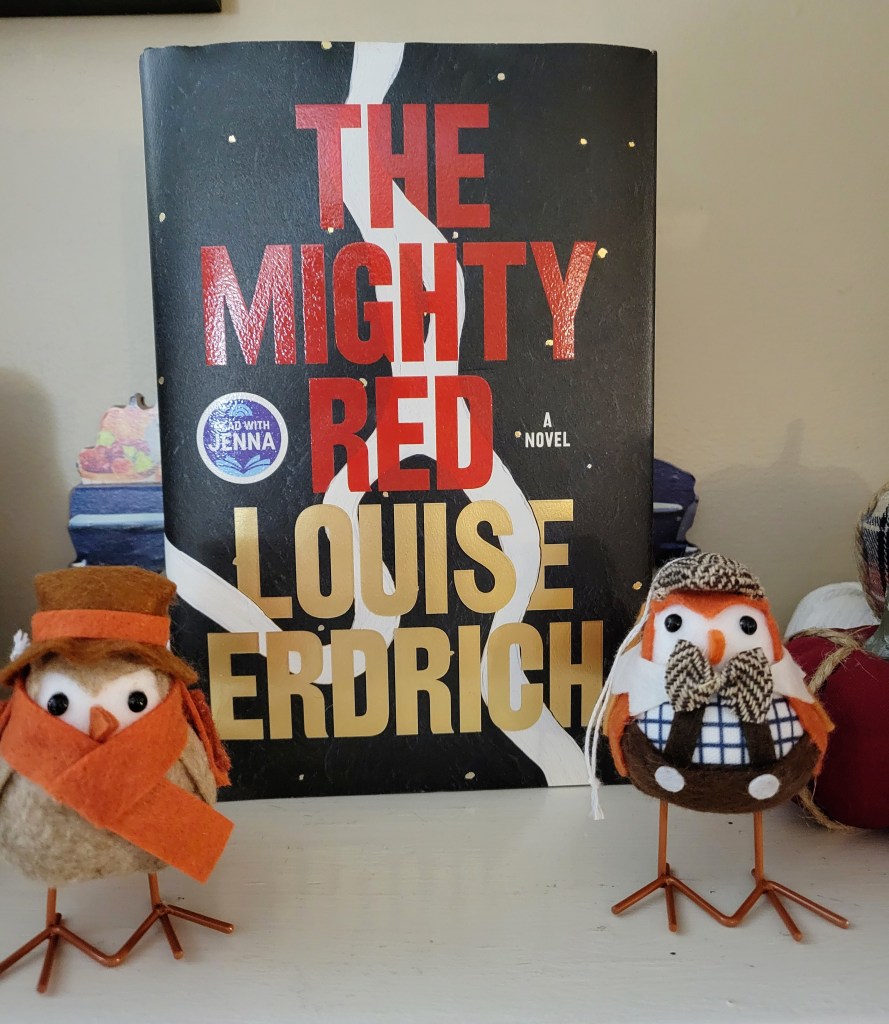
“Like the mighty red, history was a flood.”
“So it was, every teaspoon of sugar that was stirred into a cup or baked into a pudding was haunted by the slave trade and the slaughter of buffalo. Just as now, into every teaspoon, is mixed the pragmatic nihilism of industrial sugar farming and the death of our place on earth. This is the sweetness that pricks people’s senses and sparkles in a birthday cake and glitters on the tongue. Price guaranteed, delicious, a craving as strong as love.”
For me, Louise Erdrich never fails. I’ve said before and I’ll say again, reading her work is like meeting up with an old friend and marveling at how they’ve changed and at all the ways they’ve stayed the same. The Mighty Red (Harper 2024) is no exception. Dedicated to “those who love birds and defend their place on earth,” this novel comes out swinging with characters you won’t soon forget.
From the dying earth to the bleached bones of the forgotten ancestors to the chemicals and vanishing birds, this is an econovel that takes a stark look at human accountability or lack of accountability for what we’ve done in the name of profits, in this case the main focus is chemicals used in sugar beet farming that destroy everything but the sugar beets. (The historical segway into how buffalo bones were used to refine sugar in the 19th century is something I won’t soon forget.)
Set in the Red River Valley of North Dakota, the novel follows Crystal, a hardworking woman who hauls sugar beets; Crystal’s husband (despite never marrying), Martin, a down on his luck actor who is really bad at finances but somehow was put in charge of managing the church’s renovation fund; Crystal’s daughter, Kismet, a really smart Goth high schooler; Hugo, the homeschooled son of the bookstore owner who is madly in love with her; Gary, the star football player and son of a beet farmer who is believed to have a guardian angel and is convinced he has to have Kismet to keep his ghost at bay; and Winnie, Gary’s mother, who is teetering on insanity, living on her parents farmland that they’d lost to the man who later became her father-in-law – a man who’d razed her family home and destroyed the soil for profit.
The quick and dirty – the church renovation fund is at zero, Martin has disappeared, a mortgage has been placed on Crystal’s house without her knowledge, Kismet marries Gary, despite still being involved with Hugo, Hugo heads west to make money in the oil fields so he can steal her away, there’s been a string of bank robberies, and the truth about what really happened in the accident that took the lives of two football players emerges. All the while, some farmers are trying to breathe new life into the dead soil and bring the birds back.
We need this novel. More than ever. Remember, there is no planet B, and that books and reading are both political.
Read this book.
 A Girl Named Tommi