“Nyawĩra and Kamĩtĩ drifted from group to group till they came to a crowd around a storyteller with a single-stringed violin.”
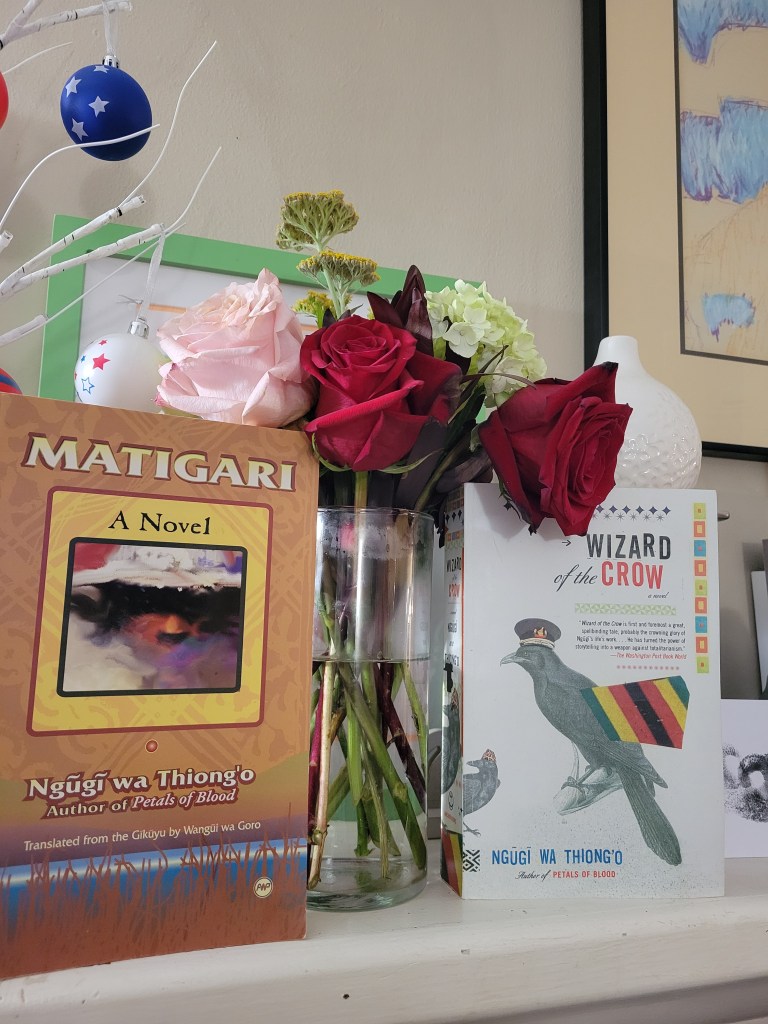
Ngũgĩ wa Thiong’o passed away on May 28, 2025. I didn’t know until recently, but perhaps that’s why Wizard of the Crow ( 2006 Random House) called out from my shelves of the unread. I knew of Thiong’o – I studied him and Matigari (1998 African World Press) back in 2003. He was a champion for African literature, particularly from his native Kenya. Perhaps more importantly, he was a champion of native African languages; his novels were written first in Gikũyũ before being translated by the author into English.
While significantly longer than Matigari, Wizard of the Crow has similar themes of postcolonialism, political corruptness, and a people finding their voice – there’s magical realism, biting commentary, and a dry humor to the writing that will have you chuckling. It’s difficult, complex, and really flippin’ funny.
Set in the fictional “Free Republic of Aburĩria,” the novel follows Kamĩtĩ, a beggar with seer capabilities, and Nyawĩra, a young woman who has been kicked out by her wealthy father and is now part of a rebellious group set to take down the Ruler and his corrupt administration. A twist of fate brings them together not once, but twice, and to avoid being arrested, Kamĩtĩ quickly takes on a persona of a sorcerer – the Wizard of the Crow. What started as a lie to avoid arrest and exposure snowballs as both Nyawĩra and Kamĩtĩ get pulled into the Ruler’s web. (The Ruler has announced his “Marching to Heaven” campaign and efforts are underway to get funding from Global Bank.)
The whole ruling party is corrupt and there’s infighting and distrust between everyone with even a hint of power – they will kill each other to be the Ruler’s right-hand man. One minister enlarges his ears to better be the Ruler’s ears. One has his eyes enlarged. Another his mouth (that one comically fails). One has an arm and leg turned white before the clinic closes for fraud. Meanwhile, the Ruler is suffering from his own comical ailment.
It’s biting and funny, and if you’ve never read Thiong’o, now is the perfect time. Like a lot of African literature, there’s an air of storytelling that just pulls you in – an oral tradition finding its way to the page.
 A Girl Named Tommi