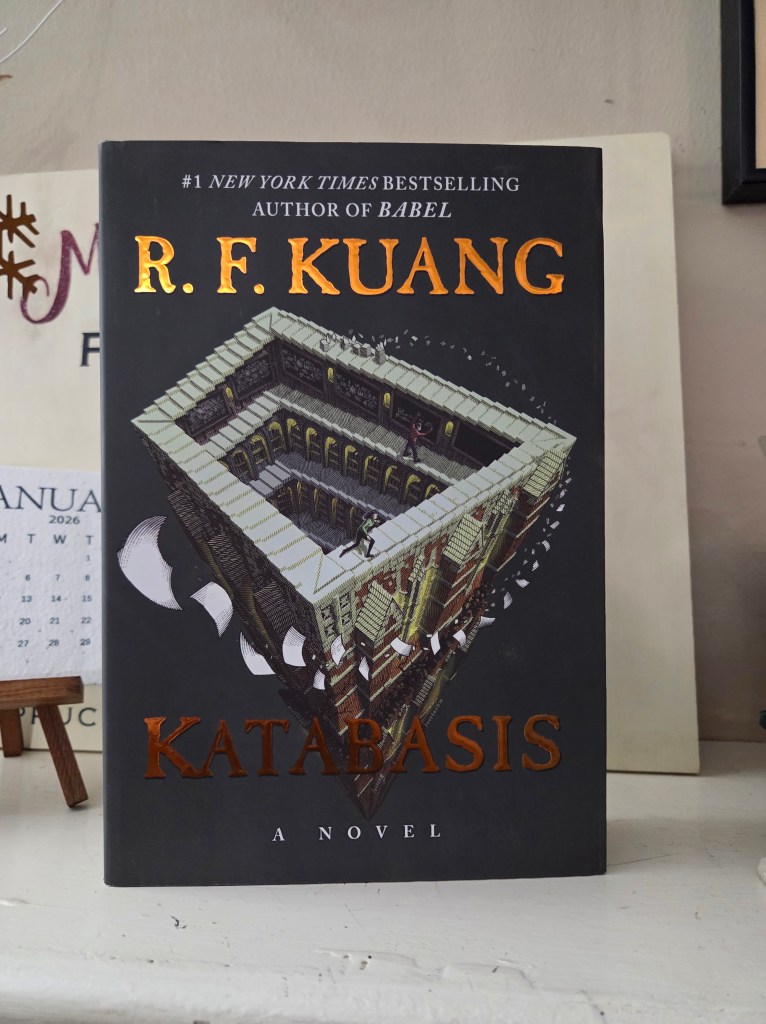
“Don’t worry, it can’t hurt them. It’s only a memory.”
The discourse around R.F. Kuang’s Katabasis (HarperCollins 2025) has been absolutely ridiculous; the book community is certainly not immune to the toxic nature bred and natured by online communities. So, I’ll begin with this – if you didn’t like this novel, it doesn’t mean you’re stupid or better than. If you did like this novel, it doesn’t mean you’re smart or a sheep. Period. The discourse is honestly why I delayed reading it. Having now read it, my thoughts are much the same as they were with Babel; it’s not a five star read FOR ME. I said the following about Babel, and it applies here as well:
“So why wasn’t it a five-star read? The storytelling itself. It is at times redundant and repetitive, with a heavy focus on telling not showing.”
Much like Babel, there are some great things at work here, and I do think the storytelling is a bit better with this one, but it just didn’t wow me. I will say, however, the novel, particularly the first ¾, is hilarious. There’s a dryness to Alice that I loved. Don’t get me wrong, both her and Peter are insufferable academics, but when that sharp wit pops up, tapdancing between low and high brow, it got me grinning.
The criticism of the novel being too pretentious is a bit unfair. Yes, Kuang is smart, and yes, she wants her reader to know and yes, she is Alice. But she knows what she is and she wrote a story that embraces that wholly – it’s dark academia after all. Academics ARE pretentious. And Kuang is not blind to how it comes across, she leans into it ON PURPOSE. And it works well – even more so here than in Babel. The best parts are the juxtaposition of scholar and kid who just wants to rot on the sofa in front of tele – been there, done that.
I’ve studied at Oxford. I have a MA in multicultural literature. I rubbed elbows with scholars and spent time in stacks. I get it. I do. While I lost my thesis director prior to defending, she did not go to hell (Gay Wilentz was a wonderful scholar and person), and I did not have to go retrieve her. (But I can recall, with clarity, the extreme grief and panic that consumed me when she finally lost her battle with ALS.) Perhaps that is why I enjoy Kuang’s dark academia – there’s something nostalgic about it, even if I never studied magic. I’m sorry… magick.
It’s a quick read, really. The end is meh, but I’d still recommend it. Just distance yourself from the discourse and enjoy it for what it is.
 A Girl Named Tommi