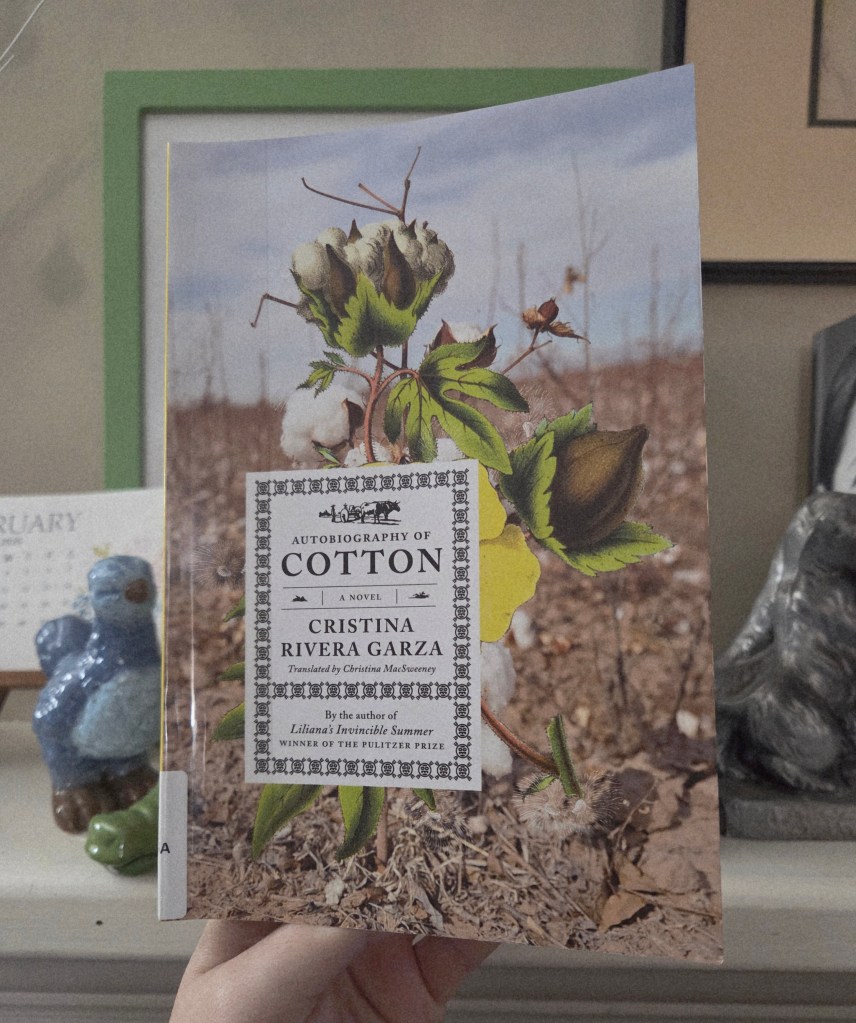
“Desire, which has been his guide during the hours of riding on horseback across the plains, leaves him no peace. Desire fires him, cuts him to pieces, lambastes him. Desire opens up his imagination and closes down his fear.”
Cristina Rivera Garza’s Autobiography of Cotton (translated by Christina MacSweeney, originally published in Spanish in 2020, English in 2026) is a fictionalized accounting of Rivera Garza’s grandparents in the 1930s. Rivera Garza is chasing down breadcrumbs, filing in the gaps of memory and written histories with a fictionalized account. The novel is partly about the unique agricultural government experiment that her grandfather was a part of, the politics surrounding the experiment, the power of the “white gold” cotton, and the strike, and also partly about migration, erasure of identities, and the buried stories of resilience in a land that was, at times, both unforgiving and home.
The novel is bit genre-bending, and there are sections that read as if pulled from a history text. Interspersed in these dry sections are moments of raw humanity – a woman finding the marriage certificate of her grandparents and becoming alarmed that it reads “by abduction.” Marriage by abduction was common in rural areas during this time as couples eloped; but the distinction also applied to forced marriages and stolen flesh. Rivera Garza also learns that her grandfather was indigenous – a fact that had been wiped out of the archives. There are additional discussions concerning how names changed, dates changed, birth places changed, etc with each piece of documentation she finds.
It’s an interesting novel, but I wish it had dabbled in the fictional retelling more.
 A Girl Named Tommi