“What had these stars not seen before? Life and death, bonds broken and repaired, and men who drew maps who couldn’t find their way home.”
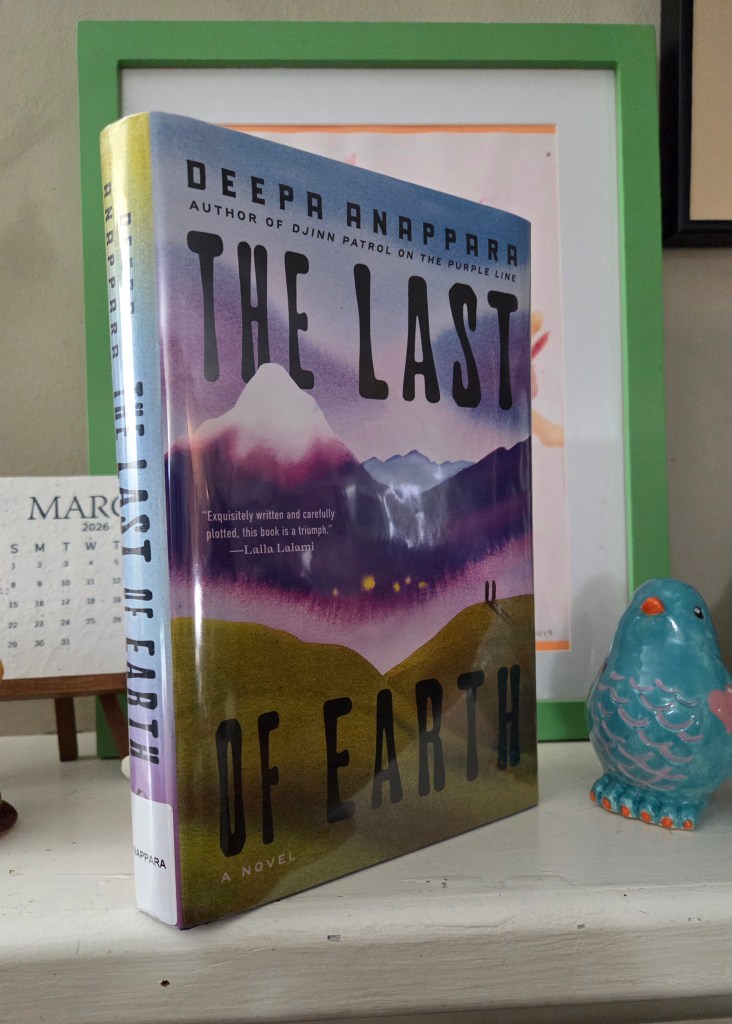
Deepa Anappara’s The Last of Earth (Random House 2026) is a really interesting slice of Tibetan history and colonization. It is beautifully rendered, but it just moved a bit too slowly for me.
Set in 1869, the novel follows two adventurers – Balram, an Indian schoolteacher who is serving as a surveyor-spy for the English, and Kathleen, a mixed-race woman who is seeking to become the first European woman to reach Lhasa. Both really bring questions of gender and race into the discourse surrounding expanding the British Empire, and their journeys are parallel, occasionally overlapping.
During this time, Tibet was closed to Europeans. Because of this, the English began training Indians as surveyor-spies – individuals who could cross the border, and who would conduct covert land studies for the British. Balram is one such spy, and he has worked for the British for several years. His close friend, Gyan, also worked as a surveyor-spy. Gyan was captured and is rumored to still be alive and held as a prisoner by the monks. Balram intends to find him and secure his release. To that end, he agrees to guide an Englishman who is hellbent on entering the country. It’s a dangerous, potentially deadly mission as the Englishman’s disguise will fool no one. Still, Balram agrees.
Kathleen has been denied a fellowship in the all-male Royal Geographical Society, and she crafts a disguise of her own to enter into Tibet and reach Lhasa. Kathleen is mixed-race, and her natural darker skin, older features (she’s 50), and the fact she’s female means no one really questions her. She hires a guide who pretends to be her son, and they set out. She has had wanderlust her entire life, and she has had some fame publishing her adventures.
Along the way, both parties encounter Chetak and a snow leopard. I’m not going to spoil who Chetak is or the significance of the snow leopard, but they are both interesting threads that tie the novel together.
One of the things I enjoyed most about the novel is how the sections are framed – Balram frequently addresses Gyan, who may or may not be dead, and Kathleen addresses her sister, Ethel, who died whilst Kathleen had been on another adventure. Both Balram and Kathleen are heavy with guilt and shame, and those emotions lace the pages.
This is a really interesting historical novel and Anappara writes beautifully, but it did miss the mark for me.
 A Girl Named Tommi