VELVET WAS THE NIGHT – Silvia Moreno-Garcia

Last year’s Mexican Gothic was my introduction to Silvia Moreno-Garcia, and while her 2021 release wasn’t a horror, I was equally drawn to the plot and, truth be told, the cover; it’s not as stunning as the cover of Mexican Gothic, but just like that cover made clear the novel was a gothic, Velvet was the Night (Del Rey, 2021) boosts a cover that announces the novel, loudly, as a noir.

Set in the 1970s in Mexico City, the novel follows Maite, an unremarkable secretary at a law firm who spends most of her time reading romance comics and making up stories about her dating life to share with her coworker.  Maite is stagnant and dissatisfied with her existence; her only excitement comes from the romance comics she devours and the daydreams that fed her.  She’s not very likable.  I understand it’s a noir and she’s supposed to be flawed, but that doesn’t mean she has to be disliked.

Consider Elvis, the other voice in the alternating POVs.  He’s horribly flawed and does horrendous things to people, but he’s likable.  His mannerisms, his voice, his thought process… he’s just darn likable.  It doesn’t matter that he is a member of the Hawks, a gang funded and trained in secret by the Mexican government, whose entire purpose is to control leftists and activists, particularly students, by any means necessary.  (The Hawks was a real group, and some of the attacks depicted in the novel are based on actual events.)

Both Elvis and Maite are looking for Leonora, Maite’s next door neighbor.  Elvis is on assignment.  Maite just wants the girl to get her damn cat.  When she’d agreed to watch the feline, it was only supposed to be for a few days, and she needs Leonora to hurry home, get her cat, and pay Maite so that Maite can get her car out of the shop. 

Maite unknowingly finds herself eyeballs deep in a very dangerous situation, but she treats it as if she is the leading lady in one of her beloved comics.  She fantasizes about two of Leonora’s former love interests, promising to help them both in their search for Leonora and the film that she has.  It’s the film that everyone wants.  The undeveloped film allegedly depicts evidence of the Hawks.  Leonora’s “friends” want the photos so they can be published in the paper and the Hawks and the government’s involvement be exposed.  The man that Elvis answers to wants the film (and Leonora) for other reasons.  Regardless of who finds her first and what happens to the film, Maite’s life (and Elvis’s) will never be the same.  I just wish Maite had liked the damn cat!

Velvet was the Night is a slow burn but a quick read, and the nuances in the characters are what make it so unique.  It’s wrapped in shadows, secrets, and smoke – as every noir should be.  If you’re looking for a historical noir with a bit of flair, pick this one up. 

CAZADORA – Romina Garber

A few months ago, I reviewed Romina Garber’s Lobizona, and I stated that “there’s a comforting familiarity” to the story.  The follow-up, Cazadora: Wolves of No World #2(Wednesday Books, 2021), continues in that familiar pattern but maintains the very unique feel that set Garber’s worldbuilding apart in Lobizona; Garber’s story relies heavily on Argentinian folklore and the concept of “borders” and “belonging.”

Cazadora opens right after the events in Lobizona, with the cazadora close on the heels of Manu and her pack.  The undercurrent of the follow-up doesn’t hit as heavily on notions of undocumented and illegals because they’re no longer in the US.  Instead, it hits a bit more heavily on gender norms and the restrictive nature of the binary classifications that influence the Septimus world.  As Manu learns more about the magical world that would deny her very existence as a hybrid, she becomes more determined to turn it on its head; it’s time for a revolution and the female werewolf becomes the face of the movement.

Manu, Cata, Tiago, and Saysa set out to find the elusive Coven, always just one step ahead of the cazadoras who are hunting them.   They find the Coven in a way reminiscent of the Room of Requirement in the HP canon. (As I’ve mentioned before, there are numerous nods to the English series and this is but one.)  The Coven is full of individuals who don’t fit in.  There is a trans werewolf (remember, until Manu, all werewolves are male and must identify as such), a werewolf who has been shunned by his family and community after an injury left him unable to transition, and infertile women and women who do not wish to have children (remember, brujas are required to “breed” and there are very strict rules concerning magic and motherhood). Alongside them are men and women who crave a revolution and a change to the status quo.

Manu and her pack fit in seamlessly with the group of misfits, idealists, rebels and dreamers.  But they don’t know her darkest secret; she’s a hybrid, and Septimus laws say she must die. The cazadora will never stop hunting her. Will the Coven continue to fight beside her if they find out the truth?  Or will they fear her and turn against her?

Cazadora shows the transition of Manu into someone who is a bit more comfortable in her skin, a bit more willing to take risks, and a bit more vocal.  With her old friends and some new characters like Zaybet by her side, Manu is set to take down Septimus.

“All I know is they’ve been making up stories about independent girls in every tradition since forever…And I think it’s time we take back our narratives.”

Read this book.

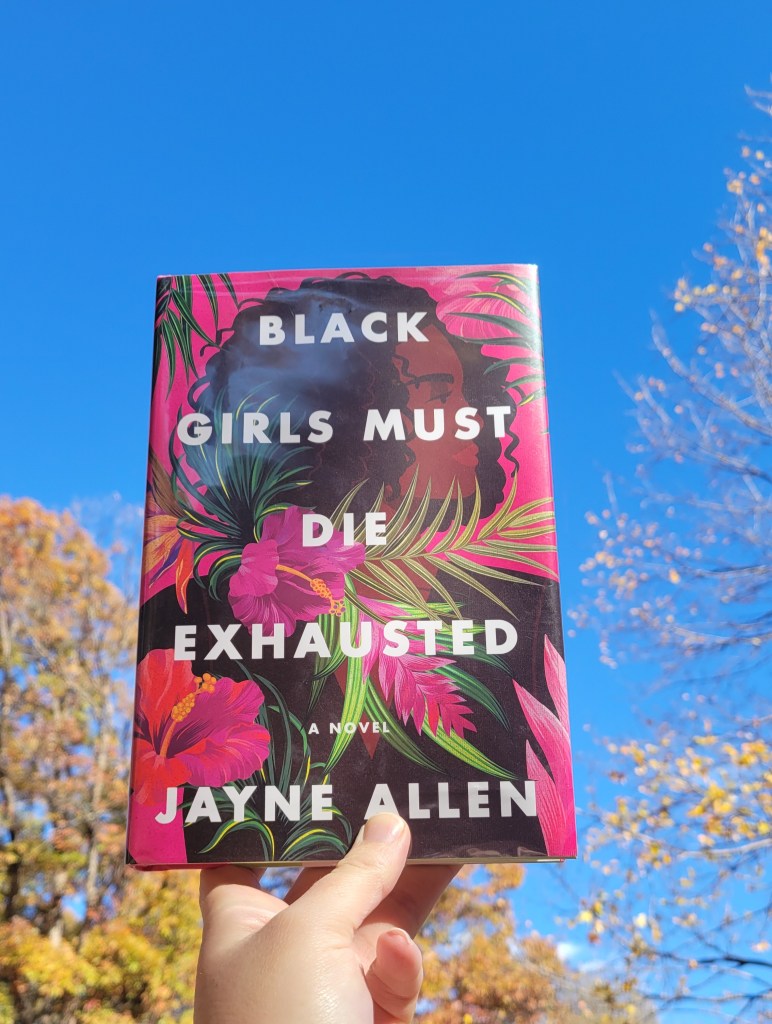
BLACK GIRLS MUST DIE EXHAUSTED – Jayne Allen

Jayne Allen’s Black Girls Must Die Exhausted (Harper, 2021 – first published in 2018) is unapologetically “black,” but it didn’t choose to be so – it just is, and it’s taken far too long for a book like this just to exist on the same shelves as books by white authors about white women with similar struggles. I’m not sure I’m articulating this the way I want to, the way this book deserves, and the author’s own words will better explain it.

“This book itself is my love letter – to you, to Black women, to women, and to all those who understand the beauty that comes through struggle and the benefit of doing their own work to heal, to understand, to grow, and, most importantly, to love more fully.”

And it is beautiful.

Tabitha Walker’s life is moving along just as she’d planned when it’s suddenly derailed following a routine doctor’s visit; Tabby’s eggs are deteriorating and if she wants children, which she very much does, she’ll have to make some tough decisions and fast.  She turns to her grandmother, her father’s mother and the woman she’d been named for, for advice and comfort, just as she’d always done growing up.  Tabby’s relationship with Granny Tab is sweetly done, and some of the more poignant scenes happen between the black woman and her white grandmother.

Tabitha also relies heavily on her two closest friends, Laila and Alexis.  The three women are remarkably different, but they highlight the importance of sisterhood; Tabitha can easily handle a boy not talking to her, but when she gets in an argument with Laila and Lexi, the silence is unbearable.  Laila and Lexi have their own struggles, and the three friends must come together to help heal.

This novel is written by a black woman about black women, but that should in no means limit its audience.  Its characters grapple with racism, sexism, imposter syndrome, infertility, infidelity, death, dating woes, family drama, depression, miscarriage, friendships, and fears.  It reminds me a bit of Jennifer Weiner’s Little Earthquakes, and I’d recommend it to anyone who enjoys women’s literature.

Read this book.

CHINA ROOM – Sunjeev Sahota

Sunjeev Sahota’s China Room (Viking, 2021) was another slim selection from the Booker 2021 longlist, but unlike A Passage North, which is a little bit longer, I gobbled it up in one sitting; it’s the kind of storytelling I prefer, and Sahota weaves an intimate and heartbreaking tale of love, independence, hate, and the chains that bind us.

Set in India and based on his own family history, China Room is the story of Mehar and her great grandson. Mehar was sold as a bride when she was five.  Her new family changes her name, and her destiny.  When she was fifteen, they came calling.  She is not told which of the three brothers she is marrying, and all three are married in the same ceremony.  Neither Mehar nor her new “sisters” know who their husbands are; they are stock, bought and paid for, who must be bred and deliver a male child.  Until then, they are kept in the “china room,” where they prepare the meals, complete domestic tasks, and sleep.  When their mother-in-law commands it, they wait for their husbands in a completely dark room and do as they are bid.

The three women are curious about their husbands.  Emboldened, one asks their mother-in-law to identify which son she is married to.  Mai, ever cruel, refuses to tell her and snarls that maybe she sends all three men to all three girls.  Mehar, younger than the other two and so curious, sets her mind to determining which brother is her husband.

When her husband tells her that he will bring her pearls so that she will birth a son, she wrongfully assumes the brother she sees twirling the pearls in the air is her husband and shyly approaches him.  Suraj, full of lust for his brother’s wife, doesn’t correct her.  They begin to meet in secret – Mehar still thinking this is her husband.  When she learns the truth, it is too late. 

Mehar’s struggles are framed by those of her great grandson, who is telling the story in 2019.  Alongside Mehar’s tragedy, he speaks of his own.  In 1999, he went to India to try and recover from a heroine addiction.  He’d turned to drugs to numb himself from the racism and discrimination his family suffered in England. After he is no longer welcomed to stay with his uncle, he goes to the dilapidated family farm where he continues to painfully withdraw from the drug.  He sleeps in the china room, feeling more of a connection to his past and begins to heal.  He sets about restoring the property, painting it the same shade of pink it had been when Mehar lived there – her favorite shade.

China Room is the story of family and of life coming full circle.  Mehar lost herself in the china room.  Seven decades later, her great grandson finds himself there.

The novel is quick delight and well worth picking up.

Read this book.

A PASSAGE NORTH – Anuk Arudpragasam

In continuing with my attempt to read the Booker Prize 2021 longlist, I finally finished Anuk Arudpragasam’s A Passage North (Random House, 2021).  While I didn’t hate it, it is certainly at the bottom of my rankings.  (It still comes in head and shoulders ahead of Second Place, though.)  My issue with the novel is not with the story or even the writing itself, but with the writing style.  The story is captivating, and, at times, the writing is beautiful; however, the meandering, introspective narrative is off-putting to this reader.

 A Passage North puts the reader deep within the recesses of Krishan’s mind, a place that is often selfish and whiny as he muddles over how to respond to an email he received from an ex-lover while he is traveling north to attend the funeral of Rani, his grandmother’s former caregiver.  When Krishan receives the call from Rani’s daughter that she has fallen in their well and died, he immediately decides something is afoot and he must go to her funeral, to represent his family, but more importantly to determine the true root of her demise.  He takes the train north, into the war-torn areas of Sri Lanka, his stream of consciousness flitting from Rani and her relationship with his grandmother and her cause of death, to Anjum, the bisexual activist he’d fallen in love with years before who’d recently reached out.

Krishan was distanced from the war in Sri Lanka by virtue of where he was born and raised.  He didn’t experience the brutal destruction firsthand, even though his father was killed by a bomb, and this distance makes him seem little more than a casual observer in his own country.  The observations are tinged with guilt, especially when he talks about Rani’s dead sons and  the children born of the diaspora who have returned for a visit after the bombs have stopped.

It is at the cremation ceremony, beautifully depicted and arguably the best section of the entire novel, that Krishan becomes more than a casual observer discussing a horror that left him relatively unscathed; as he watches the flames creep toward Rani’s body, he finally feels the full weight of the impacts of a decades long civil war on his home.  Suddenly, he is a participant.

While I dislike the writing style and found Krishan insufferable, I don’t think this novel, with its subtle survivor’s guilt, would have been as effective in any other style.  If philosophical reads and getting lost in the narrator’s headspace are things you enjoy, read this book. 

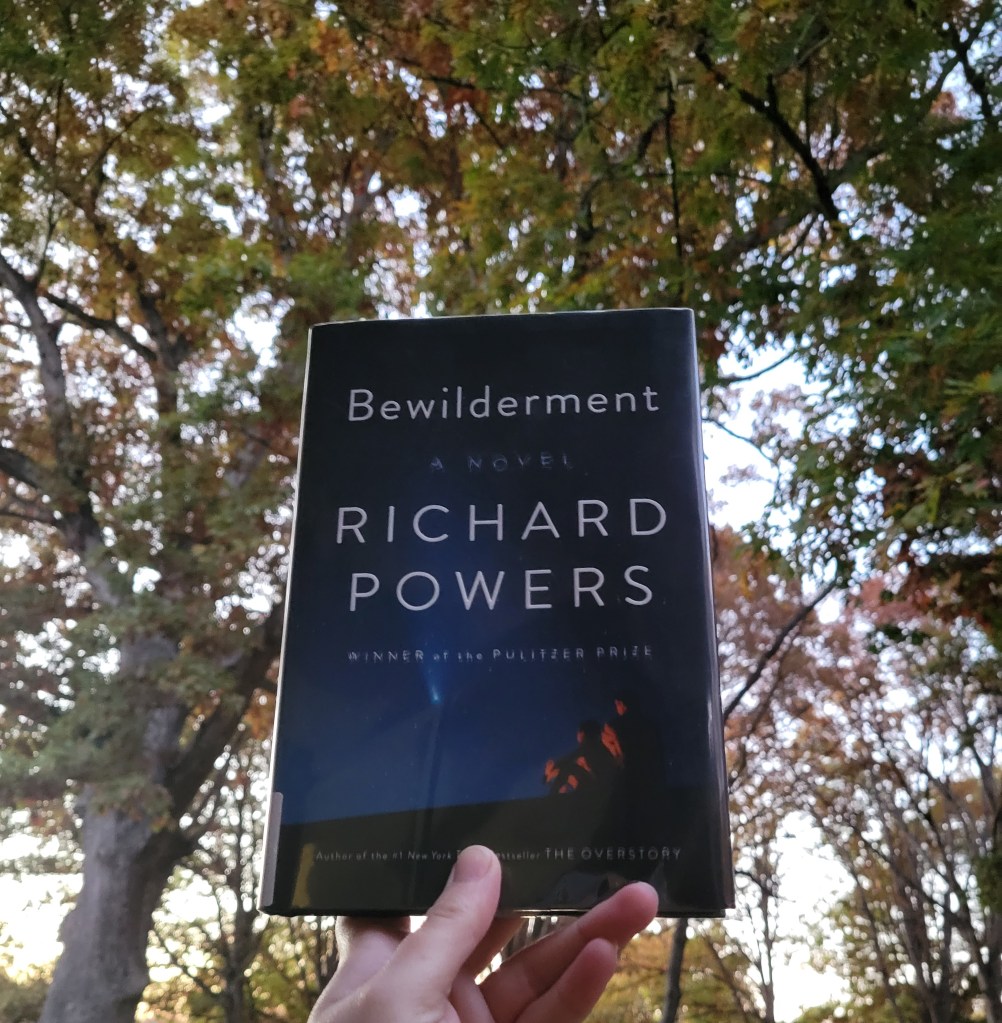
BEWILDERMENT – Richard Powers

Even though the 2021 Booker Prize has already been announced (Congrats to Damon Galgut!), I’m still making my way through the longlist.  Richard Powers’s Bewilderment (W. W. Norton & Co., 2021) received a lot of attention, and I’m not surprised it was shortlisted for the prestigious award.  The slim novel of grief and nature made me think of last year’s shortlisted “nature” book, The New Wilderness, which I found overrated.  Both are dystopian novels dealing with parent-child relationships in a world that humans are actively destroying.  The New Wilderness is a bit more gritty and narrowly tailored, whereas Bewilderment is more ethereal and expansive, displaying a heaven full of planets and hope.  And, unlike Cook’s novel, Bewilderment is dystopian-light, with the destruction of the country and society relying heavily on current political events but slanted and exaggerated toward the extreme.  As much I disliked Cook’s attempt, I loved Powers’s.

Theo Byrne is an astrobiologist scrambling to be a good father to his special needs son, Robin.  Robin is special needs, with a diagnosis that varies depending on what professional is asked, but what remains steady is that Robin has difficulty managing his emotions and he is swimming in grief and anger following the death of his mother.  Theo is equally swimming, barely keeping his head above water as he battles his own grief and tries to parent a son who is more of an enigma than a cosmos that is constantly growing and being redefined.  Theo does not want to medicate his son, and a violent outburst at school has him asking a colleague of his wife for help.  He enrolls Robin in an experimental neurofeedback treatment that focuses on training the brain to follow the patterns of another brain.  Theo and his wife had made recordings years prior, and Robin eventually starts training using his mother’s recording.

Robin has always been a lot like his mother, passionately concerned about the life and well-being of the animals and plants that inhabit the earth.  The training intensifies and focuses this passion, such that Theo can almost hear his wife when his son talks.  The training works.  Robin is calmer, he is emulating his mother and able to face the world in ways that Theo never thought would be possible. 

It’s a novel of grief and hope set in a world not far removed from this one.  Unlike the planets Theo and Robin create as calming tools, there is no Planet B.  We are the custodians of this earth, and we need to take our jobs more seriously.  The novel is perfectly nuanced and beautifully executed.  This was the “environmental novel of our time.”

Read this book.

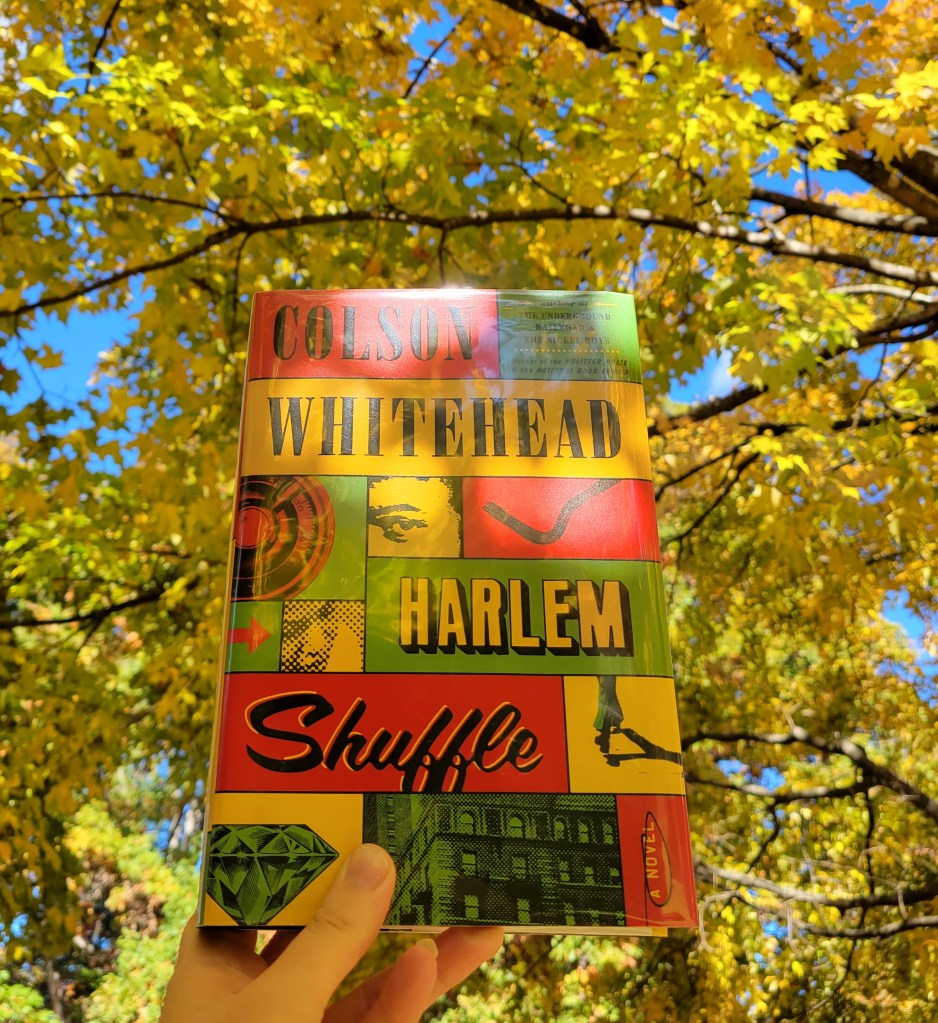
HARLEM SHUFFLE – Colson Whitehead

Colson Whitehead is an author I’ve been meaning to read for ages.  He’s won the Pulitzer Prize twice; for The Underground Railroad in 2017 and for The Nickel Boys in 2020.  I picked up his 2021 release, Harlem Shuffle (Doubleday) as my introduction to Whitehead, and what a sharp, sly read it is.

“Carney was only slightly bent when it came to being crooked…” is how the novel starts, and it is the first introduction to Ray Carney the reader gets.  The novel is set in three parts, with the first taking place in 1959, the second in 1961, and the third in 1964.  As time progresses, Ray gets a little more bent toward crooked than straight.

Ray’s father was a hustler, and Ray knew that wasn’t the life he wanted for himself.  He purchased a furniture store and is an upstanding business owner, husband, and father.  Sure, he purchased the store with his father’s ill-gotten gains, and yes, he’s a fence for stolen items, but the lion’s share of his business is on the up and up.  But in 1959, his cousin, Freddie, gets him involved in a plan to rob the Hotel Theresa, and that line between upstanding and crooked shifts.

The heist goes poorly, but Ray earns a reputation among the high profile criminals moving in the shadows of Harlem.  Within a couple of years, his low scale fencing operation has grown, and he is able to expand the furniture store.  After being hoodwinked by a friend of his father-in-law, Ray becomes bitter and hellbent on revenge – collateral consequences be damned.  Unlike the heist on the Hotel Theresa, Ray’s plan is a success; it doesn’t matter who gets hurt along the way.

As time goes by, he keeps thinking he’ll get out of the business, that he doesn’t need the money anymore, but then Freddie pulls him into another con – this time with an extremely prominent and filthy rich white family with a drug-addled son.  And this time, they know Carney’s name.

It’s a crime novel, make no mistake about that, but it’s also a novel about survival and the choices we make.  And it’s a novel about family and the choices they force us to make.  It already reads like a blockbuster, and I’d love to see it on the screen.  That’s not something I usually say, but I think they could do Harlem Shuffle justice.

Read this book.

RADIANT FUGITIVES – Nawaaz Ahmed

“My mother’s name is Seema. Which means face, something of her I will never see, or frontier, something I must leave behind.”

I wasn’t quite sure what to expect with Nawaaz Ahmed’s debut novel Radiant Fugitives (Counterpoint Press, 2021).  I’d read a blurb months before publication in a failed attempt to get an advanced copy, but it was a small blurb.  I knew the novel was sapphic and dealt with an estranged Indian family living in the US, but I didn’t realize the timeline politically or the role that religion would play.  What Ahmed has given us is a hard take on America, and it’s a take we should all pay attention to. 

Radiant Fugitives is narrated by Ishraaq as he is being born.  His mother, Seema, is dying.  They say when you die, your life passes before your eyes.  In this instance, Seema’s life passes before her son’s. Through the memories passed by blood, he tells her story.  His knowledge isn’t just limited to the present and his mother’s past; Ishraaq is an omniscient narrator, and the reader gets bits and pieces of his grandmother, Nafeesa, his aunt, Tahera, his father, Bill, and even his young cousins.  I’m not entirely sold on the fetal omniscient narrator, but I recognize that the novel would not have had the same heartbeat without it.

Growing up in India, Seema is her father’s favorite.  She is a romantic and readily adopts his love of English literature.  While studying at Oxford, she comes out.  Word gets back to her father in India, and he exiles her from the family.  Her very name is forbidden in the house.  Her younger sister, Tahera, doesn’t quite understand why Seema was exiled and feels abandoned.  To ground herself, Tahera clings to her religion, becoming a furiously devout Muslim; her prayers and jilbab providing a layer of protection against the world.  English poetry, especially Keats, and passages from the Quran appear frequently throughout the work, highlighting the four corners of the world that has defined the sisters.

The novel primarily takes place in the week leading up to Ishraaq’s birth.  Nafeesa’s death clock is ticking louder and louder as her body fails her.  She wants to not only see her grandson, but to try and mend the relationships with her daughters as well as between her daughters before she dies.  Begrudgingly, Tahera joins her mother at Seema’s to await the birth.

As the three women work through a tortured history in an attempt to reconnect, the past weaves in and out of the plot.  Of particular interest is the relationship between Seema and her ex-husband, Bill.

Seema meets Bill through her involvement in politics. From the Howard Dean campaign to the so-called “war on terrorism” to Prop 8 to Obama to Kamala Harris’s attorney general campaign, Seema’s memories are such a part of American political history.  It makes for a fascinating read, especially considering Seema is a lesbian from a Muslim Indian family and Bill is an attorney raised by his grandparents whose father, a member of the Black Panthers, had died in jail.

Bill’s reaction to Seema’s pregnancy, as well as the divorce and her return to dating women, is presented in brief, angry spurts. His emotions are not simple, and Ahmed does a respectable job of capturing that while still ensuring the heart of the novel remains with Seema, Tahera, and Nafeesa.  Similarly, the treatment of Tahera’s family and the attack on the Muslim center and her son’s response to that attack are presented quickly, but they are weighty moments in the work.

Radiant Fugitives is extremely well-written and captivating.  I hear a lot of folks say they don’t read diverse books because they can’t “relate” to the characters, and I’ve never understood that.  I’m not a lesbian who has been exiled from my Muslim Indian family, but I can certainly relate to Seema and her story of love and loss, and faith and identity.  Even more importantly, I can learn from Seema, Tahera and Nafeesa. 

Books make better people.

Read this book.

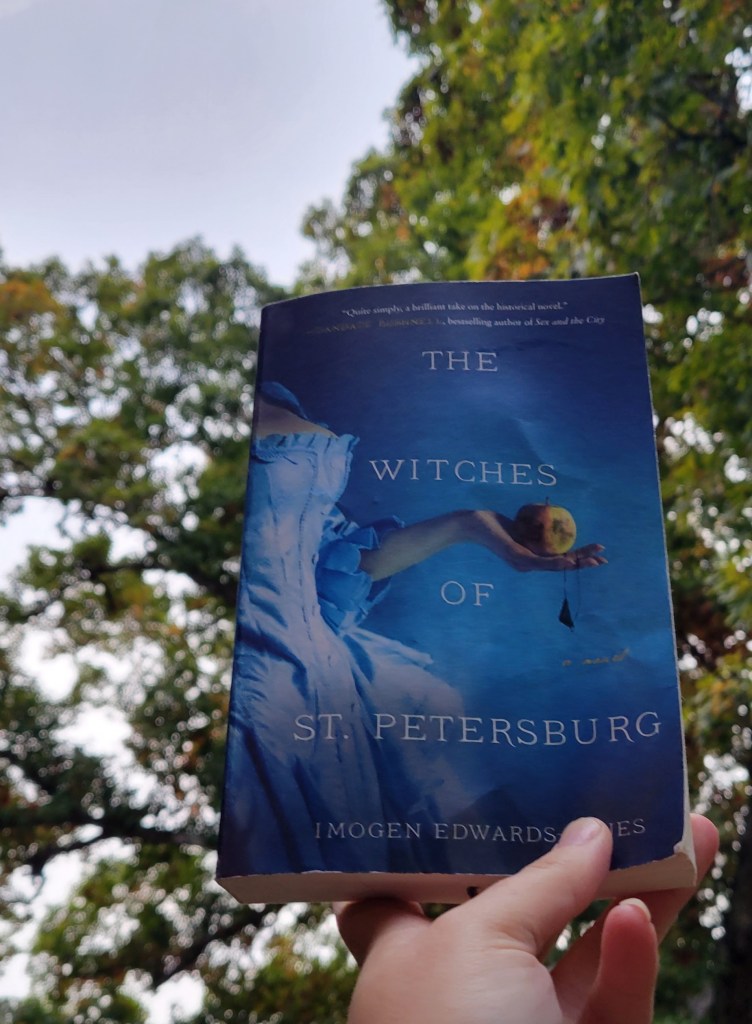
THE WITCHES OF ST. PETERSBURG – Imogen Edwards-Jones

I purchased Imogen Edwards-Jones’s The Witches of St. Petersburg (Harper, 2019) strictly because of the gorgeous, icy blue cover. As stunning as the cover is, it doesn’t begin to do the story justice – this is one of the more captivating premise-wise historical fiction novels I’ve picked up in a while, and I simply couldn’t put it down.

A little history before we get to the review is in order.

The Romanov imperial house ruled Russia from 1613 to 1917.    When Alexander III died in 1894, his son Nicholas became emperor.  Nicholas promptly married Alix of Hesse-Darmstadi, a favorite granddaughter of Queen Victoria.  Nicholas, Alix, and their children were executed in 1918, and while this is mentioned in the epilogue, The Witches of St. Petersburg begins in 1889 and ends in 1916.  It is important to note that while many of the characters and events are based in fact, this is very much a work of fiction.

The Black Sisters (named for their dark eyes), Militza and Anastasia “Stana,” are sent by their father, King of Montenegro, to marry distinguished figures in the Romanov court.  Their objective is to advance their own positions and in doing so, that of their father and Montenegro.  The St. Petersburg elite don’t approve of them.  The sisters come from a poor country, and they are outsiders rumored to practice in the dark arts.  Militza and Stana are the “witches” of St. Petersburg who carry the novel.

When Alexander III dies, the sisters seize the opportunity to make fast friends with the shy tsarina, Alix.  Alix is immediately drawn to the pair, specifically Militza, when she learns of their magical gifts. As the years go by and she keeps having daughters and no sons, she enlists their assistance and talents to ensure she delivers an heir.  After several failed attempts, a son is born; however, he has haemophilia and chances at survival are scarce.  Wanting to further ensure her position within the royal family, Militza turns to some even darker magic to summon a spiritual shaman who can keep the child alive.  From her hands, Rasputin is made and a Pandora’s box she cannot slam shut is opened.

Full of magic, betrayal, passion and privilege, The Witches of St. Petersburg is one romp of a ride.  The basis in fact only makes it more enticing, and it is well written.  

Read this book.

DEATHLESS DIVIDE – Justina Ireland

“It’s a curious thing, to watch a town fall to the dead.”

After being surprisingly pleased with Dread Nation, I couldn’t wait to start Justina Ireland’s   sequel, Deathless Divide (Balzer + Bray, 2020).  It’s got a phenomenal cover, and I was eager to have more Jane and Kate.  I really wish I hadn’t read it so close to my first reading of Dread Nation because I fear I’m having some issues removing my negative experience with Deathless Divide from my positive one of Dread Nation.  It’s not the worst follow-up in a series (coughchildrenofvirtueandvengeancecough), but it comes close.

The things I loved about Dread Nation are gone.  The relationship between Jane and Kate isn’t as effortless as in Dread Nation.  And I’m not talking about the plot, which admittedly drives the pair apart. I feel like Ireland stopped being able to hear the two as she was drafting.  The alternating POVS in the sequel had potential, but she loses their voices.

A little more than halfway through, the novel leaps forward a year and five months. The events that happened during that time are hinted at, but I wanted to see them.  Kate escaping Fort Riley in a wedding dress and heading back home to New Orleans?  Jane becoming a bounty-hunter and earning the new moniker, Devil’s Bitch?  It had so much potential.  There’s a part of me that thinks this was supposed to be books two and three, and the deadline came faster than the muse could finish what happened after the fall of Summerland.  It’s frustrating because the idea is so good, it’s just poorly executed.

There’s also a point in the novel where Ireland seems to have forgotten that one of the characters had their arm amputated. (I’m not going to say which character in case you want to read it.) That character holds out her hands, plural, to show she doesn’t have any money, but that character should only have one hand.  It’s a little slip that probably went unnoticed by most readers, and clearly the entire editorial team, but it has annoyed me immensely.

In short, this is one of my least favorite reads of the year and I don’t recommend it.   It’s set up for a continuation of the series, but I don’t know if that’s Ireland’s immediate intent and I honestly don’t think I’d read any more books in the series.  As far as I’m concerned, the hope, happiness and positivity at the end of Dread Nation survives.