The Sweet-Shop Owner – Graham Swift

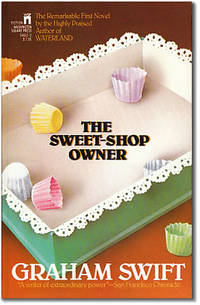
I love Graham Swift.  He is quite possibly my favorite (living) English author.  Waterland ranks in my top ten all-time favorites and for a bookslut, that says a lot.  I picked up a copy of his first novel, The Sweet-Shop Owner, when I was at a used bookstore.  It’s my favorite kind of used book – meaning that it doesn’t look like it was ever read.  While it is unfortunate that it wasn’t read because of its brilliance and fantastic writing, I loved paying used prices for new condition books.  Anyway, I digress.

As previously mentioned, The Sweet-Shop Owner is Graham’s first novel.  Published in 1980, it was highly praised and started the long amazing career for the English novelist who won the Booker Prize in ’96.  Swift’s first novel shows how he mastered the tools of genius writing early in his career, and the novel is everything I look for in a good book; each word carefully chosen, each character artfully depicted, and each heartbreak/victory/failure of resonating quality.  After the disappointing The Elephant Keeper, it was nice to pick up another English novel and be swept away.

The novel centers around Willy Chapman, the sweet-shop owner, and blends the past with the present to create the ordinary life of an ordinary man.  But things aren’t all as they seem.  The reader is introduced to his dead wife – a beautiful strange creature who, though dead, is a very living character.  Willy’s daughter also is a very present character even though she doesn’t appear physically all that much.

It is a story of family, money, and the things we do for love.  It is also a story of letting go and accepting the hand you’ve been dealt.  I’m not going to lie; the story is heartbreaking and I learned to hate the women that Willy loved with all his being, but if you’re looking for a great story, a story that is tightly woven by a true literary master, then pick up any Swift novel.  Better yet, pick up this one.

The Elephant Keeper – Christopher Nicholson

The Elephant Keeper is the best book I’ve read in the past twenty years or so.” – Nikki Giovanni

Dear Nikki,

You clearly don’t read many books.

Sincerely,

The Bookslut.

I didn’t purchase this book because of Giovanni’s blurb or the pretty colors of the cover (okay, maybe the colors did factor in) – it was an impulse buy in a very sad Borders that had been stripped done to barely nothing.  And I’m a sucker for books about animals.  I should have spent my money on something else.

The author, Christopher Nicholson is a radio documentary producer who worked for BBC and many of the shows he produced dealt with the connections/bonds between animals and humans so it is not surprising that his novel focuses around such a bond.  How he develops the bond between human and animal is fantastically done and the writing is quite beautiful, but the novel reaches a point where I was left going “oh no, honey,” which tends to my response when a book takes a turn or jumps the track and the editor didn’t put things back on track before print.  Sigh.

Set in England in the 1770s, The Elephant Keeper is about Tom Page, a man who followed his father’s footsteps into a stable as a groomsman and later as the elephant keeper.  When his employer decided to acquire two young elephants, Tom could barely contain his excitement.  As the male and female elephants grew, Tom created a bond with the two of them that went beyond any connection he’d had with horses, family, or other people.  This “feeling each other out” period of the bonding process is the best of the book.

Due to expenses, Tom’s employer has to get rid of one of the elephants and Tom suggests he keep the more docile female and sell the less predictable male.  Tom’s relationship with the elephant he calls Jenny takes a weird turn as he begins to have conversations with her, forsakes his family and his “true” love for her, and begins to have sexual fantasies about her.  This single obsession ruins what had been a very interesting book about developing bonds between animal and keeper set against a backdrop of the social hierarchy of England.  (There are some fantastic parallels between Tom and Jenny – isn’t Tom but a “pet” of his employer’s son?)

I think Nicholson is channeling a bit of Martel is this work, but he fails horribly.

Christopher Moore – Lamb, the Gospel According to Biff, Christ’s Childhood Pal

“Nobody’s perfect… Well, there was this one guy, but we killed him.”

An only child, Christopher Moore spent much of his childhood in Ohio entertaining himself with books and his imagination; it paid off – big time. With titles like You Suck: A Love Story and Fluke, or, I Know Why the Winged Whale Sings, his books (and imagination) have been entertaining readers since the early ‘90s. When I saw Lamb: The Gospel According to Biff, Christ’s Childhood Pal (2002) at a local used bookstore, I had to pick it up.

Any book dealing with a fictional account of the life of Jesus (this is not an opportunity to bash the Bible as fiction) has to be careful. You don’t want to piss your readers off. You don’t want to alienate your publisher. And you certainly don’t want to anger the Big Guy. Moore tackles the subject matter with grace, wit, humility, and a chuckle that you just cannot resist.

The afterword opens with a Bible verse, John 21:25:

“And there are also many other things which Jesus did, the which, if they should be written everyone, I suppose that even the world itself could not contain the books that should be written. Amen.”

Moore then makes it very clear that the novel is a made-up story, born in his imagination, based on historical information and the gospels (both those found in the Bible and those the Catholics opted not to include) and passion plays, etc. – but it’s fiction and Moore hopes it doesn’t change anyone’s religious views. “This story is not and never was meant to challenge anyone’s faith; however, if one’s faith can be shaken by stories in a humorous novel, one may have a bit more praying to do.” Preach on, Moore. Preach on.

The story itself covers the “lost” years of Jesus. Those of you familiar with the New Testament know there is a serious gap in the life of Jesus. There is only one scene in the Bible after his birth and before he begins his ministries in his thirties. And that scene is only in Luke. This is a story that has been begging to have its day.
Lamb is told through the eyes and voice of Levi, who is called Biff. Biff has been resurrected to tell the story of Jesus. “By the way, his name was Joshua. Jesus is the Greek translation of the Hebrew Yeshua, which is Joshua. Christ is not a last name. It’s the Greek for messiah, a Hebrew word meaning anointed. I have no idea what the “H” in Jesus H. Christ stood for. It’s one of the many things I should have asked him.”

And so the reader falls in love with Biff, Christ’s childhood friend who is rude, mouthy, obnoxious, horny as hell, and the best friend a guy could have. Mary Magdalene makes an appearance as Maggie. Maggie loves both boys, but Joshua is very special. The boys leave when Maggie announces her pending nuptials. Unlike some portrayals, Maggie is not a whore.

The story takes Josh and Biff from killing and resurrecting lizards to the far East where they sought the three wise men that made an appearance at Christ’s birth. Biff constantly quotes from books of the Old Testament that do not exist – like Amphibians. Biff also “creates” sarcasm and gets a bit annoyed with Josh masters it. They learn kung fu and what Buddhism really means. Biff gets to tackle the Karma Sutra with quite a few women. There are great discussions about bacon where Josh determines that God doesn’t really care about what you eat. Whenever Josh says something that contradicts the Torah and Jewish ways, Biff calls him on. Josh replies “Bacon.” Biblical miracles appear and some of the most memorable sermons are shown at the “composing” stage. You have to own and respect a sense of humor to appreciate this book. Trust me, it’s a rollicking good read.

I’m a Christian so I knew how the story would have to end, but I wasn’t expecting the amount of emotion Moore was able to apply to this comedic book when it came to the crucifixion. The bond between Biff and Josh is great, so great that Biff tries to thwart Josh’s plan to sacrifice himself. Biff plots with the other disciples and the women who followed them. He’d been given a poison in China that makes one appear dead. He plotted a way to get Josh to drink the poison – he had the women soak the sponge in the poison and attempt to give it to Josh while on the cross. It doesn’t work and Moore captures serious emotion when Biff watches Christ die. Biff kills Judas. And then himself. So he missed the resurrection.  (Luckily the hotel the angel sequestered him in had the Bible and he was able to hide in the bathroom and read the gospels.)

After Biff finishes his gospel, the angel tells him that he and Maggie can have a life in the present day. And Maggie reveals one great secret:

“By the way, it was Hallowed,” she said.

“What was Hallowed?”

“The H. His middle name. It was Hallowed. It’s a family name, remember, ‘Our father, who art in heaven, Hallowed be thy name.”

“Damn, I would have guessed Harvey,” Biff said.

And so the novel ends.

The Book Thief – Markus Zusak

“First the colors.
Then the humans.
That’s usually how I see things.
Or at least, how I try.
*** HERE IS A SMALL FACT***
           You are going to die.”

And so Markus Zusak’s novel, The Book Thief, begins.  Told from Death’s point of view, The Book Thief, is the story of Liesel Meminger and her encounters with Death in war-torn Germany.  As Death explains in the prologue, “It’s just a small story really, about, among other things: A girl, some words, an accordionist, some fanatical Germans, a Jewish fist fighter, and quite a lot of thievery.”

But it’s not really a small story at all.  Well over 500 pages, The Book Thief, is a book those who love to read will love to read.  Since these are Death’s words and it’s WWII, it’s not a stretch for the reader to know and understand that dying will litter the pages.  What the reader may not expect is the tightness of the threat and the burning of the eyes as the story unfolds.  And, should the reader expect tears, s/he may not expect laughing through them.  Well deserving of the numerous awards lavished upon it, this novel grabs you and holds until the last page and long after – leaving you reeling.  And, if you’re like me, when you read the last page, you read those last words one more time before closing the book, pulling it to you, and closing your eyes.  And you see colors.  And words.  And know you’ve read something great.  And that for a brief moment, you were apart of it.

The novel opens with Liesel on a train with her mother and brother.  She is nine and her brother is dead.  The dead brother is how she first encounters Death.  The dead brother also results in her first theft of a book.  She steals The Gravedigger’s Handbook.  She is taken from her mother and left with Rosa and Hans Hubermann, her foster parents.  This is due to her mother’s involvement in communism.    Rosa is gruff and often violent with the child.  Hans is soft and gentle.  Liesel opens herself up to him quickly.  In the dead of night, when the world is sleeping, he teaches her to read the book she’d stolen.

Hans is trying to gain acceptance into “the party.”  This is hard because he is known as a “Jew lover” because he’d painted over the vile words some placed on a Jewish shopkeeper’s door.  The party will not accept him.  Hans finally gets accepted.  But it is as a means of punishment.  When the Jews are marched through the town, he hands one bread.  He is beaten for this.  And then sent off to fight for Hitler.  (A man he loathes.  A hatred he must swallow for his family’s safety.)  He is a painter.  And an accordion player.  The accordion is ultimately what brings the Jewish fist fighter to their home for refuge.  A refuge they willingly give.

Rosa, for all her harshness, is to be admired.  She does not question her husband when Max shows up for safety.  She feels for Liesel when Liesel keeps writing her mother, who will never answer her.  And when Hans is sent to fight a war that isn’t his, she clutches his accordion to her chest – bruising her heart with her love.  It may be tough love, but it’s strong love.

Liesel’s best friend is Rudy – a beautiful blond haired boy who wants to be Jesse Jackson.  Once, he paints himself black and runs through the town.  Hitler wants him.  His father refuses.  For this, his father is sent off to join the war.  Liesel loves him as children love.  Rudy grows to hate Hitler.  The two encounter a downed plane with a dead American inside.  (This is the second time Death encounters Liesel.)  The young boy places a stuffed bear next to the soldier – a man society screams is an enemy.  Death with take Rudy as well.  Death will take everyone.  Liesel finally gives Rudy the kiss he’d been begging for since meeting her when he is cold and dead.  Your heart will break.

Liesel steals books.  The Grave-digger’s Handbook is but her first.  Her other comes from a Jewish bookburning.  It is wet and hot when she hides it against her chest.  It burns her.  But she reads it.  She then steals from the mayor’s wife’s library.  But it isn’t stealing.  The white-haired woman opens the library for the girl.  She leaves her notes.  Liesel gives her life.  (And when her entire home is destroyed, Liesel finds solace and refuge in her home.)

When Max shows up, Liesel is uncertain of him.  He is a “Jew.”  But she begins to love him.  He is the one secret she keeps from Rudy.  He is the one secret that tightly links the small family.  He writes her books.  When the family hides in bomb shelters, he comes out to see the stars.  When it snows, she brings the snow to the basement so they can build a snowman.  They live as best they can.  He writes her a book.  He paints the pages of Mein Kampf.  The book of hate was used to hide a key.  Once safe, Max paints the pages white and writes over it with his own story.  After Max leaves (he must – it is no longer safe), he leaves the book with Rosa to give to Liesel.

When the Jews are marched through town, Liesel watches for one Jew.  She does not hide from him or from her connection with him.  She runs to him, calling his name.  She pays for this.

Liesel begins to write her own story.  When the town is bombed and her entire street (and family) destroy, Death returns.  Liesel is spared, but she leaves her book in the rubble.  Death steals it.  It is only fitting.  Death does not see Liesel again until years later when he comes to get her.  She sits up to meet him.

The novel ends:

“A last note from your narrator:  I am haunted by humans.”

This novel is fantastic.  And one any lover of words, life and love must read.

W. Somerset Maugham – The Razor’s Edge

There’s a story behind this review and, as all stories must, it involves a pretty eyed boy and a girl who thought she knew everything. The short version is thus: your bookslut had never heard of William Somerset Maugham – a man who just happened to be a pretty eyed boy’s favorite author. For Christmas, I received two novels by W. Somerset Maugham: The Razor’s Edge and The Magician. It makes my heart happy when someone I love points me in the direction of a book like this – a book I can see, taste, smell – a book I can see myself in. Maybe it’s the influence of a pretty eyed boy or maybe it’s that sensation I get when I FEEL the words of a book, but The Razor’s Edge is on my “special” shelf.

William Somerset Maugham was one of the most popular authors of the 1930s and it escapes me as to how I’d never come across his name or his works. I guess when you turn your back on the canon and the works of dead white guys, you miss out. A novelist, playwright, and short story writer, Maugham’s body of work is quite extensive. The Razor’s Edge (1944) was one of his last major works and has a bit of a Gatsby-like quality to it.

It is the story of Larry Darrell, a World War I veteran on a search for self, meaning, and God. While the story is his, it’s not. I felt that so much of the life in this story is found in the women that love and are loved by Larry – Isabel Maturin and Sophie Macdonald. (I saw myself in Sophie in ways that made me uncomfortable.) Perhaps the most memorable character is Elliott Templeton – a snobby art dealer who doesn’t quite understand that he’s a snob. Elliott is the narrator’s tie-in with the rest of the odd bunch that the story revolves around.

The story opens with a bit of an explanation and is billed as a “true account.” Maugham is the narrator and an active participant in the actions. The only time he is referred to by name (at least that I recall) is when Larry refers to him as “Mr. M”. I usually take issue with books about authors and as I read the first chapter, my heart was already turning against this work. But I quickly abandoned any prejudice I had and fell head over heels.

A brief summary will tell you that Isabel, Elliott’s niece, is engaged to Larry. Sophie is one of their friends, as is Gray. Money, prestige, power and privilege soak the pages of the novel and their social circle. But Larry, after watching a man die during the war, is removed. He wants to find salvation. He wants to find God so he can understand God. And he realizes the path to God isn’t paved in money and social standing. Isabel never quite understand that, and when Larry decides to travel on his quest for self, she marries Gray – a man accustomed to the finer things in life and a man who can afford her rich taste. Sophie appears early on as a quiet girl at a dinner table. She doesn’t show up again until Paris at a seedy bar where she’s drunk, doped up, and fucking away her troubles. She’d lost her husband and child and her search for self resulted in burying herself and her memories. Her eyes were only green and alive when doped up, as the dear author noticed. At this point, Gray has lost all his money after the crash and the family is living off of Elliott’s generosity in Paris. Larry is visiting. Larry decides to marry Sophie. To save her. Sophie bails on the arrangement and later tells our narrator: “Darling, when it came to the point, I couldn’t see myself being Mary Magdalen to his Jesus Christ. No, sir.” Of course, things aren’t nearly that simple as Isabel is at the core of her decision to walk, no, run away from Larry. And it’s jealousy that prompts Isabel’s actions. The female jealousy wears a fancier coat than that of jealous of men which bears arms, but it cuts just as sure and quick in the end. The narrator tells her she’ll end up with her throat cut. “I wouldn’t be surprised,” she grinned. “Good riddance to bad rubbish.”

There are parts of the novel I would cut completely. I realize that the parts I’d cut are really what the story is supposed to be about, but there is so much more lurking in the pages for me to focus my energies on Larry and his search for God. What Maugham says about love and money and society far outweigh any faith points for me. I also think the story could have been stronger if presented differently; parts of the story seem misplaced and the narrator apologizes for such placement and tries to explain as he is telling the story. This was jarring and disruptive. That said, it was intentionally jarring and disruptive. There’s not a mark in this book that wasn’t thoughtfully considered and purposely placed. Books like this, structured like this, fleshed out like this, are works of art. Books like this are why I don’t read genre fiction often. Books like this are what make me a booksnob.  I don’t have to like what he did – but I sure as hell respect it.

I could write much more about the story, the settings, the cast of characters, and the use of words, but I could never do it justice. Let me just say that Maugham is a man I have added to my list of writers I want to have a pint with and just listen to the stories they tell.

Robert Jordan – From the Two Rivers

This bookslut seldom ventures into the realm of genre fiction, but she made an exception for a friend.  For years, this particular friend has been pushing The Wheel of Time series on me like a drug dealer pushes crack.  When I found From the Two Rivers on the dollar table at a local used bookstore, I had to buy it.

Fans of the series probably do not recognize this title.  The reason for this is simple; I purchased the illustrated part one of The Eye of the World.  Marketing strategy for young adults resulted in the novels being split into parts.  Don’t despair; I have purchased the second part of book one to ensure I give Jordan an honest chance.

Initially, I didn’t care for the book.  I didn’t hate it; I was quite indifferent.  (Which is a horrible thing for a reader.  To have a book that results in NOTHING from you is quite horrible.)  But I stuck with it, and I must admit to being pleased I did.  Jordan needed a better editor and at times I found his writing to be a bit too formulaic, but the meat of the story is worth the effort.

The story is tailored to young adults – as evidenced by both the characters and the writing style.  Perhaps I’d have been more quickly captivated as a child, but the 28 year old in me had a very difficult time relating to and/or caring for the characters.  I found Egwene a whiny, self-important little brat.  While I like the character of Mat and his boyish pranks, it just didn’t mesh the way I think Jordan had hoped it would.  (I’m sure many people think it meshed just fine.)  Rand reminded me of Harry Potter.  (Yes, I know Rand existed long before sweet ‘Arry, but in my reading chronology, Potter was first.)  There are a lot of similarities in Rand and Harry and it would be interesting to see if those comparisons continue.  I’d bet money on Rowling having read Jordan’s series.  (No, I’m not saying she copied him in any way, but reading is what develops writers and some things you read are bound to stick.)  Perrin isn’t all that developed in part one of the first book.  But what Jordan has done with him is make a character I want to know more about.  There’s a lot of foreshadowing with Perrin and Jordan makes it clear he isn’t just filler.  I’m eager to know how Perrin fits in – he is my favorite.  Nynaeve, the Wisdom, was artfully developed and as the book progressed, I found myself liking her more and more.  There’s a nervous condition in her due to her age and power, and I like where that is going.  Moiraine is a fantastic character and I was drawn to her (and Lan) more than the children.  Again, I think it’s due to the age at which I’m first reading this.

The Gleeman is also a huge favorite of mine.  I’ve always been drawn to the trickster/story-teller characters and they abound in the books I tend to favor.  The man clearly knows more than he lets on and I want to know what secrets he hides beneath his colorful cloak.

The use of the animals is fantastic.  The horses, the wolves, the ravens…  I think Robert shined the most in his brief discussions of them.  My favorite part of this section was when Perrin and Egwene meet Elyas and his wolves.  There’s beautiful writing here, especially when Elyas is explaining the relationship between wolves and humans and how memory works.

“Wolves remember things differently from the way people do…  Every wolf remembers the history of all the wolves, or at least the shape of it.  Like I said, it can’t be put into words very well.  They remember running down prey side-by-side with men, but it was so long ago that it’s more like a shadow of a shadow than a memory.”

There is some quite lovely writing (and a bunch of stuff that should have been cut).  I will read the second half of the first novel, that I can promise – I cannot promise, however, that I will complete the series.

Mishna Wolff – I’m Down

This review has been a long time coming.  Law school gets in the way of fun things.  My apologies.  Of all the books of 2010 (which weren’t nearly as many as I would have liked), I’d recommend I’m Down the most.  Well, I’m Down and God of the Animals

Mishna Wolff’s childhood memoir is brilliant.  If you’ve ever felt like you didn’t belong and were the black white sheep of your family, this memoir is for you.  Wolff is white, but she grew up in a poor black neighborhood with her father – a man who really believed he was black.

“I am white.  My parents, both white.  My sister had the same mother and father as me – all of us completely white.  White Americans of European ancestry.  White, white, white, white, white, white, white, white.  I think it’s important to make this clear, because when I describe my childhood to people: the years of moving from one black Baptist church to the next, the all-black basketball teams, the hours having my hair painfully braided into cornrows, of their response is, ‘So… who in your family was black?’  No one.  All white.”

And so her memoir opens.  She then describes her father as “strutt[ing] around with a short perm, a Cosby-esqe sweater, gold chains, and a Kangol – telling jokes like Redd Foxx, and giving advice like Jesse Jackson.  He walked like a black man, he talked like a black man, and he played sports like a black man.  You couldn’t tell my father he was white.  Believe me, I tried.  It wasn’t an identity crisis; it’s who he was.”

Her childhood story will make you laugh out loud.  Seriously.  You will lol all over yourself – if you don’t, you don’t know what it’s like to grow up with a family you don’t understand and have difficulty relating to.  And that’s what the memoir really is about – family.  It would be easy to sell it as a take on race, but it isn’t.  It’s a novel about a father and daughter and how they relate with each other and the bonds that hold them together and the moments that threaten to rip them apart.

But it is America and race always has been and unfortunately, at least for my lifetime, always will be an issue.  (People have difficulty with those that are “different” – black, white, rich, poor.)  And while the racial issues are quite poignant and very important in understanding some of the racial dynamics that still exist in the states, the memoir is not weighted with it.  For me, it’s not a black/white story.  And that is what makes Wolff an amazing writer – that and her killer instinct when it comes to all things funny.

White… Black… Purple… Red…  I don’t care what “color” you are – this book is one we all can relate to.  Her story is one that, while quite unique, has echoes of all our childhoods.  Pick it up.  Enjoy.  It’s not all rainbows and unicorns – some moments are downright heartbreaking – but no one’s childhood is all rainbows and unicorns.  If yours was, pull that horseshoe out of your ass let me have some of your luck.

Kent Nelson – Land that Moves, Land that Stands Still

Apparently your bookslut has only been picking books written by those with a Juris Doctor degree. Kent Nelson graduated from Yale with a degree in Political Science and then went on to Harvard Law where he earned a JD in Environmental Law. To be honest, he strikes me as a bit of a bum; the nomadic sort that is never happy with life. It seems like he’s been trying to “find himself” since 1943 when he first latched on to his mom’s breast. Those types annoy me. Anyway, Land that Moves, Land that Stands Still was published in 2003 and set in the Black Hills of South Dakota on a farm.

The novel opens with Mattie reveling in the sounds and sights of the farm, before assisting her husband in manual labor. Her husband doesn’t last long as a living character as a farming accident quickly takes his life, but his ghost haunts the novel as he remains quite present. After his death, Mattie learns that he was gay and had been having affairs with men for years. He kept all the damning evidence in the car that Mattie refused to get in. At times, Nelson tries too hard to set the scene of how Mattie and her daughter deal with husband/father’s lifestyle. The novel also becomes cluttered with its many subplots and concurrent plots and nearly every horrible thing that can happen happens. There’s an attempted rape, an attempted murder, thievery, a high school English teacher sleeping with this students, murder of pets (including the drowning of a cat), barroom brawls, drugs, and some pretty serious child abuse. Worse? All the women are broken by the men in their lives and they all turn to men to fix them. The only character that didn’t make me want to scream was the Indian runaway, Elton and the Mexican neighbor, Hector, who had to lay low because he wasn’t a legal citizen.
The writing is poetic and the stories are intricately woven, but Nelson could have benefited from some serious cutting down. The dialogue is well done between the mother and daughter, but stilted at other times, especially in the heterosexual relationships where the men and women seem to be playing stereotypical roles from the hard fucking of the drug deal in the trailer park to the sweet, soft love-making of the English teacher who brings her to her first orgasm with his poetry and mouth. For a man who has spent so much time “living life” and “finding himself,” his story seems contrived and his characters fit in boxes.

Debra Magpie Earling – Perma Red

I adore Native American literature – Sherman Alexie, James Welch, Louise Erdrich, Leslie Marmon Silko… all have homes on my bookshelf. They recently had to move over to make room for Debra Magpie Earling.

Earling is a member of the Bitterroot Salish tribe in Montana. She currently teaches Native American Studies and Fiction at the University of Montana. Perma Red (2002) is her first (and to date, only) novel, and it took decades (and many drafts) to perfect. It truly is quite the remarkable novel and well-deserving of all the accolades it has received. Earling has affectively joined the ranks of such greats as Alexie and Silko as far as Native American literature goes, but I’m reluctant to pigeon-hole this book as simply “Native American” literature. Perma Red is literature at its finest; it is a damn fine book.

Perma Red is the story of Louise White Elk, a young Indian girl with shockingly red hair who longs to escape the reservation life and the Indian-way. Yet, even in the same breath as she’s seeking to run, she craves belonging to this world. It’s the story of a girl growing up, finding out who she is, what she’s made of, and what matters to her. It’s a coming of age love story full of violence and heartbreak. It’s a story of split cultures and what happens when they collide in ways that forever alter Louise’s life.

Earling subtly weaves in magic and tradition into her words to such extent the reader is just as apt to believe Baptiste Yellow Knife has used love magic as Louise as. In addition to content, the writing is quite lovely.

In discussing how the school girls matured over the summer, Earling writes: “And their silk stockings and panties hung on the bushes with their boyfriends’ sighs.”

But the novel isn’t all sex and sighs – there’s a brutal violence and scars that not even time can heal. The people are all wounded, but Louise and Baptiste (her husband, her curse, and the man who beats the hell out of her) appeal the reader. There is something real in their relationship – something real and something magic. Despite all his flaws, I loved Baptiste.

The novel is divided into chapters. Louise’s chapters are told in third person at a distance. The other chapters are told in first person from the point of view of Charlie Kicking Woman – a tribal officer who seems to often forget his identity. Initially, I liked Charlie quite a bit. He’s a bit too obsessed with Louise, but I could overlook it as I thought he truly had her best interests at heart. But the more he appeared, the more of the story he told, I hated him. I hated everything about him. Perhaps the most violent scene, minus when Baptiste beats Louise and slices her open with the broken beer bottle, is what Charlie witnesses and walks away from without doing nothing. He turns his back on his people and his history repeatedly in the novel – but when he literally turned away, my stomach turned. To me, that hatred signifies excellent writing.

Your bookslut highly recommends Perma Red.

Tamar Yellin – The Genizah at the House of Shepher

Religion has always fascinated me. I grew up in a Southern Baptist Church and have a pretty decent grasp of the Bible. Biblical stories were my bedtime stories and I prayed to the Father, Son, and the Holy Ghost. As I grew up, I began to explore other religions – never as faith-altering explorations, just to understand the similarities and differences. I suppose I always have been and always will be hungry for knowledge – maybe that’s why I read.

I’ve read books that center around all sorts of faiths – from Eastern Religions to spirituality of natives from Africa to South Dakota. I respect the beliefs of others. When I saw Tamar Yellin’s The Genizah at the House of Shepher (2005), I had to grab it; it contains all things I know I love in a book – religion, family stories, intrigue, love, and loss.

A genizah is a “hiding place” for old or damaged sacred documents. Jewish faith requires that sacred texts and anything containing God’s name not be destroyed, thus these depositories were established. When Shulamit Shepher returned to her family in Jerusalem, she knew she’d be facing her family’s ghosts and demons, but she never expected what she actually found in the attic, the family’s genizah – a place to store more than just religious artifacts.

Shulamit is a rootless person; after abandoning her faith and her family, she buries herself in her studies and has become a true scholar, lecturing in biblical studies. Twenty years pass and she receives a letter from her uncle telling her that the family house is going to be destroyed and if she wants to see it one last time, she must come. She flies to Jerusalem.

When she arrives, her uncle tells her about the Codex, a religious document found among the family’s belongings. Thought to be worth thousands, the Codex is a keter Torah – a handwritten copy of unknown origins. Shulamit’s uncle has given it to the Institute to authenticate, but the Shepher family has already started bickering and fighting over it. Shulamit is eager to see the document, to study it – what biblical scholar would not want to see the unknown manuscript that has been in her family for years? The Codex could MAKE her career.

With the thread of the Codex holding the story together, Yellin presents a family saga of faith, loss, and exile. Shulamit, going through items in the genizah, begins to learn more about her family, begins to remember the legends she’d been told as a child, and slowly begins to connect with her past – she begins to “heal” when she embraces her family and their combined history. The Codex is a character, but it is a secondary character; do not read this novel if you’re looking for a thrilling suspense novel like The Da Vinci Code.

The writing is simply stunning and the family lore is fantastically dependent on religion and myth. I thought the novel slightly incomplete – it began to fall flat after such an amazing start. This is Yellin’s first novel so there is plenty of time for her talents to improve and her novels to be consistently “tight.” It’s definitely worth a read, even with the problems I have with the last fifty or so pages. If you like family sagas and have a fascination with how faith runs families, read it – you won’t be disappointed.