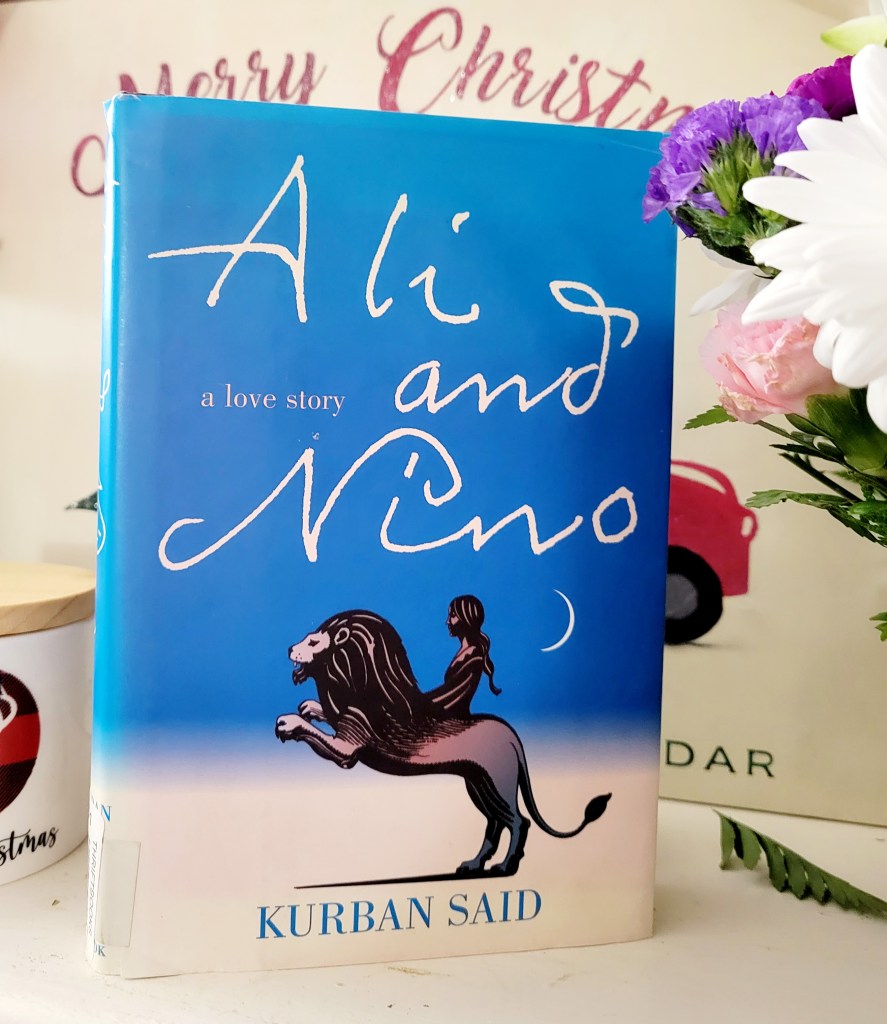
Next installment of Tommi Reads the World – the last of the As.
Country: Azerbaijan
Title: Ali and Nino, A Love Story
Author: Kurban Said
Language: German
Translator: Jenia Graman
Publisher: E. P. Tal (1937), First published in the US by The Overlook Press (1999)
“I, your Nino, I too am a tiny piece of this Europe that you hate, and here in Tiflis I feel it more than ever. I love you, and you love me. But I love woods and meadows, and you love hills and stones and sand. And that’s why I am afraid of you, afraid of your love and your world.”
“Other people will probably say I stay at home because I do not want to leave Nino’s dark eyes. Maybe. Maybe these people will even be right. For to me those dark eyes are my native earth, the call of home to the son a stranger tries to lead astray. I will defend the dark eyes of my homeland from the invisible danger.”
Published in Vienna in 1937, Ali and Nino was forgotten during WWII and fell out of print. Jenia Graman found a copy in a used bookstore in postwar Berlin and translated it in 1970. The history of the novel and its authorship is its own story. Kurban Said is a pseudonym, and there has been a bit of speculation and even claims made as to authorship, but nothing has been confirmed. Despite not knowing for sure the identity of the author, I elected to include it in my “Tommi Reads the World” challenge because it is set in Azerbaijan, and because the most likely author is Lev Nussimbaum (a Jewish man born in Baku who converted to Islam – he adopted the name Essad Bey after he converted) along with the Baroness Elfriede Ehrenfels, an Austrian with whom Nussimbaum had a very intense friendship with – the romantics will say they were writing their own love story with Ali and Nino.
The novel follows Ali, an Islamic boy “of the sand” with a lion’s heart. He loves the desert. He loves his culture. He loves his people. He loves his home. But he also loves Nino, a beautiful Georgian Christian, who craves trees and meadows, and who has European tastes. Against all odds, their relationship grows. Ali is willing to give up certain traditions for Nino, and Nino is also willing to give up some of her own dreams for him. But she will not convert. Ali’s family doesn’t really protest the match – they are men who don’t believe women have souls or opinions, and they believe she would have beautiful children. Ali is a bit disgusted at how they discuss his future wife, but that is the constant battle that rages within him as he tries to position who he is and his beliefs with his love for Nino. Nino’s family takes a little bit of convincing – ultimately, they agree, thanks to an Armenian who convinces them that the merging of Ali and Nino will have far reaching positive implications.
But a Russian Revolution and world war come to Azerbaijan, and Ali will fight for his home. While the novel is written as a love story, and it has been compared to Romeo and Juliet, and the novel itself even draws that comparison between Ali and Nino, I’d argue that the true love story is between Ali and his home.
Ali and Nino is a slim novel with an epic story. It is heartbreaking and infuriating, and also really funny. Both Ali and Nino are quick witted with delightful senses of humor, and there are scenes, even during very tumultuous and chaotic times, that had me laughing out loud. I am very glad that the novel was rediscovered and that it continues to be published.
Read this book.
 A Girl Named Tommi