“You know me now. You know him as well as I did. Maybe better. You have raised the dead and given us one more turn. Now tell me how this long match ought to end.”
“Our first god mad the world from eggshells and tears and bone. Then our artists made the other gods out of shells and coral and sand and the fiber from palm fronds. All those gods are dead now, now. What am I supposed to do? What am I supposed to make?”
“For centuries, the island has always hung flowers around the necks of its destroyers.”
“It a thing still garbage once life starts using it?”
The last of the 2024 Booker Prize Longlist needs to be on syllabi regarding the art of storytelling; it’s certainly a book that begs to be studied for craft purposes. But I’m not surprised – it’s Richard Powers, after all. Playground (W.W. Norton & Company 2024) is an expansive, fragmented man vs. man, man vs. nature, and man vs. machine with an ending that seems both a cheap trick and the only possibly and brilliant conclusion.
The novel ripples, like a tidal pool of life, focusing on Evie Beaulieu, a female diver, Ina Aroita, a Pacific Islander who grew on bases across the Pacific with no true home, Rafi Young, a black man from Chicago with the weight of the world, his race, and his family on his shoulders who gets lost in literature, and Todd Keane, a once rich white kid who loses himself to the technology that will change the world. Long story short? As a child, Todd read Evie’s book and fell in love with her and the ocean. That love was replaced with one for Rafi and board games. When the friends went to college, they roomed together, their lives so intertwined. Enter Ina. A girl they both loved. Choices were made and children grew up.
Stop reading now if you don’t want this novel spoiled.
When the novel opens, Todd, age 57, has recently been diagnosed with Dementia with Lewy bodies. Extremely successful and extremely rich, he finds himself getting his affairs in order, parsing out hallucinations from reality, and getting lost in memories (and in the grocery store). Meanwhile, on the island of Makatea, Rafi and Ina and the two children they’ve adopted, are preparing for their island to be sold to the highest bidder. A California corporation wants to use the island as a base for seastanding, a series of floating cities that move and interlock much like the pieces on a gameboard. Building it will destroy so much of the life on and around the island. But it will also provide funds that will greatly improve the lives of the inhabitants of the island, which include Rafi, Ina, and Evie, now in her 90s. It’s not a surprise that Todd is behind the corporation spearheading seastanding; the reader can gather that pretty much immediately. The surprise comes later.
Stop reading. Seriously.
Playground is the story of a man who has built a machine that allows him to resurrect the dead, a path Rafi had set him on back in high school, and that machine is feeding him stories of how he wants life to shake out, how the game should end. Rafi and Ina were never married, they never adopted children, or had an island life together. Rafi never really found peace. He died surrounded by his books and frenzied writings and his desire for perfection. Todd and Rafi never reconciled. Evie, the great female diver and Todd’s first love, is also dead. Ina is living on an island with adopted children, and that truth forms a foundation for the stories Todd’s great creation spits out. And that’s the surprise – the computer has cobbled the story from Todd’s memories, Rafi’s writings, Evie’s book. And that is why Rafi, Ina, and Evie all shimmer, a little glitch here and there that one could argue is lack of character development (like Evie’s announcement she likes women that never goes anywhere), but it’s because the computer is regurgitating what Todd has feed it in palatable way to please Todd – they’re not real.
The question we’re left with is which story is better – the truth or the world that was created? This question is one that isn’t uncommon in works of fiction – as mentioned previously, the reveal seems a bit of a trick. A very popular example that asks on the page which story is better is Life of Pi. In Life of Pi the driving force behind the story with the animals in one of literal survival. In Playground, the driving force behind this beautiful island world is fear and love and the desire to win. I don’t think there is any other way the story could have ended.
While not my favorite selection from the longlist, I’d argue it belongs on the shortlist. Hopefully, I’ll get a complete Booker wrap up soon that will detail my rankings. I am very excited to have finished the entire longlist before the winner is announced next week.
Playground is a spotlight on how technology, AI and social media are eroding human interactions and nature while also breathing new life into the dead, lost, and forgotten. Go read this book. Then maybe play a board game with a friend on some grass.
Booker Count: 13 of 13
 A Girl Named Tommi
Warning, this review (also) contains spoilers!
Thank you for the honest, accurate review written by a real person!
After finishing the last page, I spent a good half hour trying to wrap my head around what happened at the end of the book, wondering if I really understood. Frustratingly–though perhaps fittingly given the themes of the book–every website I looked at contained AI-generated gobbledygook. Half-truths that sounded convincing enough that I thought *I* was hallucinating (or really dumb), till I finally figured out they were all AI-generated crap. It’s a sad state of affairs, what our internet is turning into…
While I’m still grappling with the book’s ending, my immediate reaction was ANGER. The fact that the whole story on Makatea was made up by an AI I found to be devastating. It was almost like reading a beautiful and amazing book you thought was non-fiction, only to find out at the end it was all made up.
It’s not quite that bad in reality, but my reaction was so strong that I’m currently sifting through , trying to figure out where such a strong reaction is coming from. I think it comes from a few places.
First, I use AI a lot in my life right now, and the technology amazes and fascinates me. But I also get a lot of AI hallucinations as a result, and they’ve led to countless hours of frustration and wasted time. I don’t need more made up crap from AI. (And finding just that on the internet afterwards was salt in the wound.)
Second, while I can’t put my finger on where it comes from, I find the notion of AI doing art anathema. And so, even though this book was written by a real human, the idea that the most beautiful parts of it were AI fabrications–even though that is itself a fabrication–came too close for me and touched on a nerve.
And finally, like you mentioned, there were some weird things that just didn’t quite add up. Evie’s latent lesbianism; the unaccounted for reuniting of Rafi and Ina and his decision to move halfway around the world to be with her (her moving there makes some sense given her roots, but him?? I don’t get it…); the semi-unbelievable happenstance that Evie ends up in Makatea of all places… I like your take that they’re artifacts of AI cobbling together things to please Todd. But if the AI tells such beautiful and convincing stories, shouldn’t it have been able to weave these things together better?
With all that said, I don’t want to crap all over the book. It was beautifully written and I enjoyed reading it most of the time. The underwater scenery was breathtakingly brought to life, even for a landlubber like me. Life on Makatea, and its history, were eye opening. Also, in a funny way, timely: I watched Moana 2 in the midst of this and between the two, I have a newfound appreciation for Pacific Islanders and the feats of their ancient “way finders.”
And who knows, maybe sleeping on it a few more days, more appreciation will come. If I have more thoughts, I’ll certainly share!
LikeLike
Yes, please share once you sleep on it for a bit. I did lean more towards “the only way it could end” over “cheap trick” the more I thought about it, and decided the imperfectness and incomplete nature of the renditions was genius – AI can be beautiful, but it can never be the real thing.
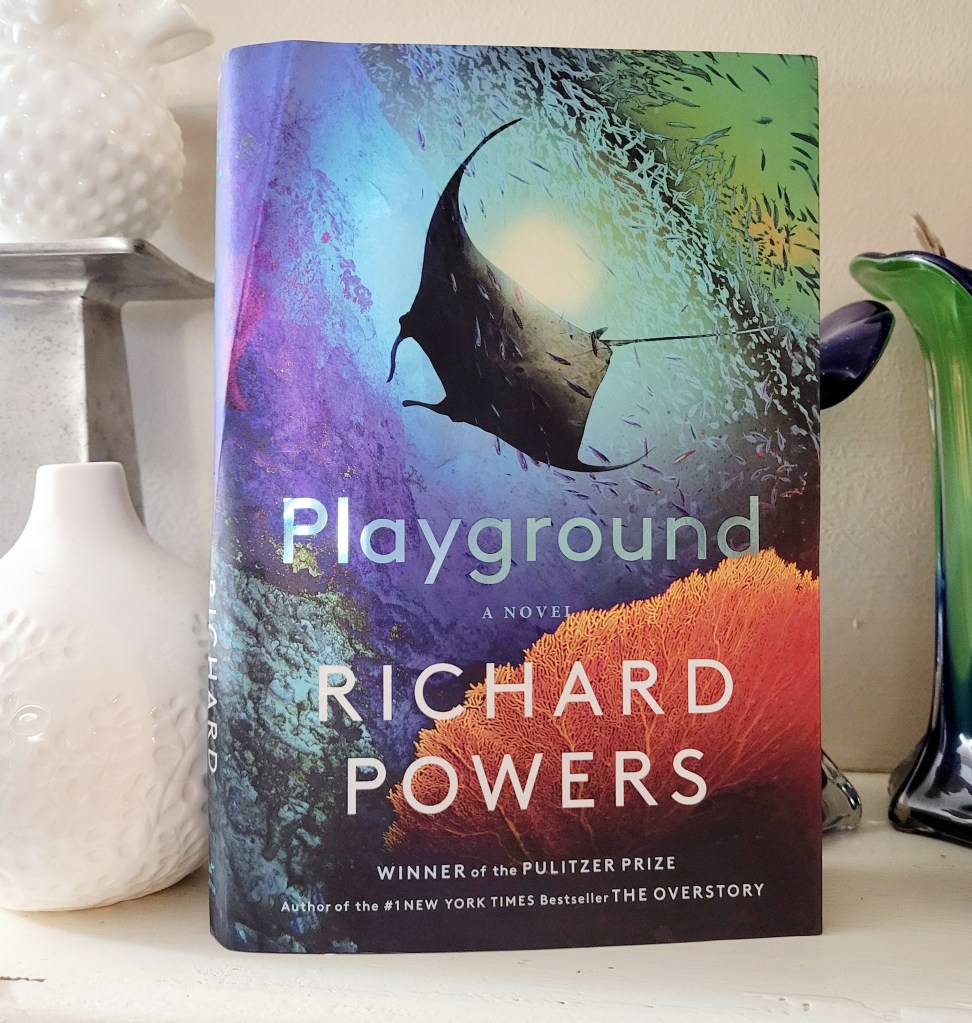
And I’m still smitten with the cover.
LikeLike
I finished the book late last night, and I was both confused and disturbed enough by the ending to need clarification from other readers, hence my comments here. I’ve adored Richard Powers since being introduced to him through his novel The Echomaker (2006) by author and professor T.M. McNally in a graduate level creative writing course at Arizona State University in 2008. I mention McNally because it was in his class that I delivered an embarrassingly unhinged rant after he asked me to share my opinion on In the Lake of the Woods (1994) by Tim O’Brien. I felt betrayed by the author, who uses a footnote to address readers and intimates that a certain interpretation of the story (the only one that made sense to me) reveals murderous intent in the reader. I felt personally wounded by the comment and felt the author had crossed a line. Though I admire many of his books, I have never trusted O’Brien since. Not so with Richard Powers. I awoke this morning and grabbed the book, planning to write about it and type an excerpt from it into my journal, but I checked the internet first and ended up here. I’ve since gone back to the book, after remembering that early on the narrator addresses a “you” that did not seem to be referring to me. He states: “It’s a simple, small thing, but I’ve never told anyone but you. When I was young, I could breathe underwater” (13). Who else could the “you” be but AI? After one night of sleeping on it, I’m still sad, but I’m decidedly in the Powell no “other way it could have ended” camp.
LikeLike