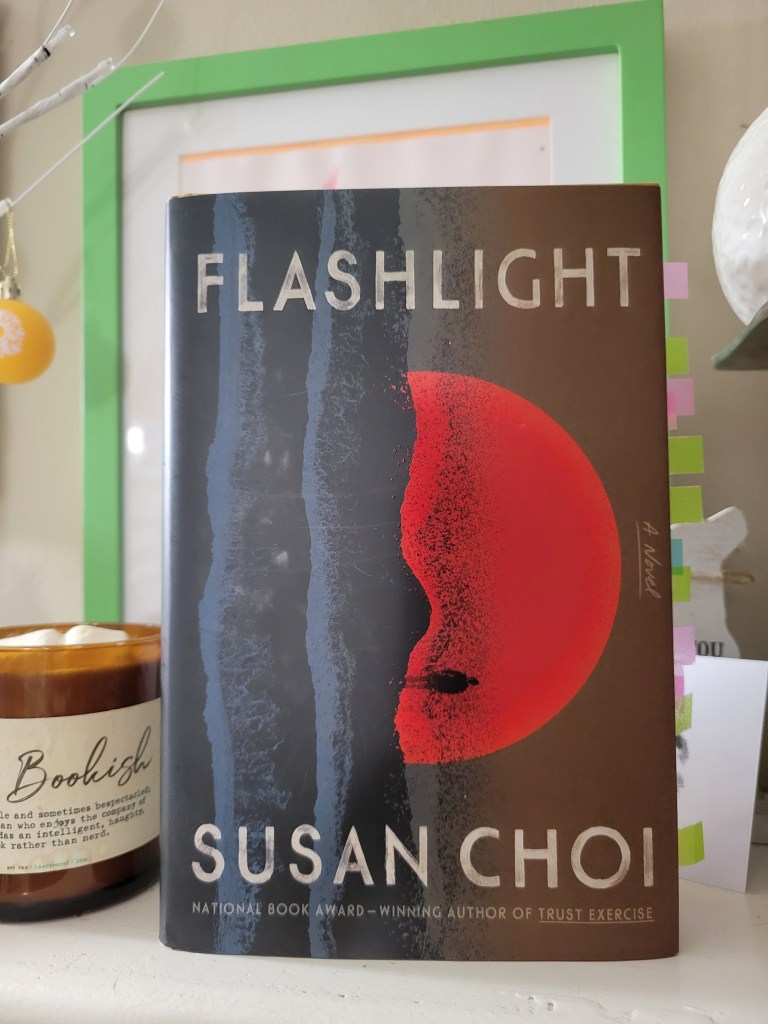
“In one hand he holds a flashlight which is not necessary, in the other hand he holds Louisa’s hand which is also not necessary.” (3)
“Up and down with their flashlights: one carries the flashlight, the other carries the gun.” (378)
Susan Choi’s Flashlight (Farrar, Straus and Giroux 2025) is next up in the Booker longlist. This novel, a family saga laced with trauma, identity, geopolitical drama, mystery and slices of history, ticks a lot of boxes for what I enjoy in a story. Add Choi’s storytelling talent, and it’s likely this will be my favorite of the longlist. (I do so love a slow burn of a family saga!)
The novel opens when Louisa is 9. She and her Japanese-born Korean father are in Japan where he is teaching. They are walking the shore. Her mother is sick and did not join them. This is the last time she sees her father, and her memories of what happened that night, on the shore, are locked up tight. The reader then gets her father’s back story (Seok turned Hiroshi turned Serk turned The Crab), which is heavy on the conflict between being a Korean in Japan, calling his Japanese name something he only puts on when he’s outside “like a coat.” We also get Anne’s backstory. The youngest of seven and just eager to get out, she winds up becoming involved with a married professor. He and his wife adopt the child she carries, and she continues on a solitude path. Anne and Serk eventually meet when he comes to the US. They get married and Louisa is born. It’s a pretty volatile marriage, and there remains a lot of disconnect between the couple.
Anne’s sections are beautiful and achingly crafted. She’s a woman at odds with her choices and her body. And Louisa is positively awful to her, just like Serk had been. Justice for Anne. Lousia’s sections are equally well defined and powerful. She’s marked by the trauma of losing her father that night and an inability to address the loss in a healthy, productive way. Generational trauma from both of her parents taint her choices throughout her life.
Serk’s sections are less formed, just as much a shell of the man as he is at those points. With Choi’s talents, I imagine this is intentional and not just hollow writing. The pain and trauma he endures, the loss of time and memory, is captured in these stripped-down, seemingly underdeveloped sections.
Tobias, the son Anne had at 19, and Ji-hoon (AKA The Fisherman) have sections that serve clear and exact purposes – they serve as info dumps and provide context, especially as it relates to the geopolitical climate and the “based on actual events” abductions of Japanese by North Korea.
Some things worth further discussion – Holden, Lousia’s cat and her reaction to learning it had disappeared, the pronunciation of Kang (oh man even at the end, I hated Louisa who seemed she could only show her mother love by being dismissive and angry), and of course, the many uses of flashlights throughout (Serk’s EVERREADY we open with that shows up again, the child psychologist’s flashlight that Lousia steals, the flashlights searching for Louisa and Serk, the red plastic flashlight at the hostel used to summon a ghost, the flashlight at Daniel’s worksite, and the flashlight (and gun) carried by security agents patrolling. (Did I miss any!?!?) The line that made me cry? “They threw me out of the boat, and I swam.” IYKYK. Justice for Anne.
Read this book!
 A Girl Named Tommi