Booker 101 Quick & Dirty Monday!
MISINTERPRETATION: Ledia Xhoga
Tin House : 3 September 2024 (US) (unless otherwise noted, I’m reading the US edition)
Daunt Books: 6 May 2025 (UK)
Page Count: 287
First line: I was fifteen minutes late and his phone number was out of service.
Blurbed by:
Jennifer Croft – (With the author Olga Tokarczuk, she was awarded the 2018 Booker International Prize for her translation of FLIGHTS)
Idra Novey – (Numerous awards, no Booker nominations.)
Maisy Card — (Numerous awards, no Booker nominations. Her THESE GHOSTS ARE FAMILYwas my top read of 2020)
Elizabeth Gaffney – (Numerous awards, no Booker nominations.)
Tom Grimes – (Numerous awards, no Booker nominations. I think, but could be wrong, he was Xhoga’s advisor during her MFA.)
Ledia Xhoga (pronounced Joga) was born and raised in Albania. She worked in publishing in New York prior to going to Texas for her MFA. She currently lives in Brooklyn. This is her first novel.
Booker 101 “Don’t Judge a Book…” Wednesdays
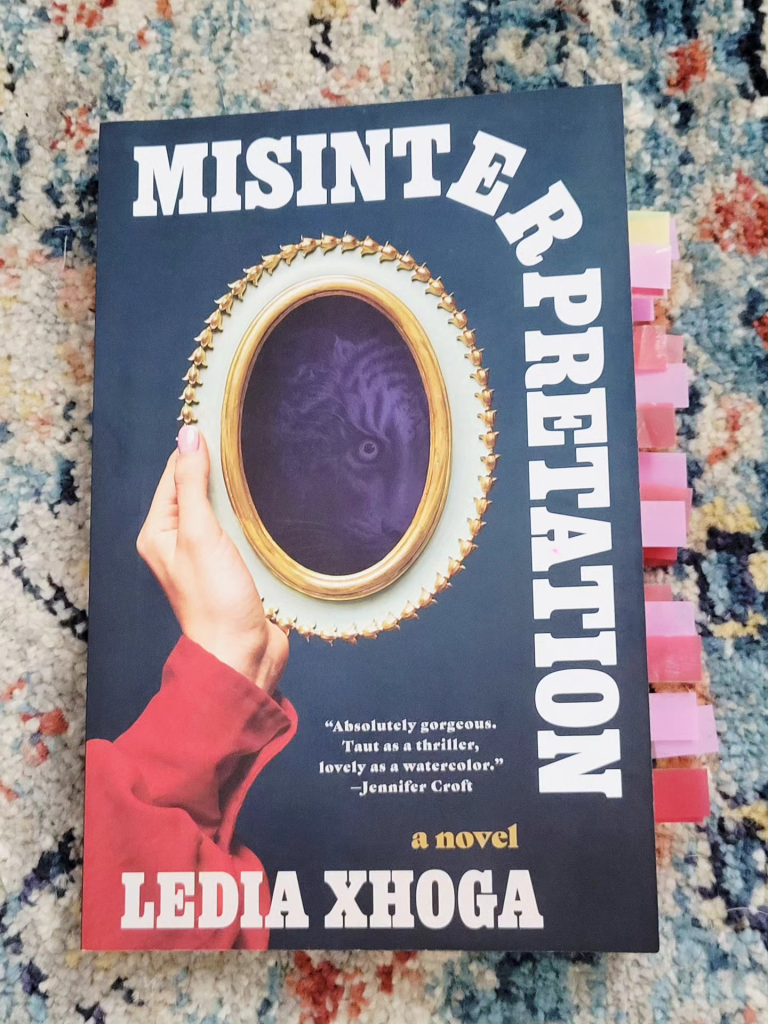
I think we finally have one of the longlist selections where I prefer the UK cover. The Daunt Books Publishing cover of Xhoga’s MISINTERPRETATION is more appealing than the Tin House version, though I appreciate what Tin House was trying to do.
The UK version captures the narrators paranoia and descent into madness in the font and the way it’s fall down the side of the page. (This is similar to what is attempted on the US cover, but the differences in font make all the difference.) The shade of purple is the shade I imagine her mystery hyacinths are. Those flowers are important aspects to the novel, in particular in building the “thriller” aspect, which the rest of the cover heavily leans into with the magnifying glass over the New York skyline. As the narrator serves as both prey fleeing and the predator prowling the New York streets, this choice nails that “thriller” vibe.
The US version went an entirely different way, moving away from the “thriller” aspect and more into the gothic. A seemingly female hand (the clothing choice a nod to the coat Billy gives the narrator that she gives to Leyla) holds an ornate, vintage mirror that is reflecting a human-looking big cat with stripes. Per the cover art description, it’s a tiger. Now, the Cheshire cat does show up in the text, and Alfred is seeing hybrid animals, but I think this reflection in particular references a scene near the end with a panther. But that reflection isn’t of a panther. Panthers don’t have stripes. Panthers also aren’t in Albania. But you know what is – the critically endangered Balkan lynx. Is that what is supposed to be on the cover? The panther is a reflection of the narrator in the text. Was the panther in the text originally a Balkan lynx? Or is it really supposed to reflect Alfred’s fragmented hybrids? (Considering the artist being Anton Vierietin, I think that might be the point. I don’t like it – his visions are not her’s.)
I’m not sure that either cover would cause me to pick the book up for further inspection. And while I think the Tin House version is on the right track, it falls short. Because of that, I’d likely pick the UK version.
What about you? Which one is your favorite?
“You’re misinterpreting your emotions.” (58)
“Old ghosts were everywhere and proved more helpful than the rare street signs.” (160)
Booker loves a unnamed and unreliable narrator, and they have one in Ledia Xhoga’s Misinterpretation. (This is the Creation Lake of this longlist, I believe.) The novel is set primarily in New York, with a brief 50-page trip to Albania. It has some thriller vibes and some gothic vibes, but it’s not squarely either. And I think that’s part of the point. There’s a lot of fragments in the novel, including Alfred’s face, caused by the narrator’s lived experiences and trauma and the stories she carries for those she translates for; she’s become a vessel for the pain and horrors of others, and it begins to flow outward.
As a former immigration attorney, the themes of the immigrant experience in America, including visa overstays, Anna saying she once thought Billy had married the unnamed narrator to get her a greencard, and the fear of being removed silencing victims, stood out to me as some of the stronger snapshots of time, place, and people. It’s likely what I appreciated the most from the novel because of how honestly it is depicted.
The unnamed narrator becomes a predator when she begins stalking Rakan, who is in turn stalking Leyla. Upon returning from Albania, the roles have reverses; she has become the prey. Billy leaving her to her own devices during these moments was one of the many times I said “he is not the one for you.” (I didn’t like Billy. Not in the slightest. But for what it’s worth, I don’t really like our “Clara” – the only name given to the narrator is the “joke” name bestowed upon based upon some man who had been obsessed with her mother.)
The novel deals with displacement, trauma, identity, immigration, self-preservation, domesticity, and motherhood (she doesn’t want to become a mother. Billy wants a family. She ignores those conversations). I think it’s an interesting novel that isn’t necessarily as polished as I would like – but I’m apt to believe that was intentional – first narration and madness? It’s not meant to be polished.
The longlist is feeling pretty global this year, and I am appreciating that.
 A Girl Named Tommi