
Booker 101 Quick & Dirty Monday!
ENDLING: Maria Reva
Knopf Doubleday Publishing Group.: 3 June 2025 (US) (unless otherwise noted, I’m reading the US edition)
Little, Brown Book Group / Virago Books: 3 July 2025 (UK)
Page Count: 338
First line: In the cities, buildings still stood whole.
Blurbed by:
Ann Patchett – (Numerous awards. No Booker nominations.)
Percival Everett – (Shortlisted for the Booker twice – THE TREES (2022) and JAMES (2024))
Lara Prescott – (Bestselling author of THE SECRETS WE KEPT. No Booker nominations.)
Ben Fountain – (Numerous awards. No Booker nominations.)
Anelise Chen – (Numerous awards. No Booker nominations.)
Karen Mahajan – (Numerous awards. No Booker nominations.)
Margaret Atwood – (Joint winner of the 2019 Booker Prize.)
Maria Reva was born in Ukraine and grew up in Vancouver. She earned her MFA from the University of Texas. In 2022, she was included on the Russian Foreign Ministry’s list of Canadian citizens who are forbidden from entering Russia. In addition to writing fiction, she works as an opera librettist. Endling is her first novel.
Don’t Judge a Book… Wednesday
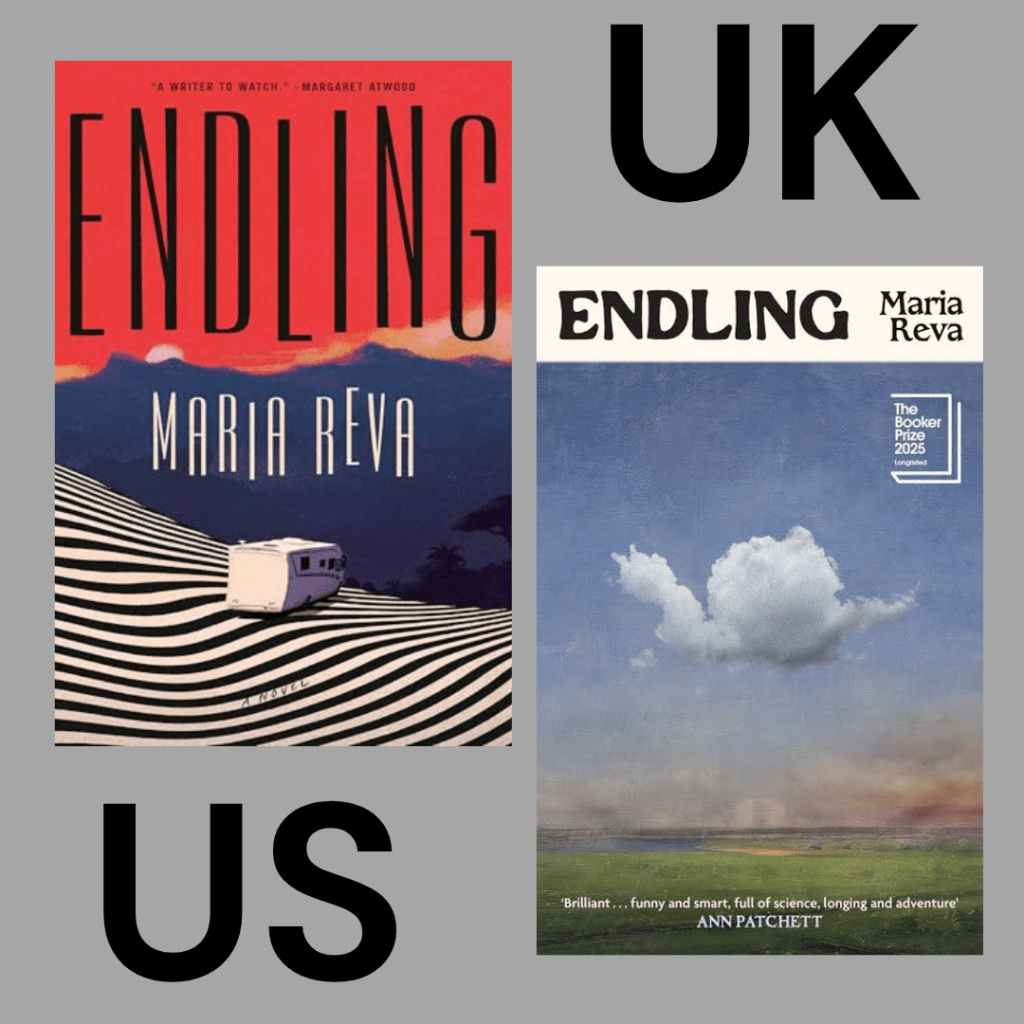
This might prove my most controversial cover discussion yet – I choose the US version. Don’t get me wrong – I love the snail cloud, I do – but the US version matches the vibes of the book better.
The UK version features a beautiful illustration of a puffy white snail cloud hanging in a blue sky over a lush green area with a body of water. In the distance, there appears to be smoke. This may speak to the dreamer in Yeva, who is trying to save snails from extinction. She has several “endlings,” thought to be the last of their kind, in her care, including a tree snail she calls Lefty. As Russia attacks Ukraine, she gets word from another conservationist that Lefty might not be the last. With a backdrop of bombs, she sets out to find the other snail.
The title of the novel sits in all caps, sectioned off from the image. (Is this a UK thing? This blocking?) It’s a lovely cover, but it doesn’t have the grit and roar of the US version, a version with a textured cover that even feels gritty. If you haven’t read Endling, stop now. I’m going to get into spoilers a bit.
ENDLING’s “Acknowledgements,” “About the Author, and “A Note on the Type” fall in the middle of the novel and are an active part of the story. Emily Mahon gets a shout out for designing the cover with “adapted artwork by Valentin Pavageau.” Pavageau is known for drawing on the fields of collage and illustration, creating mesmerizing bits. (They remind me of those posters that were big in 1990s where you’d stare at the image until another image emerged.) I wonder if the UK version thanks Emily as well or if there’s a different note.
On top of Pavageau’s print, there is a motorhome driving into the shadows. You can see the trees and the dark blue and the red of the sun as this RV seems to be booking it across the cover. This is the novel in a nut shell.
While I do find the snail cloud charming, this vibrant, mesmerizing cover takes the prize for me.
Final Thoughts Fridays
“Here’s how it all ends: happily, believably.” (128)
“Life teetered between annihilation and – could she dare think it? – hope.” (264)
“If I get the details just right, my grandfather will leave Kherson.” (297)
I’ve been quite vocal that Maria Reva’s Endling is my choice to take home The Booker Prize 2025; the book is next to perfect. As you’ve likely realized by now, I hate metafiction; however, Endling’s clever and unique use of the technique may just convert me. Maybe because there is more at stake for Reva as an author who is on the outside looking in to a homeland that is being destroyed, an author with family still there, an author who questions her own voice. “Am I no better than a snail, sniffing out the most softest, most rotten part of a log to feast on? At least a snail digests the rot and excretes nutrients, useful.” (331) And not only does the author break the fourth wall, Reva is in the story within the story as Masha, the head of the matchmaking agency. This is where things blur in such a beautiful, chaotic way.
The story within the story is about Yeva, a snail conservationist who is trying to save as many species as possible. She becomes one of the “Brides” with the Ukrainian romance tours for money. There, she meets Nastia. The 18-year-old daughter of an activist who has abandoned her and her sister. She has joined the “Brides” to get her mother’s attention. Her sister, Sol, has joined as a translator. Nastia hatches a plot to kidnap some of the men using Yeva’s lab, which is an RV. Things go south when Russia attacks Ukraine whilst they are traveling with their captives. The three women, their captives, and a snail named Lefty are just trying to survive, hoping to save Masha/the author’s grandfather and find the snail that a fellow conservationist (not without its own complications) has told her he has seen in a clip of a boy releasing his pet rats before fleeing his home. Maybe Lefty isn’t an “endling – the last of his kind” after all.
Things of note:
Paul/Pasha/Pavel/Pavlo (he doesn’t understand that Pavel is Russian while Pavlo is the Ukrainian version) and his future career as an artist of bridges (without the bodies).
Nastia comparing her mom to Hitler.
The placement of the author’s note and the hilarious note on type in the center of the book being part of that dark humor she talks about in one of the more meta sections.
The use of dog breeds to draw connections to readers (she indicates this is why she uses the border collie but it is likely also why the two goldens show up).
Motherhood and sisterhood.
Sol’s cake that took 3 days to make.
Hope.
There is so much I could say about this book, but we are short on space. Not only is it my pick to win the prize, it is likely my best read of the year.
 A Girl Named Tommi