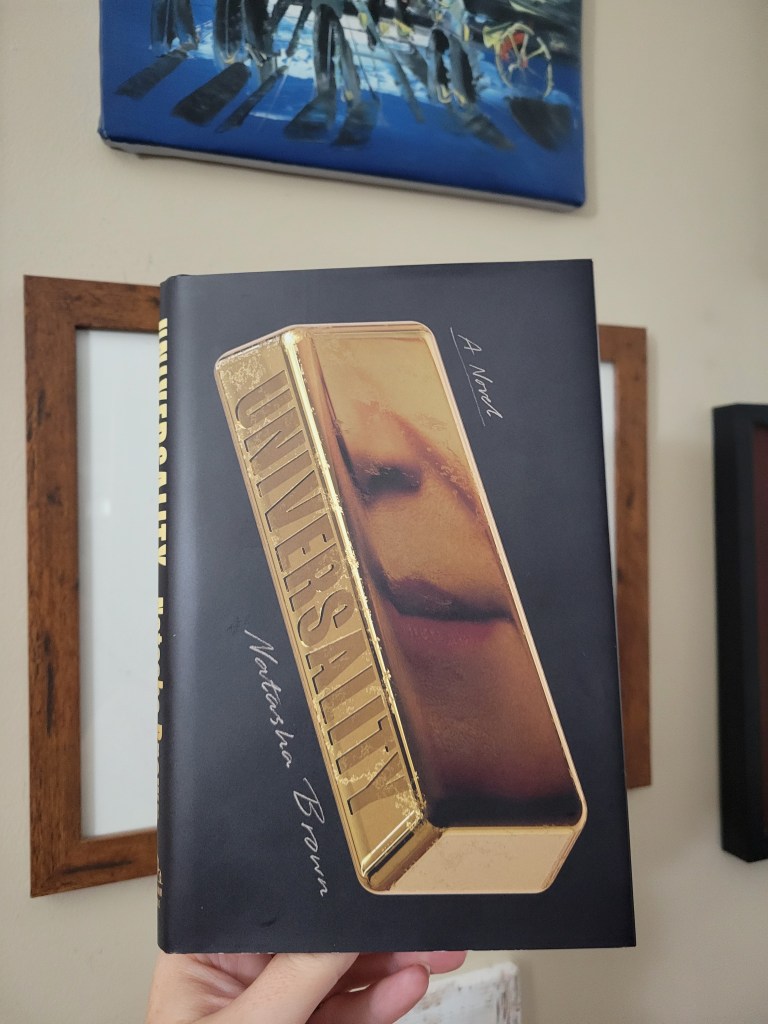
UNIVERSALITY: Natasha Brown
Random House: 4 March 2025 (US) (unless otherwise noted, I’m reading the US edition)
Faber & Faber: 13 March 2025 (UK)
Page Count: 152
First line: A gold bar is deceptively heavy.
Blurbed by:
Tess Gunty – (Numerous awards. No Booker nominations.)
Raven Leilani – (Numerous awards. No Booker nominations.)
Andrew O’Hagan – (Nominated for the Booker Prize three times, shortlisted in 1999 for OUR FATHERS)
Mendez – (Numerous awards. No Booker nominations.)
Elizabeth Day – (Numerous awards, including for her podcast. No Booker nominations.)
Jo Hamya – (Numerous awards. No Booker nominations, but she does host The Booker Prize podcast)
UNIVERSIALITY is Natasha Brown’s second novel. Her debut, ASSEMBLY, earned her numerous awards. Prior to becoming an author, Brown worked in finance after having studied mathematics at Cambridge. In 2023, she was named on Granta’s Best of Young British Novelists list, which is compiled once every decade. Fellow longlister Tash Aw was on that judging panel. Brown lives in London.

Don’t Judge a Book…
Yet again I am going to pick the US cover. While the US and UK covers of Natasha Brown’s UNIVERSALITY are similar, the US version is much more appealing. Both feature the golden bar on a dark background, albeit tilted opposite ways, but the devil is in the details.
The US version shows a tarnished bar, signifying what’s to come as pure gold does not tarnish. The title is imprinted on the side of the bar, and a feminine face, nose and lips, is reflected on the top. Considering the role women play in the novel in creating the “story,” this is perfect. The reflection is absent on the UK version as is the tarnishing. Brown’s name appears as if written in gold ink beneath the bar on the US version and in big gold letters at the bottom of the cover on the UK version.
The imperfect bar and the reflection as well as the font used for Brown’s name make the US version the clear winner in my book.
“Words are your weapons, they’re your tools, your currency.” (127)
Divided into four sections with each adding to or rewriting the facts of the section that came before, Natasha Brown’s Universality is certainly a remarkable work and well-deserving of being listed; I just didn’t like it. At all. But why? The writing is biting and sharp. The story-telling is exciting and tightly wound. Each word on the page was chosen with the precision of a mathematician. So what’s the problem? The problem is me. I hated everyone. (Pretty sure that was the point, but I find little joy in novels where I loathe every person on the page.)
The novel opens with Hannah’s article, “Fool’s Gold,” which introduces us to the Universalists – a group of white, middle-class folks crying for “progress.” They’ve created a little commune on a farm owned by Richard Spencer, a rich banker, where they grow pot. (Funniest part of the novel is that what they’re growing is just hemp, which is perfectly legally and not going to get you stoned.) Jake’s mother gave him access to the farm because she was sleeping with Richard. He invited Indiya, and suddenly Rob, Tim, Pete and Pegasus join. Jake ends up striking Pegasus repeatedly with a bar of gold Richard kept on the mantle. As each section unfolds, the more convoluted of a manipulative mess things are. The novel serves as a reminder that there are three sides to every story.
I appreciate stories that call into question whether the truth or fiction would sell better and how things get manipulated based on the intent of the involved parties, and I appreciate that aspect here. I just hated Miriam Leonard. And I found Hannah with her “bohemian brokenness” positively annoying. Everyone in the Universalities aggravates me – especially Pegasus. Richard and Claire interest me the most, but they’re also unlikeable.
While I can appreciate the craft, I still hate the final product.
 A Girl Named Tommi