“I have learned not to tell stories that frighten children.”
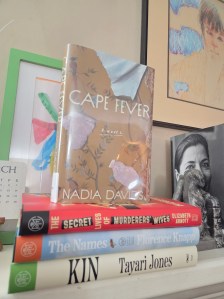
If you’ve been here a bit, you likely know that South African literature has a special place in this reader’s heart, with both Gordimer and Coetzee holding top rankings. When I read the summary of Nadia Davids’s debut novel, Cape Fever (Simon and Schuster 2026) and then saw the blurb by Coetzee on the back, I had a feeling the novel would tick most of my boxes. I’d say it’s Gordimer meets Silvia Moreno-Garcia with a faint echo of Daphne du Maurier. (The blurb draws the Moreno-Garcia and Rebecca comparison – I added Gordimer, because I think she’s in there, too.) I really enjoyed it.
The slim and haunting novel follows Soraya Matas, who takes a job as a personal maid to Mrs. Hattingh at Heron House in 1920. The job is not far from Soraya’s home in Muslin Quarter and though the house is grand, there is only Mrs. Hattingh to care for. It seems the perfect position. But Soraya soon realizes Mrs. Hattingh is touch eccentric, seemingly harmless, but a bit odd.
Soraya has a bit of a second sight, seeing ghosts and djinn in the world around her. She remembers the first time a Gray Woman revealed herself, and she isn’t too surprised to find one at Heron House. She does seem a bit more surprised at the girl in the portrait, but Soraya is not scared.
Mrs. Hattingh’s son is in England and she lives for his letters. He often sends money, which is a blessing because the home is falling apart and there are accounts owing. Letters from England, or the absence of them, have a noticeable effect on Mrs. Hattingh, and Soraya is forced to placate her moods and whims.
Mrs. Hattingh, often being controlling and chummy all at once, believes Soraya is illiterate – a notion Soraya intentionally allows her to hold. She offers to write letters dictated by Soraya to her fiancé, Nour, and Soraya readily agrees. The slow burn of a psychological thriller hums in the scratch of her pen.Soraya soon realizes something is amiss with the letter writing and control Mrs. Hattingh exerts over it and Soraya.
The depiction of Soraya’s general naiveté, which is at times inconsistent, and a rushed conclusion are what kept this from being a five-star read. But I did thoroughly enjoy it.
 A Girl Named Tommi