“First you get accused of something you haven’t done. Then you do it… He was called a rebel and then he rebelled.”
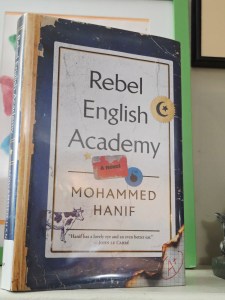
Mohammed Hanif’s Rebel English Academy (Grove Press 2026) is another novel I fully expect to see making the rounds during awards season. Hanif’s voice, the sharpness of that satire, renders this book as a big belly laugh with sharp, blood-soaked teeth; not only can it bite, it already has. And that is attributed solely to Hanif’s storytelling, which is reminiscent of Heller’s Catch-22. (With military satire, it’s hard to avoid the comparison. It would seem A Case of Exploding Mangoes boasts even more of a comparison.)
Rebel English Academy is set in OK Town in 1979, opening with the execution of Pakistan’s first elected Prime Minister Zulfikar Ali Bhutto. What follows is a violent period of corruption, martial law, and survival. And it’s hilarious. Don’t misunderstand me – there are horrific things that happen in this novel, including rape, murder, and torture, but how Hanif presents them, how his characters navigate these experiences, is what makes this novel brilliant. It’s survival and dissent wrapped in a wry humor that peels back your eyelids and says LOOK.
The novel follows a cast of interconnected characters. Sir Baghi, a former rebel, teaches English at the “Rebel English Academy,” a course of instruction praised for its successes. He is housed in the mosque where his childhood friend, Molly, is a popular religious leader. Baghi has promised the government that he will no longer be involved in politics. Sabiha, daughter of rebels and his former student, seeks safety at the mosque following her house being burnt down with her husband inside and speculation that she killed him. Captain Gul (a fake name because he’s a spy – there are three Guls in the novel by the time you reach the last page, making his character even more absurd) has been sent to OK Town as a punishment for botching his job in the hanging of Bhutto. He is tasked with addressing the protests and rumors that Bhutto still lives, but he is frequently distracted by his sexual desires with Sabiha soon catching his eye.
The best sections are Sabiha’s “homework” sections. Baghi has informed her if she’s going to stay there, she should practice her English. Her story unfolds in “homework” essays, and it’s not an easy story. Sabiha brings a gun with her to the mosque, which Baghi quickly takes, scoffing about Chekhov’s gun theory. Spoiler – the gun is fired before the novel ends.
The novel tackles education, religion, politics, sexuality, and the power of all four all the while grinning at you with its bloody teeth. I really enjoyed it.
 A Girl Named Tommi