“I am failing. I want to go home. But not that home. Home to the past. I am so stupid that it burns. But not hot enough.”
“stories and soil change and stay the same”
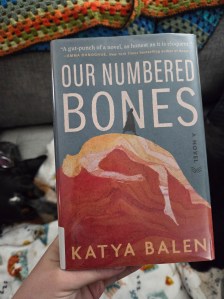
Katya Balen’s first adult novel, Our Numbered Bones (HarperVia 2026), is a 237-page gut punch; the ache in the pages weeps and bleeds out, settling on the reader with the weight of loose dirt. This one got under my skin and in my bones. As someone who suffered from infertility and struggled mentally following a miscarriage, I felt like Balen had peeled my skin back to show those bones. It’s so well done, but man, did it hurt.
This may be a spoiler, so you should stop now if you don’t want it spoiled. I don’t really think it’s a spoiler because I think it’s pretty apparent early on, but here’s your chance.
The novel follows Anna, a writer who is descending into madness following the stillbirth of her daughter. Following some light prodding by her editor and the encouragement of her husband, JP, she goes to a secluded cabin for a writer’s retreat. While there, she stumbles upon two men who have uncovered a body. She is fascinated by the body, believing it initially to be a statue, and she wonders who buried it in the bog. It’s not a statue, but the body of a woman dated back to the Iron Ages. She joins the team of archaeologists who are doing the dig, telling them she is a writer. They want her to tell the dead woman’s story.
That’s the crux of the storyline, but where this novel excels is in Anna’s rapid descent into madness. She becomes as obsessed with the woman as she had recently been with various ways to die. The novel is stabbed with prose often akin to ramblings of a woman who would tear the yellow wallpaper if there was any. (iykyk)
Anna is forced to face her past, including the death of her daughter and her mother’s dementia, in order to find her “story.” The role of the archaeologist is a bit on the nose – we’re all relics, are we not? The archaeologists even reference King on stories as artifacts. (The exact quote is: Stories are artifacts, not really made things which we create and can take credit for, but pre-existing objects which we dig up.”) But I did really enjoy that framework.
This is a novel that is best read in one sitting to best appreciate how Balen captures the grief and madness and makes the reader one with it.
Read this book.
 A Girl Named Tommi