“Ghosts and Orphans.
Orphans and Ghosts.
The ways we’re abandoned and never left alone.”
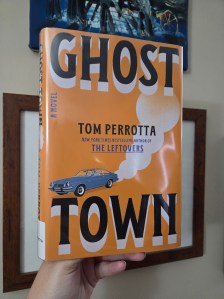
This quote from Tom Perrotta’s Ghost Town (Scribner 2026) could also apply to the other book I read today, Ali Smith’s Glyph. Stay tuned for that review, but they were certainly interesting to read back-to-back. As for Perotta’s novel, I didn’t know what to expect and was convinced it would remind me of The Rest of Our Lives (I blame it on the cover). Thank goodness I was wrong. Perotta’s novel has a “Stand by Me” King feel, and the very short chapters work extremely well in crafting this “ghost story” of a classic coming of age.
The novel is framed with the adult Jay receiving an invitation to return to his hometown for a ribbon-cutting ceremony of a new municipal building that will bear his father’s name. These sections are told in first person, but the looking back sections, the sections about 13-year-old Jimmy, are removed from the first-person narration. This choice reminded me of Tash Aw’s The South, which also featured an adult “looking back” on a life-changing summer of his youth.
The novel is set in the 1970s in the all-white Creamwood, New Jersey, where, as Jimmy says, his family was normal until it wasn’t. His 8th grade year is coming to a close with a summer of baseball and the beach and maybe kissing his maybe girlfriend on the horizon. And then his mother dies on page nine. It’s not sudden, but it was for Jimmy who had been shielded from the seriousness of her illness. An estranged cousin interrupts a Little League game to let him know, because some messages should only come from family – estranged and strange as they may be.
These look back sections are a time capsule of being a grieving 13-year-old boy in the 1970s America. But this is also a ghost story, with Jimmy’s mother speaking to him and another ghost shimmering in to upend Jimmy’s life in Creamwood forever. (There’s also arguably another ghost, but I don’t want to spoil it.) Perrotta has a steady hand in crafting this story that could have easily ventured into the overly preachy and/or paranormal. He does get a bit heavy handed toward the end with one of the present-day sections, but it was an important acknowledgement that I don’t know how else he could have handled.
I would not be mad if I saw this on a longlist. Not mad in the slightest.
Read this book.

