WILD DARK SHORE – Charlotte McConaghy

“I loved a landscape and watched it burn.”

I really enjoyed Charlotte McConaghy’s Once There Were Wolves (2021), and Migrations (2020) has been sitting on my TBR cart for years, so picking Wild Dark Shore ( Flatiron Books 2025) as my BOTM selection was a no brainer.  I was a bit concerned that it would fall into the “trauma porn” category that I found Once There Were Wolves teetering into (not my fav), but I think WDS delicately dances around it a bit more, resulting in that five-star read I wouldn’t give Once There Were Wolves.

The page count of 298 is misleading; this is an extremely short novel, rapidly propelled forward by short sections. I read it in one sitting before bed, and yes, I did cry.  The part that was my undoing?

“I will go back with your body now. This beautiful body. This strong body that endured all it could. I will stay with it, I will wash it and wrap it and hold it as we leave this place. I will carry it across the sea, and I will return it to your land, to live among the snow gums. It is just a body but it was yours, and beloved.”

Now, I’m not going to tell you who was speaking or who they were talking about, because I’m not spoiling this novel.  But people die.

This is the novel of the Salt family, Dominic and his three children, Fen, Raffy, and Orly. They are all that remain on what had once been a research island that houses a seed vault. The researchers have left and Dominic, as caretaker, is tasked with packing up the seeds to be moved. The sea is reclaiming the land, and it is no longer safe. One night, a body catches Fen’s eye.  It’s breathing.  They pull Rowan from the sea, and the four become five. But Rowan has a secret – she’s there looking for her researcher husband. The Salts have their own secrets, including what happened to her husband.

The island teems with wildlife, a history of poaching a trauma that still soaks the land. The Salts all have their own relationships to the island – some with the animals, some with the seeds, and some with the ghosts that inhabit its shores. It’s an island of skeletons and secrets, blood and bonds, lies and loyalties. Rowan, despite her attempts not to, develops her own relationship with the island.  And the Salts.

It’s a novel of motherhood and choices, mistakes, misunderstandings, and forgiveness. Of turning trauma into something still broken but beautiful. And that ending, while many will hate it, is perfection.  Because a choice has to be made, and that choice both shatters and heals.

Read this book.

OATHBOUND – Tracy Deonn

“What is a bargain if not an oath? And what is an oath if not a promise with a price? Call these what you will. All are cut from the same cloth -a cloth woven of intention, will, and sacrifice.”

The long-awaited third installment of Tracy Deonn’s remarkable The Legendborn Cycle was released this past Tuesday.  I finished Oathbound (Simon & Schuster 2025) on Wednesday; I could not put it down. I said previously that Bloodmarked “is soaked in grief and anger, with legends and lore at the crossroads where history tends to be remembered by those with the most power and a different history rests in the roots and blook-soaked soil.” In my review of the second installment, I echoed back to my review of Legendborn, stating:

“Deonn boldly stares down the traditional fantasy canon while giving the reader an Arthurian legend unlike anything Tennyson or Malory could have imagined.  She gives her reader Merlin and the magic expected from the likes of a kingsmage.  But she also gives us rootcraft and generational power.  She gives us Bree.”

And she keeps giving us Bree.  And while the grief and anger remain in Oathbound, there is a resilience, a relentlessness, a reckoning that roars.  Deonn continues to throw the canon on its head, which I love.  And while I anticipated that book three would give us more of the Morgaines, which it does, it gives us more bonds of loyalty, maternal connections, and reminds us that no man, or woman, is an island.  Bree has to lose herself entirely to find herself. So does Nick.  So does Sel.

And that ending, with Bree, Nick and Sel as that triangle, tells me this round table is about to be shattered even more – King Arthur needed his knights; Bree needs her people. I’m not going to say anything more because this book, from its layout to its plot, needs to be experienced.   But know this book was unexpected and somehow exactly right.

And yes, we’re back at Carolina and also in Asheville.  The books still feel like home.

WRITTEN IN BLACK – KH Lim

“There’s a Malay word called geram, and it describes a feeling that no English term I know could properly communicate. Imagine the worst itch in the world, an itch one hundred times worse than the itchiest bite that the itchiest mosquito could ever give you, but that it’s inside you, stirring up all your internal organs and agitating them to the point where you’re on the verge of clawing and tearing them out with your bare hands if only to make it stop.”

Current installment of Tommi Reads the World – we’re still in the Bs.

Country: Brunei
Title: Written in Black
Author: KH Lim
Language: English
Translator: N/A
Publisher: Monsoon Books 2014

There are not a lot of novels coming out of Brunei. Literary tradition in this small Asian country consists of oral storytelling, poetry, and epics, and while there does seem to be an active and exciting effort to make Brunei’s literature more readily available, my options were extremely limited.  Written in Black is set in Brunei. KH Lim was born and raised in Brunei, and he is currently a medical doctor in Singapore.  In the acknowledgements, he welcomes readers to learn more about Brunei utilizing other resources (as his book is not intended to nor should it be our sole education) or visiting the country.

The novel is a brief snapshot in the life of Jonathan, a ten-year-old boy whose grandfather has just died.  The cover is a bit misleading because it would appear he floats down a river in casket, and while there is an “escape” via caskets, it’s not down a river. The name derives from Jonathan’s preference (possibly obsession) with writing in black ink. His teacher insists on blue, but Jonathan prefers black.  Particularly from his G2 pen.  (I get that.  I love a G2.)  He is a Huckleberry Finn loving middle child who gets into a bit of trouble, but usually always for the right reasons. His mother has left them, and no one is really being honest about why and when or even if she’ll be back.  His older brother has been kicked out of the home.  And now, his grandfather has died.  Jonathan, along with his sister and younger brother, must attend the funeral.

Jonathan goes on a “quest” to find his brother and bring him to the funeral.  Along the way, he meets a few unsavory characters, including glue sniffing poklans, which he likens to the pirates of Brunei’s past. It’s a bit of a funny epic that hints at Huck while still being very much Brunei.

I look forward to seeing more literature out of Brunei.

DEATH OF THE AUTHOR – Nnedi Okorafor

“Tomorrow is where my hope lives. I can’t be normal, so I’ll be something else.”

“I will spread the word like a virus.”

All aboard the hype train – Choo! Choo! Nnedi Okorafor’s Death of the Author (William Morrow 2025) is a beautiful marriage of literary fiction and science fiction that scratches a particular itch. If you’re new here, hello.  If you’re not, you know I love genre-blending, hard to pin down and label books, particularly if the writing is sharp and fun. I’m not new to Okorafor as I’m familiar with The Nsibidi Scripts series, but this is the first non-middle grade Okorafor for me.  I loved it.  There’s something that made me think of Thomas Pynchon’s V., but my most recent robot read was, of course, Klara and the Sun – that’s a good comparison namely because it is heavy on the lit fic as well.

Death of the Author is a book within a book.  Zelu, a paraplegic author, has written a remarkable novel, called Rusted Robots. This novel, unlike her previous works, gives her insta fame and insta cash.  She becomes an international sensation.  In addition to the book within a book, there are also interviews with Zelu’s family members and loved ones.  Rusted Robots unfolds on the pages in snippets as Zelu’s life takes on a new trajectory following its publication.

There’s a lot to unpack with the novel. Zelu is an outsider.  She is Nigerian American, her parents are Igbo and Yoruba, which already makes her a curiosity in both America and Nigeria.  Added to that, she is paralyzed as a child and confined to a wheelchair.  There are issues of colonialism, ableism, fealty, tokenism, cancel culture, generational trauma, and the nervous conditions of the diaspora.  And then there’s Rusted Robots, a world where humans are extinct and robots roam Lagos, the two primary groups being Humes (who look like humans) and Ghosts, who don’t need a body.  Both stories will test loyalties and love, define and redefine “family,” and push boundaries.  And they bleed into each other in the most exciting ways.

This is a novel that needs to unfold in its own time, revealing its secrets when you read it.  As such, I’m not going to say much more.  Except for be prepared to want egusi soup and fufu.

Read this book.

WE ALL LOVED COWBOYS – Carol Bensimon

“All great ideas seem like bad ones at some point.”

Current installment of Tommi Reads the World – we’re still in the Bs.

Country: Brazil
Title: We All Loved Cowboys
Author: Carol Bensimon
Language: Portuguese
Translator: Beth Fowler
Publisher: Companhia das Letras 2013; English translation, Transit Books 2018

We All Loved Cowboys is a queer, coming of age novel that both seems too short and too long. It’s a slim volume that flashes between present and past, sometimes without warning, but is centered primarily on a road trip between ex-lovers who haven’t seen each other in years. Cora is bisexual but primarily attracted to women – typically straight women.  Julia is closeted.  Their relationship is one of secrets and shadows, lovemaking in the dark or hurried in public restrooms. Cora never felt good enough, and Julia was never fully invested in the relationship.  With one foot always half out of the door, Julia made arrangements to move to Canada without even bringing it up to Cora until it was done. That is what broke their relationship, which had become essentially friends with secreted benefits. But a chance conversation, a moment of weakness in both women, and suddenly plans are made to meet back in Brazil (Cora’s been living in Paris) for the road trip they’d always talked about going on. What could possibly go wrong?

Both women have grown up during the few years that separated them, but there is still resentment, anger, frustration, passion, and love between the two. Can they figure it out before their road trip comes to an end?

EDGEDANCER – Brandon Sanderson

“I gots magic spit.”

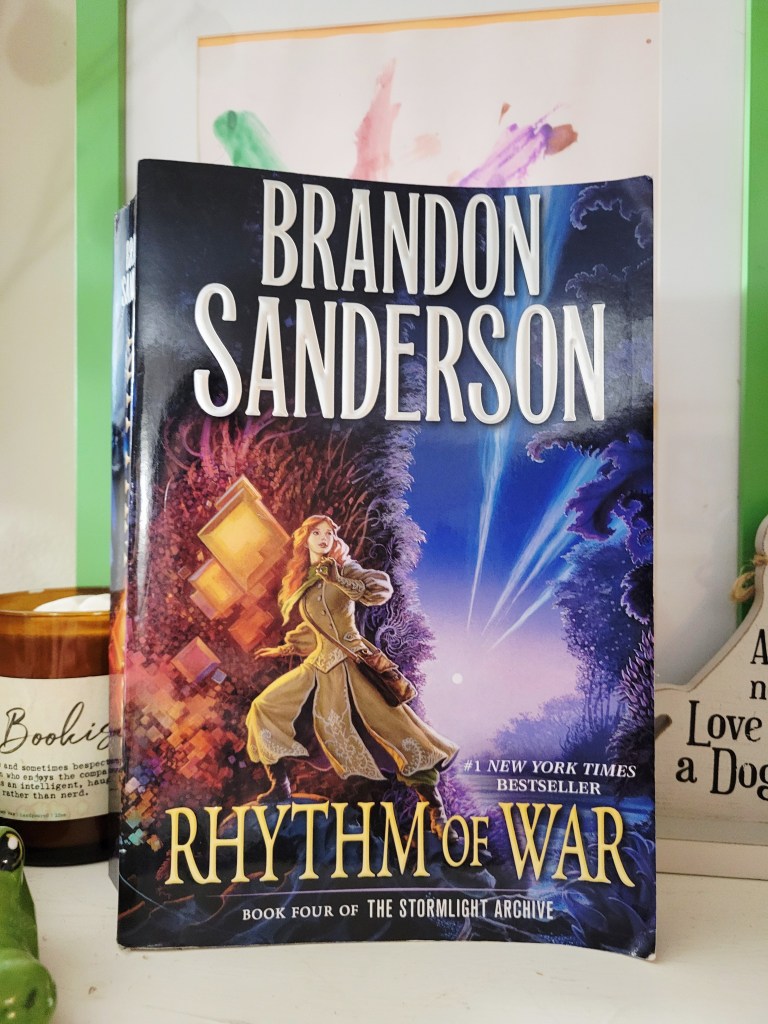
You’re likely going to get sick of me talking about Brandon Sanderson, but, as you’re aware, it is indeed the year of Sanderson.  My second February selection is Edgedancer, a “novella” (though arguably more of a novel) that is part of The StormLight Archive.  I believe it’s best referred to as #2.5, fitting neatly between Words of Radiance and Oathbringer, that brings us back to an “Interlude” in Words involving a young street urchin named Lift. Lift is smart-mouthed, uncouth, and forever hungry.  And yeah, she “Awesome”  because she is, of course, a Radiant.  Bound a child, Lift’s spren, Wyndle, assumes a bit more a babysitting role with her, his frustration and disappointment a mask for the feelings he has readily developed for the young girl.  She doesn’t know the rules, and he can’t tell her.  So, he just has to make sure she doesn’t kill them both.

A man with a shardblade, an executioner known as Darkness, is seeking her and others like her out; his mission, while tied to that of the Assassin in White’s, is a little different.  He is trying to stop the return of the Radiants; he just doesn’t understand he is too late.

Edgedancer is a bit different because it’s much shorter, a snapshot of moment for this Radiant, a little more juvenile, and Lift is an extremely annoying (and lovable) child. I’m fascinated that her powers are fed by literal food not stormlight, making her a bit of an oddity. She’s nomadic, never wanting to stay in one place long, and struggling with choices she made, expectations, a power that is still a mystery to her, and a hunger that gnaws at her.

Sanderson better not make her and Wyndle a casualty of the storm.

PUNISHED – Ann- Helén Laestadius

“If she’s going through the pearly gates, she damn well ought to suffer on her way there.”

Ann- Helén Laestadius’s Punished (translated from the Swedish by Rachel Willson-Broyles, Scribner 2025 – originally published by Romanus & Selling in 2023) will gut you just as surely and jaggedly as Stolen. I’ve said before that Laestadius reminds me of Backman, only a bit grittier – her “heart hugs” come with a  song on the wind, haunting and powerful – it’s the joik – a traditional  Sámi way of singing that the children in Punished are not allowed to sing.

Punished is the story of five Sámi children at the “nomad school” , a government-run boarding facility in Sweden in the 1950s. There, they are not allowed to speak their native language, sing their songs, or wear their traditional clothes (except when they need to be paraded around.). For all intents and purposes, they are there to cease being Sámi despite the purported goal being an education tailored to nomadic people. It’s inspired by true events, and it’s unflinching and unapologetic in its presentation.  (The Church of Sweden has apologized for its centuries long systematic abuse and repeated trauma to the Indigenous people, but words don’t erase scars.)

The novel flips between the 1950s with the children in the school and the 1980s with the now adults still struggling with the abuse that was inflicted upon them at the school. What unfolds is partly a story of revenge as the evil headmistress has returned to the town, and the children must confront that ghost, but also a story of resilience and finding your way back home.

It’s a hard read, but it’s a read with a heartbeat. It bleeds and weeps, the bruise spreading as you read, but there’s a warmth and a brightness and above all – a voice, a joik, that you’ll hear long after the last page.

Read this book.

WORDS OF RADIANCE – Brandon Sanderson

“No apologize. Boots.”

“I know most stories, But I’d never sung this one before.”

“The storm catches everyone, eventually.”

My “Year of Sanderson” continues, and the first Sanderson selection of February was Words of Radiance. (Edgedancer rounded out the month, but I’ll get to that later.) The second book of The Stormlight Archive accomplished something that most second books in a series fail at – it’s better than the first.  And that is saying A LOT.

Sanderson is clearly the Hamilton of fantasy – he must do nothing but write at least 23 hours of every day.  Or he’s invented some time freeze.  Or he has writing spren.  Because Words, like The Way of Kings, is huge, sitting pretty at 1096 pages.  And much like The Way of Kings, each word is intentional.  There is no fluff – each sentence is carefully constructed to add to the world, character, or plot.  Now that said, there is some repetitiveness.  I think it’s less being sloppy and more Sanderson saying “Hey, I know I’ve thrown a lot at you, but pay attention to this.  No, seriously.  PAY ATTENTION TO THIS.” 

Now on to the book.  Like Way, it derives its name from a text.  Whereas the text in the first novel was Dalinar’s guidebook, Words of Radiance is the book that Shallan is trying to get her hands on after her copy was lost to the sea.  And words are indeed very important to our “Radiants.”  They have to say the words, feel the words, know the words. 

Dalinar is fantastic in this novel.  Shallan comes into her own and is able to embrace more of her power.  She is also forced to face her past – a past that has been hinted at, but is painfully revealed in Words.  Wit is back, of course. And I still think he’s Sanderson. And Kal, Bridge Four forever, is still the tortured soldier/surgeon.  Revenge nearly destroys everything, and I mean everything, for him. Words sees Dalinar, Kal, and Shallan finally all three together, with Shallan continuing Jasnah’s scholarship.  Our assassin in white is still a threat, and the mysteries of the Parshendi spill forth, bringing a storm unlike anything anyone has ever seen.  And we learn a bit more about those shardblades and the spren.

The Radiants have returned.  And with them, the Voidbringers.

BEFORE THE FEAST – Saša Stanišic

“I am sure she wanted me as a witness to carry the story of her child out into the world, and may God help me, I will do so.”

Current installment of Tommi Reads the World – we’re still in the Bs.

Country: Bosnia
Title: Before the Feast
Author: Saša Stanišic
Language: German
Translator: Anthea Bell
Publisher: ‎ Random House GmbH, 2014; English translation, Pushkin Press 2015

Bubba may have shot the jukebox in American country music lore, but Herr Schramm shoots the cigarette machine in Bosnian-born Saša Stanišic’s Before the Feast.  The novel, set in a small German village, takes place over the course of one night as the town “sleeps” before the Feast – a celebration that will bring in some tourists. Only the town isn’t sleeping. 

Herr Schramm keeps getting interrupted in his quest to commit suicide. The fox is trying to bring back eggs to her kits. The renowned town painter is apt to drown herself in her attempts to paint the artwork that will be auctioned off during the celebration. Something’s a miss with the church bells and the young apprentice, an atheist, isn’t getting the opportunity to show what he can do. Frau Schwermuth is combatting a bit of madness as the town’s legends, lore, and history is spilling forth into the night.  More people die than are born there, and they’ve already lost the ferryman.  Who knows what the night will hold?

It’s a snapshot of one night, but that brief moment has flashes that take us back hundreds of years.  The town is as much a character, if not more so, than the current and past inhabitants that walk the pages.  Ghosts are disturbed. Memories stalk. Fear returns. The ground is stained with blood and life and still yet hope.  And cigarette ash.

It’s a novel of remembering, of oral traditions, of storytelling deep into the night.  The prose is at times jumbled, but mostly pretty.  If you’re looking to follow a plot, there is not one.  The plot is in the night and the stories themselves.  It’s the night before the feast and everyone is sleeping and everything is alive.  Except for the ferryman.

Read this book.

THE FAVORITES – Layne Fargo

At the beginning of the year, I resolved to listen to more audio books, and while it is not my preferred reading medium, I am finding that I really enjoy it – especially if the narrator(s) “work” with the words. I think some of my early dislike of audio books was due to poor narration that couldn’t hold my attention. I recently read Layne Fargo’s The Favorites (Random House 2025), narrated by Christine Lakin, Louisa Zhu, Amy Landon, Elena Rey, Valerie Rose Lohman, Suzanne Toren, Graham Halstead, Julia Emelin, Layne Fargo, Eric Yang, and Johnny Weir.  It was a PRODUCTION, let me tell you.  I’m not sure if it was the set up of the book being a documentary with multiple talking heads, but the audio is bloody fantastic.  And Johnny Weir narrating a character in a book about competitive ice dancing?  Color me sold.

Some folks draw a ready comparison between The Favorites and works by Taylor Jenkins Reid and Fargo does thank Reid in her acknowledgments, but I’ve never read TJR.  (I know.  I KNOW.) The Favorites, however, is the best kind of reading candy.  It’s toxic and sexy, bloody and brilliant, full of obsession, jealousy, and glitter.  Every character skates in a morally grey part of the rink, each with a taste of villain and hero, and I loved each jagged-lined one.

The novel is equal parts bildungsroman, love story, thriller, and competitive sports novel – and these four parts bleed seamlessly into the other. The writing is as sharp as the blades on the skates and as fun as a free skate program.

Long story short – Katarina Shaw is a young kid with a dream – she’s going to be an Olympic skater, and she will do whatever it takes to accomplish her goals. When she meets Heath Rocha, a broken kid in the foster care system, they lean into each other to escape reality for dreams. They become a formidable pairs team, full of passion, angst, and toxicity. Their relationship on the ice is magic, off the ice, it’s toxic and marred by gossip and competitive spirits.  Their relationships with their colleagues and fellow competitors are full of respect and sabotage, false smiles and distrust.  It is an edge of the seat, thrilling read – a train wreck of a career you can’t look away from.

As someone who grew up in the 80s & 90s, Nancy and Tanya were household names. And I’d watch the skaters, the gorgeous outfits and breathtaking jumps, turns, and fancy footwork with a child’s abandon and imagination. This book fed something in that little girl in me and reminded me of sitting cross legged on the living room floor and being entertained by the beautiful and talented athletes.

Read this book.

And there is plenty of time to read it before April 21st when Laura Beth will be hosting an author chat with Layne Fargo! For more information, check out Laura Beth at:

https://www.youtube.com/@lbtheloverofbooks

https://www.facebook.com/groups/lbsbooklovers/

https://www.instagram.com/lbtheloverofbooks/

You can see her upcoming schedule of author chats and watch some of the other ones on her Youtube channel!