THE HOUSE OF DOORS – Tan Twan Eng

“Where does a story begin, Willie?” I asked.
  For a while he did not say anything. Then he shifted in his chair.  “Where does a wave on the ocean begin?” he said. “Where does it form a welt on the skin of the sea, to swell and expand and rush towards shore?”
 “I want to tell you a story, Willie,” I said.

I’m still reading the 2023 Booker longlist, and I remain rather unimpressed with the selections; the overwhelming majority of those I’ve read are simply “just okay.”  (Western Lane is my hopeful to win.)  They’re perfectly fine, but the books nominated for the Booker shouldn’t be just “perfectly fine.”  Tan Twan Eng’s The House of Doors (Bloomsbury 2023) falls into that lukewarm “perfectly fine” category. Eng is no stranger to the Booker prize; this is his third time on the longlist, and he was a judge of the 2023 Booker International prize. He can certainly write, and this novel does have that “Booker” quality, but I couldn’t help but draw comparisons with Tom Crewe’s The New Life – in my opinion, a better selection for the prize. Crewe’s novel has similar themes, is also based on historical events and people, and soars where The House of Doors flounders.

                In 1921, Lesley Hamlyn is living at Cassowary House on the Straits Settlement of Penang when her husband’s old friend, none other than famed author Somerset Maugham, comes for an extended visit.  “Willie,” as they call him, brings his young and attractive assistant, Gerald. Lesley is quite disturbed to realize they are “homosexuals,” a word she can barely bring herself to say. What transpires is a fictional account of how Maugham was inspired to write The Casuarina Tree, a collection of short stories set in the Federated Malay states during the 1920s.

                Lesley tells Willie about her best friend, Ethel, who had been charged with murder after killing a man she’d accused of trying to rape her. Ethel’s trial in Kuala Lumpur in 1911 actually happened and was quite the tantalizing drama. Lesley also talks about her relationship with the revolutionary Dr. Sun Yat Sen (also a real figure). Eng plays with the timeline so that the trial and Dr. Sun Yat Sen being in Malay all happen at the same time.  Lesley also reveals her husband’s infidelity and sexuality as well as her own affair.

                The novel should be a riveting ride of court room drama, colonialism, scandal, revolution, love, lust and duty.  But it takes forever to get the heart of the story.  Lesley is boring, unlikeable, and unauthentic. Gerald is a caricature.  Absolutely beautiful language, but eh.

Booker count: 7 of 13.

**One of the 2023 judges is a Shakespeare scholar. I’ve decided to keep track of the novels that name drop Shakespeare or his works.  Willie notices Robert’s Shakespeare collection, making this 5 of 7.

THE SANDCASTLE GIRLS – Chris Bohjalian

Next installment of Tommi Reads the World – still in the As.

Country: Armenia
Title: The Sandcastle Girls
Author: Chris Bohjalian
Language: English
Translator: N/A
Publisher: Doubleday (2012), First Vintage Contemporaries Edition (2013)

“But history does matter. There is a line connecting the Armenians and the Jews and the Cambodians and the Bosnians and the Rwandans. There are obviously more, but, really, how much genocide can one sentence handle? You get the point.  Besides, my grandparents’ story deserves to be told, regardless of their nationalities.”

This one may be a bit of a cheat as it is written by a rather prominent American author.  (I read Midwives over 20 years ago.)  But while American, Chris Bojalian is also Armenian, and his Armenian grandparents, survivors of the Armenian genocide, are the voices in this historical novel of love, resilience, brutality, and the secrets and scars a family carry.

I don’t usually care for novels about authors and their writing process, but Laura’s journey through her grandparents’ history and her determination to tell their story didn’t bother me – perhaps because I didn’t hear her voice when we stepped back in time to 1915 Aleppo where Elizabeth, her wealthy, white grandmother, has arrived to bring food and medical aid to the refugees of the Armenian Genocide.  Elizabeth, bold and fierce with a naïve strength, falls in love with Armen, an Armenian engineer who has lost his wife and infant daughter.

Another benefit of having Laura’s present view as she uncovers the past is the realization that she knew nothing of the history, had no real grasp as to why it was such a big deal when her first love was a young Turkish boy, mirrors the realization of a reader who like Laura, might not even be able to find Armenia on the map let alone know the horrors faced.  Structurally, I find it a success.

Story wise, it’s also an expected success.  Bohjalian writes in a familiar and comforting style that is extremely palatable.   I stand by my decision that this counts as Armenian literature – an Armenian American is telling a story inspired by the resilience and survival of his own grandparents.

Read this book.

*Please recommend any Armenian novels, translated into English, that you have enjoyed! *

THE PIANO TEACHER – Elfriede Jelinek

Next installment of Tommi Reads the World – still in the As.

Country: Austria
Title: The Piano Teacher
Author: Elfriede Jelinek
Language: German
Translator: Joachim Neugroschel
Publisher: Rowholt Verlag GmbH (1983), English translation by Weidenfeld & Nicolson (1988)

What on earth did I just read?  The Piano Teacher is one of the more disturbing novels I’ve cracked the spine of.  The blurb indicates “the dark passions roiling under her subdued exterior explode in a release of perversity, violence, and degradation.”  – That doesn’t even scratch the surface. Umph.

Erika is a 38-year-old piano teacher who was supposed to be a famous pianist but didn’t exactly live up to her mother’s unrealistic expectations.  She teaches at the Vienne Conservatory (where the author attended having had similar expectations placed on her), and lives entirely under mother’s control. While she has a room in which she keeps her items, it doesn’t even have a bed – she continues to share a bed with her mother. She secretly watches peep shows and softcore porn, but she feels nothing when watching them.  She also feels nothing when she cuts herself, including cutting her genitals.

One of her students becomes a bit obsessed with her. He wants at times to possess her and other times to have her teach him how to be a good lover. (He doesn’t know Erika has limited experience.) The book indicates he is 17, but it also indicates only ten years separate them. Personally, I’d rather imagine them closer in age.

He assaults her.  She assaults him.  Her mother assaults her. He assaults her mother. She assaults her mother.  It’s a violent book of misplaced emotions and lust – Erika is a bit Norman Bates.

The second half of the novel either went entirely off the rails or the translator didn’t know how best to translate it. More than likely, it’s both. The student’s seven inch “small” “love organ” is also referred to as “his asparagus,” and he is referred to as a “venomous love-dwarf.”

Y’all. I can’t.

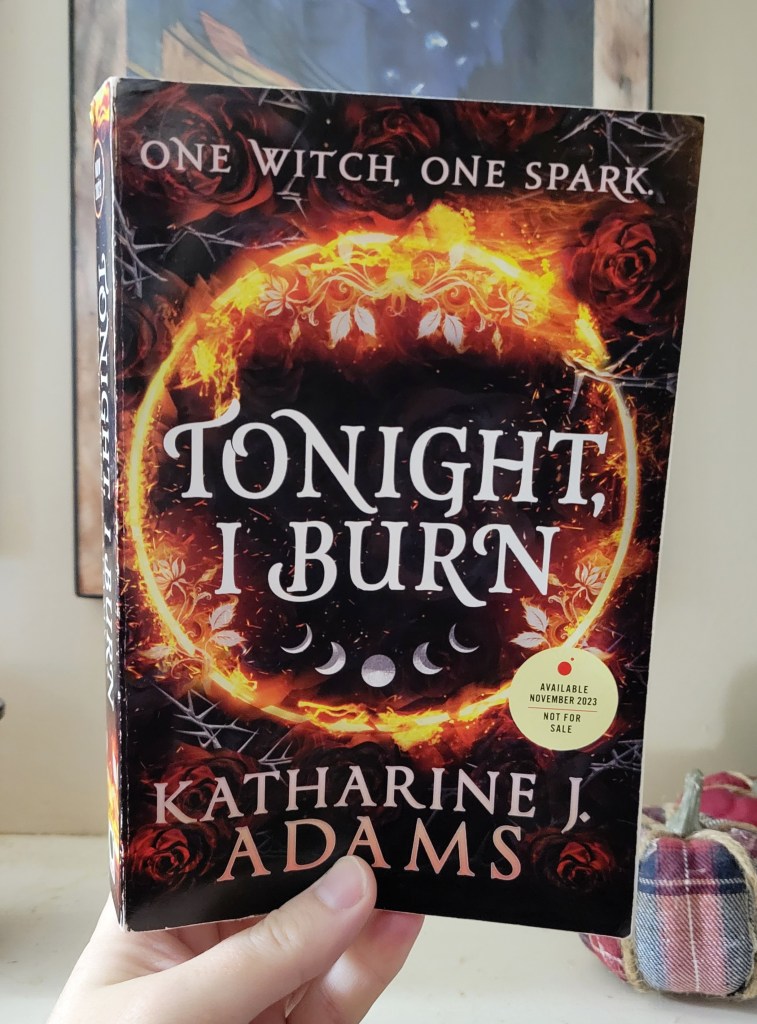
TONIGHT, I BURN – Katherine J. Adams

Katharine J. Adams’s debut novel, Tonight, I Burn, (Orbit – expected 7 Nov 2023) echoes with legends, fairytales and folklore that came before.  While I heard Hades and Persephone and Beauty and the Beast the most; I wouldn’t call this a retelling of either. Adams is a reader first, and it shows beautifully in her writing.  This was a very impressive debut, and I hope the spark carries to the second in the series, Tonight, I Bleed.

Penny is a thorn witch, third in line the throne.  While she remembers what life was like before the Warden, she’s spent more time under his control after he destroys all that was colorful and beautiful than out of it.  Her grandmother is under the Warden’s control.  Her father has become one of the Warden’s Gilded – a process that strips a person of their soul and binds them to the Warden’s command.  Her mother is just trying to keep her three daughters out of trouble and alive.

The Warden needs the thorn witches, Penny included, for they can walk the veil between life and Death – using their magic to weave his immortality.  Each night, a witch burns at the pyre and walks in Death.  If all goes well, the witch can cross back over the veil and return home to burn another night, but each walk into Death takes a bit of their soul.  Just before Penny is to have her first walk, her sister doesn’t return.  Penny will risk everything and break every rule to save her, and Penny walks into Death alone and in secret.  There, she makes a deal with a beautiful and dangerous man who awakes confusing feelings in her.

As she seeks to honor the deal that saved her sister but risked her soul, a rebellion is brewing – and Penny, with her rare obsidian crystal, is in the thick of it.  The Warden wants her as a pet because her talents exceed those of the average thorn witch.  The Resistance wants her because her dark crystal magic can forge the spell that can change their lives forever.

The romance is a bit clunky, but it takes backseat to parallel high stakes – the Resistance and the deal to save her sister – which I prefer.  Some aspects, particularly those involving Penny’s father, are rushed, but I imagine there will be more flesh to those bones in the second book of the series.  Overall, this debut far exceeded my expectations.

Read this book.

*A huge thanks to the publisher for gifting me this early copy!

NIGHT WATCH- Jayne Anne Phillips

“Her mother had named her the name he’d taken – her given name a version of her surname.  She was a hint, a riddle, a remembrance.”

Longlisted for the 2023 National Book Awards, Jayne Anne Phillips’s Night Watch (Knopf 2023) is a powerful historical novel that echoes with Faulkner but with a feminine energy that hums throughout the pages. Set during and just after the Civil War, the novel beautifully and painfully captures what war did not just to the men who fought it, but to the women left behind.

Twelve-year-old ConaLee has watched her mother become a shell of the woman who’d raised her.  She no longer speaks, no longer reads, and no longer plays with her daughter.  Not only that, she also does not care for the children she continues to birth, and it is ConaLee’s responsibility to care for the little boy called Chap and the twins who are never named.

A man came to their cabin after the war, insisting everyone call him Papa and making himself at home.  It’s not his first time at the cabin, but ConaLee was shielded from his first trip.  Over and over and over again, he pushes ConaLee’s mother, a woman once called Eliza, further inside herself as he uses and abuses her body.  He’s forbidden them from speaking with Dearbhla, the woman who’d raised both ConaLee’s mother and father, and there’s only so much her conjuring can do to save them after he gets his hooks in.  But Dearbhla doesn’t give up, and Papa is “convinced” to take ConaLee and her mother to the Trans-Allegheny Lunatic Asylum in West Virginia.  By the time ConaLee realizes the permanency of the situation, the other children have been given away.  The man called Papa instructs her that she is the caregiver of “Miss Janet”, and she becomes Nurse Eliza Connolly. He tells her then that he is not her father.  Mother and daughter attempt to rediscover their lives while under the protection of the Asylum, and ConaLee struggles to come to terms with the children she’d left behind that her mother doesn’t remember.

But the Asylum isn’t just a safe haven for ConaLee and her mother; her real father also calls it home.  As the novel unfolds, the reader learns the truth of who ConaLee’s father is, why he and Eliza fled with Dearbhla, and what happened to him during the war.

Night Watch is a novel of wreckage and resilience.  And while some things that are lost can never be reclaimed, ConaLee, her mother, and her father, all learn how to move forward despite the painful scars that mar their bodies, minds, and souls.

Read this book.                


*Thank you to the publisher for sending me not one but two finished copies. One will be added to my collection of favorites and the other will be sent out this week for another reader to enjoy.*

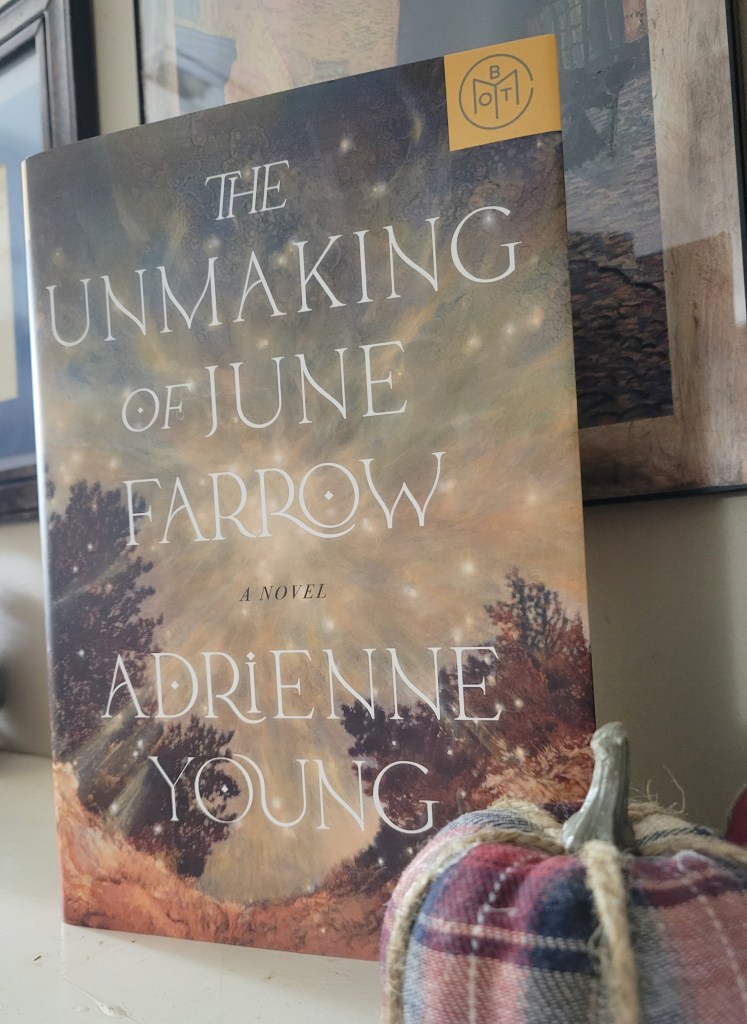
THE UNMAKING OF JUNE FARROW – Adrienne Young

I love magical realism.  I do not love time travel.  Admittedly, I should have looked into Adrienne Young’s The Unmaking of June Farrow (Delacorte Press 2023) beyond the magical realism and North Carolina setting BEFORE selecting it for my BOTM box, but I did not.  This novel has overwhelmingly positive reviews so take this for what it’s worth.

Despite being well-written, The Unmaking of June Farrow was painful to get through – namely because I felt deceived.  I wanted small-town North Carolina, magical realism, maybe a familiar or two, some sweet romance, etc.  Instead, I got a convoluted curse/magic system that makes no sense, a horse that could have had a larger role if Young had leaned into a bit more, and a couple of lukewarm romances or wannabe romances.  Oh. And a big part of the plot is told through memories of a time traveler traveling from a time before the time the “before her” traveled before.  Yeah.  I said what I said.

There could have been more tension between 2023 June and 1951 June – in particular between Mason and Eamon – but it’s all just blech.

 This one is a no.

I still ranked it high because I think this is a me issue – this just isn’t something I should have read.

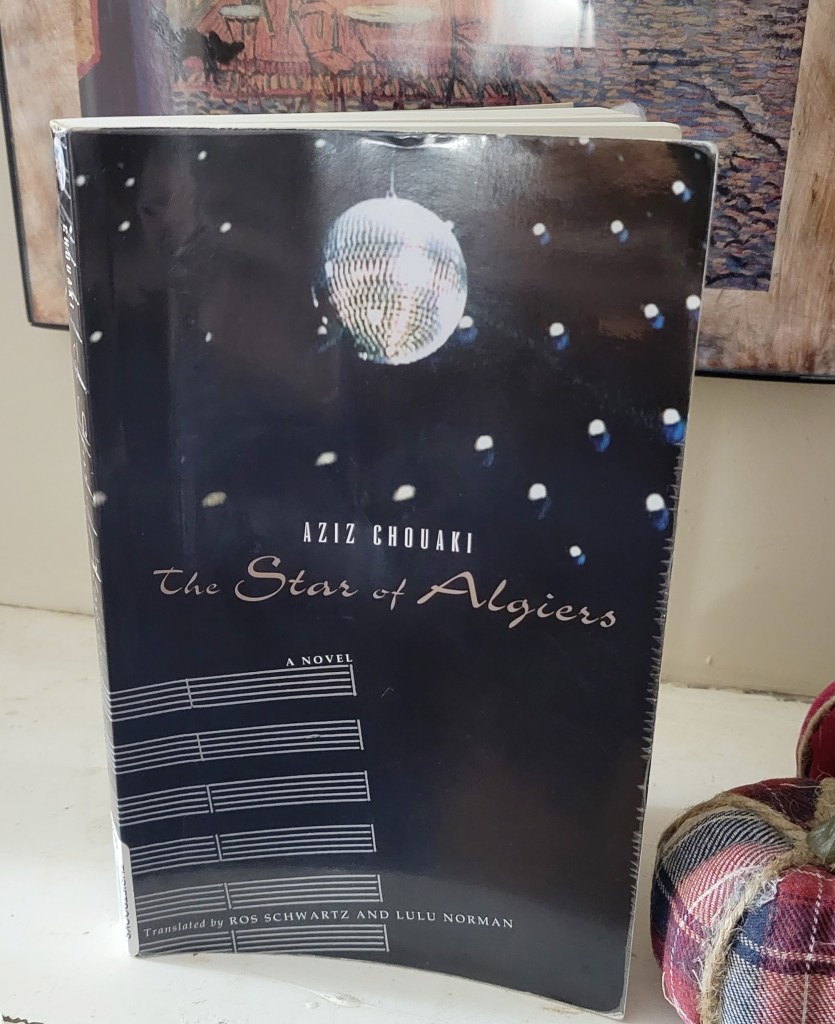
THE STAR OF ALGIERS – Aziz Chouaki

Next installment of Tommi Reads the World – still in the As.

Country: Algeria
Title: The Star of Algiers
Author: Aziz Chouaki
Language: French
Translator: Ros Schwartz and Lulu Norman
Publisher: Graywolf Press (2005), éditions Balland (2002)

Aziz Chouaki fled Algeria in 1991 due to the civil unrest and the placement of the author on an assassination list.  He died in France in 2019. It’s not a stretch of the imagination to recognize that Chouaki painted himself in the contours of singer Moussa Massy in The Star of Algiers; only Massy’s path is remarkably different as he was not able to escape.

Massy wants to be the Algerian Michael Jackson. He lives in a three-room apartment with thirteen other family members. His father doesn’t support his endeavors as a musician, one of his brothers is leaning into the fundamental Islamic group (FIS), one of his brothers is non-verbal autistic who enjoys mystery novels and cigarettes. He has to keep his relationship with his girlfriend a secret because he is in no position to get married.  He spends his waking hours performing or trying to avoid the Islamic brothers.

As the fundamental and progressive Islamic groups clash, Massy is struggling to make it as a musician.  He has a dream, and even though his world is going to shit around him, he’s going to chase it. He starts making a name for himself as the political situation worsens.  But a child born on April first and growing up in a country in turmoil was never going to shine bright for long; his musical career ends and he finds himself in a deep depression.  Those who can are escaping Algeria and encouraging him to do the same.  He tries, but hope is fleeting.  And when one dream dies, the star can die with it or set fire to the sky with a rage.

Set just before the “Black Decade,” which resulted in the deaths of over 200,000 Algerians, The Star of Algiers is a heartbreaking account of a boy with a dream who becomes the man hellbent on snatching stars from the sky.

STARTER VILLAIN – John Scalzi

Sometimes you buy a book strictly because of its cover.  This is one of those times.   Admittedly the cover should have an orange and white kitty on it, and this annoys me, but how fun is this?  I’ve never read John Scalzi before, but his brand of quirky SF is exactly the kind of candy book I need in rotation.  Starter Villain (TOR 2023) is just fun – from the beginning until the end.  Not only is it hilarious and ridiculous in all the best ways, it’s also extremely well-written. Scalzi also seems to recognize the limitations of his readers, or at least my limitations, and this short book is the absolute perfect length.

Our hero (or villain) is Charlie, a laid-off journalist who is recently divorced and trying to make ends meet by substitute teaching.  He lives with his cat, but his housing situation isn’t ideal.  (No issues with the cat. He adores that cat.) The novel opens with him learning his estranged and filthy rich uncle has died. Charlie makes note of it, but that’s it; he didn’t know his uncle and doesn’t really mourn.  Charlie heads to the bank to apply for a loan so he can purchase a local pub; owning McDougal’s is his singular dream.  While licking his wounds from a less than productive meeting at the bank, Charlie is approached by a young woman who had worked for his uncle.  She makes him a proposition – if he goes and stands at the funeral and meets the mourners, he’ll get a nifty little sum.  Not nearly as much as his uncle’s estate is worth and not enough to buy the pub, but a decent amount just for pretending to mourn a dead guy he doesn’t really remember.

Charlie quickly comes to realize his uncle was not just a parking garage mogul; Uncle Jake was a powerful and dangerous supervillain with a powerful and dangerous supervillain island lair, complete with talking spy cats and a unionized dolphin pod. And of course, every dangerous and powerful supervillain has a list of dangerous and powerful supervillain enemies, and since Charlie stood for his uncle at the funeral, they’ve set their sights on the presumed heir to Jake’s empire.

Starter Villain is an extremely quick read that is a lot of fun – in part because I think most millennials would respond to the news that their estranged uncle was a super villain and their housecat is a spy much the same as Charlie.

Read this book.

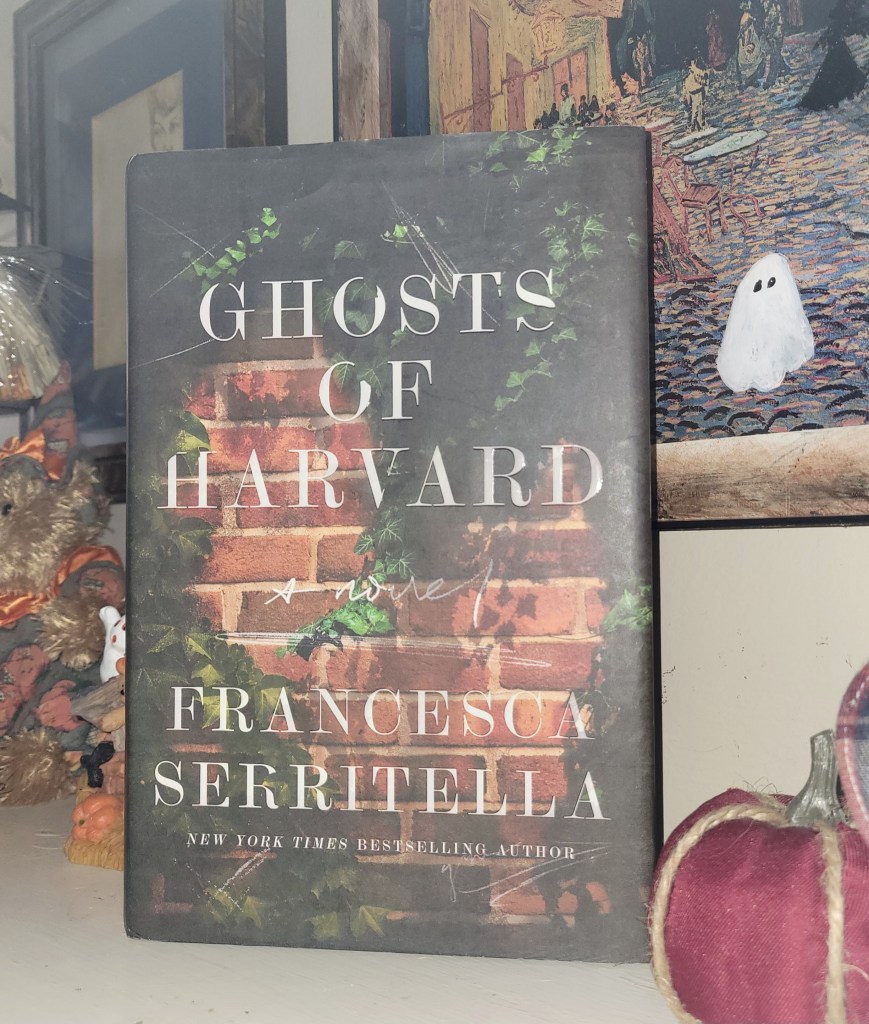
GHOSTS OF HARVARD – Francesca Serritella

“They were ghosts, after all, and happy endings don’t haunt anyone.”

Francesca Serritella’s Ghosts of Harvard (Random House 2020) is a rather ambitious work that suffers from trying to do too much.  There’s a lot of good things, but the ghost story, mental health awareness, and political thriller don’t always mesh that nicely in the novel – all three areas, which could have been strong backbones for the novel, suffer from sacrificing to the others.

Cadence Arthur’s brother, a brilliant student at Harvard, was diagnosed with schizophrenia and dies by suicide on campus.  He was a research assistant for a prominent (and beautiful) professor whose work was top secret and protected by the Department of Defense.  He continued to work with her as his illness, in particular the paranoia, worsened. Months later, Cadence, still cloaked in grief and guilt, enrolls as a freshman at Harvard – intent on finding what pushed her brother over the edge – figuratively and possibly literally. She begins hearing voices and begins to question her own sanity.

The ghost stories are my favorite – clearly Cady is chasing the ghost of her brother, but while doing so, she encounters the ghosts of a Harvard slave and two students.  All three help her, and she attempts to help them. She falls in love with one, but that isn’t fully explored and seems more of a plot device to make her relationship with another character a bit more palatable. 

In addition to these ghosts that protect, guide, and even do her homework for her, Cady is attempting to decode the notebook left by her brother.  Growing up, they’d created their own code and her brother would leave her missions to complete in the code.  She sees this as her final mission.  But is the mission born of his paranoia or was he really on to something that put him at risk?  The ghosts pretty much disappear when the political thriller takes over.  It reads with a madness that, if intentional, was genius – I just wish it had been more genre-blurring than genre-jumping.

It’s an interesting read, but it was just okay for me.  I really wanted to like it more than I did; there was so much potential with the ghost of the Harvard slave.

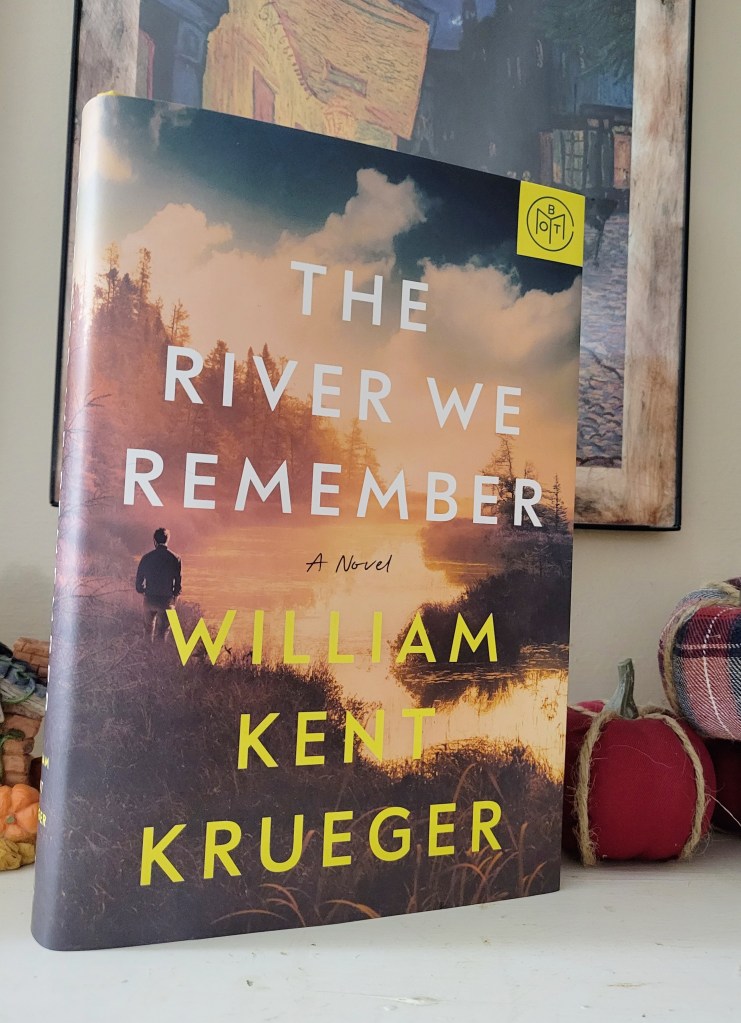
THE RIVER WE REMEMBER – William Kent Krueger

“Charlie Bauer doesn’t intend to leave this life filled with rancor or regret or plagued by the demons of if only. She intends to lie down in peace. 

And so, she sips her whiskey and reads her books and every once in a great while allows herself the pleasure of a cigar, and she awaits without fear her own passing, when she will be lowered into the soil of Black Earth County and laid to rest forever beside the moonlit, milk-white flow of the Alabaster, a river she remembers fondly as an old friend.”

William Kent Krueger’s The River We Remember (Atria 2023) flows like the river on which it is set; at times it is gentle and soft, while also being unpredictable and raging.  Like the river, the novel is brimming with life, death, and secrets – and it may prove one of my favorite mysteries.

On Memorial Day in 1958, while much of Jewel, Minnesota is at a parade to remember and honor those lost to war, the body of Jimmy Quinn is found in the Alabaster.  The catfish have made a snack of him, but it’s not difficult to determine the cause of death was a shot gun blast to the gut.  Suicide?  Accident?  Murder?

Powerful and wealthy, Quinn wasn’t a kind man.  There are many who’d love to see him dead. Sheriff Brody Dern would prefer it not be a murder.  But why?  Why does he wipe away evidence?  And why is everyone so quick to blame Noah Bluestone, a Native American war veteran who’d returned to Jewel with his beautiful Japanese wife after twenty years of military service? And why won’t Noah or his wife answer any questions related to Quinn?

The town drips with secrets – some are meaningless, but others would destroy lives.  While the novel centers on Quinn’s murder and the investigation surrounding Noah Bluestone, Krueger gives us some memorable characters who are all just a little bruised from the cards they’ve been dealt.  (Some carry the scars from the war on their bodies, others in their minds. Some have escaped abuse, and some are still hiding their bruises. Some have a hidden past as a sex worker. Some are having affairs. Some are lying. Some are stealing. Some are plotting. Some are suicidal. Some are alcoholics.)  My favorite is likely Charlie, a retired attorney who has spent her life in a male dominated field.  When Noah is arrested, she is appointed as his counsel – against his wishes.  Charlie, along with the retired sheriff, set out to prove Noah’s innocence despite his refusal to discuss what happened.

The novel reminded me a bit of Beartown and The Bee Sting – especially in the scenes with Scott and Del – and I thoroughly enjoyed it.  Despite Kruegar having published over 20 novels, The River We Remember is my first read of his.  While I enjoy a good mystery, I don’t read them often.  I may have to change that.

Read this book.