AN EVENING IN GUANIMA: A TREASURY OF FOLKTALES FROM THE BAHAMAS – Patricia Glinton-Meicholas

“Once upon a time, a very good time, Monkey chew terbakker and spit white lime, Bullfrog jump from bank to bank while Mosquiter keep up the time.”

Current installment of Tommi Reads the World – we’re in the Bs.

Country: The Bahamas
Title: An Evening in Guanima: A Treasury of Folktales from The Bahamas
Author: Patricia Glinton-Meicholas
Language: English
Translator: None
Publisher: Guanima Press Ltd 1993

This collection of folktales from The Bahamas is an absolute delight.  As someone who enjoys folktales from throughout the world, I enjoyed seeing how stories travel through time and space.  There is a heavy influence from West Africa, the African diaspora and African Americans, the American South, as well as a notable Scottish influence.  Glinton-Meicholas discusses these varied influences in her introduction, which is a must read.  I was also reminded of Russian and Asian works while reading the brief collection.  “The Gaulin Wife” certainly has echoes of the Japanese folktale “The Crane Wife” as an example.

Like most folktales, the lessons are the same: don’t be greedy, listen to your elders, don’t be a glutton, watch out for tricksters, and a melon don’t grow on a pumpkin vine. 

It’s certainly worth a read.

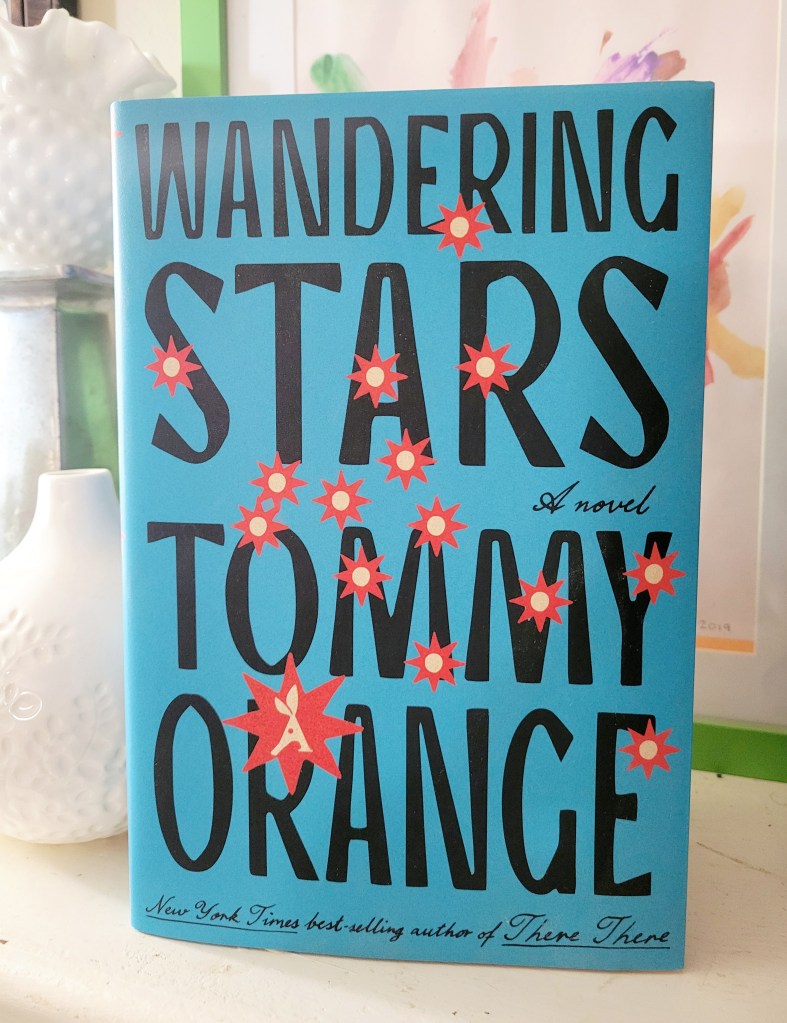
THERE THERE – Tommy Orange

“We are the memories we don’t remember, which live in us, which we feel, which make us sing and dance and pray the way we do, feeling from memories that flare and bloom unexpectedly in our lives like blood through a blanket from a wound made by a bullet fired by a man shooting us in the back for our hair, for our heads, for a bounty, or just to get rid of us.”

“Stray bullets and consequences are landing on our unsuspecting bodies even now.”

Tommy Orange’s debut novel, There There (Penguin Random House 2018) is a brilliant and raw novel of interwoven stories, all leading to the Big Oakland Powwow.   You may remember the middle grade Ancestor Approved collection of intertribal stories with the powwow as the linking element; this is the much more adult version of that.  Soaked and blood, tears, and alcohol, it drips with generational trauma, past and present assaults.  It echoes with the screams of the dead, dying and lost.  It gets under your skin, in your ear – the thrum of a drum in your heart as the sound of gunshots leaves your head ringing.  You feel this novel.  You taste this novel.  You breathe this novel.

Dene is making a documentary of untold stories, continuing a project started by his now dead uncle.  He intends to record stories at the powwow. Jacquie Red Feather, recently sober, is headed back to Oakland to claim her three grandsons from her sister, Opal Viola Victoria Bear Shield. Edwin, half-white, has just learned the indemnity of his father and starts an internship assisting with the powwow. Orvil Red Feather, one of Jacquie’s three grandsons, is planning to dance at the powwow – his longing for his heritage an unanswered cry within his family.  Blue was adopted by a prominent white couple as a baby; she’s head of the powwow committee. Octavio is a local drug dealer; Tony, Calvin and Charles work for him.  They intend to rob the powwow, which has advertised thousands of dollars in cash prizes.

The sections leading up to the powwow provide the strong and necessary character development that makes the powwow section, with its short bursts of stories, pierce the skin.  I’m not going to delve into what happens, but trust me when I say you should read this.  As for my favorite section,  it’s likely Opal’s as a child during the Occupation of Alcatraz Island – in particular, her conversation with her teddy bear.

Read this book.

JADED – Ela Lee

Ela Lee’s debut novel, Jaded, (Simon & Schuster 3/19/2024) is a sharp and raw depiction of the complete mind fuckery a sexual assault does on a person. Before getting into the review/reaction, I must stress that this novel is not for everyone, and it’s okay if you are not in the headspace to read it or if you have no desire to read it. It is okay.  If you are the victim of a sexual assault, I urge you to reach out for help.  You can speak with someone at National Sexual Assault Hotline at 800-656-HOPE (4673).

Jade is the biracial daughter of immigrants.  Jade is her “Starbucks name” because it’s easier than her actual name, which is Ceyda.  Korean and Turkish, Jade doesn’t quite feel like she “fits” anywhere, and she’s spent her life bending over backwards to be the “perfect” daughter, student, girlfriend, employee. Her hard work has paid off as she an associate at a prestigious law firm in London and she’s been in a steady relationship with a wealthy white man for seven years.  She is not only succeeding – she is thriving.  At least she is until a firm party where she is preyed upon by one of the partners – a man you can’t say no to, not if you want to keep your job.  He is hellbent on getting her pliably drunk. She is “saved” from these unwanted advanced by a colleague, who promises to get her home safely.  When she wakes up, her mind is fuzzy, her body is sore, there are bruises on her legs and arms, and she is bleeding such that she believes her period has started.  The assault comes back to her in flashes, and she begins to unravel. She starts having panic attacks, develops an eating disorder, avoids taxis,  has horrific nightmares, and continues to bleed from the vaginal trauma.  She feels unsafe in her home, at work, and even on the streets. Rumors circulate at work and eventually get back to her boyfriend that she had sex with a coworker.

Jade’s friends aren’t oblivious to her struggle; they just don’t know what’s wrong.  When she finally tells them, Adele tells her to report it and Eve tells her to just keep quiet and move on.  Eve, a true chameleon, has been molding, fitting, performing and using her body to advance her career for years – she takes the assaults, leers, comments, and gropes as just part of her job description, a necessary evil for advancement. Jade’s boyfriend is skeptical that she’s telling the truth and is, at times, angry, understanding, and dismissive. As Jade unravels, the reader sees just how toxic her relationship with him is, even before the rape – something it takes Jade a bit longer to realize. 

The novel also dances around the nervous condition of a biracial child of immigrants and the fractured relationship she has with her parents, and the disconnect she feels, in particular, with her Korean heritage and the unspoken generational trauma of her mother. Of note is the use of kintsugi. Jade knows how it’s become a “kitsch, insta-metaphor for embracing one’s setbacks or flaws.” But she also knows that her mother’s use of it stems from Japan having colonized her homeland and the need to make something that is broken functional.

Jaded does not flinch, does not sugar coat, does not bend. It’s a raw and biting portrayal that still sings with heart and hope.

The Sorrow of Belgium – Hugo Claus

“Times are bad, the radio says so, and the newspapers. No, things aren’t getting any better, far from it.”

Current installment of Tommi Reads the World – we’re in the Bs.

Country: Belgium
Title: The Sorrow of Belgium
Author: Hugo Claus
Language: DutchTranslator: Arnold J. Pomerans
Publisher: First published in Dutch as Het Verdriet van Belgie by De Bezige Bij in 1983, translation first published by Random House in 1990.

I hate to say it, but this well-renowned novel was 603 pages of a story I didn’t want to read – a story I forced myself to finish. While I think some things may have gotten lost in translation, especially as it relates to the use of the French versus Dutch language and the combination of the two, that’s not why this book was such a chore to read.  The novel is structured into two parts, with the first section having chapters and form and the latter morphing into a chaotic stream of events.  (The second half is actually when our protagonist Louis “writes” the first half.)  This annoyed some readers.  I wasn’t bothered by it, and I actually preferred the chaotic second half to the first.  For me, it was the story itself and its entirely unlikeable cast of characters that made this work such a slug.

The struggle for identity in Belgium, being torn between the French and the Flemish, during the second world war as seen from the eyes of an eleven-year-old boy sold me on getting this chunker as my Belgium selection.  Oh, how I wish I hadn’t.  I lost count of the number of sexual assaults in the novel – both on Louis and by Louis.  At the age of eleven, we know he’s been molested by a man who works for his father. We watch him molest two classmates (one he’s in love with) and a nun who has gone a bit senile. He forces himself on a female friend more than once, with the reader getting lengthy descriptions of what her “opening” looks like. (This particular part of the female anatomy is described quite frequently.) He is raped as a minor by his aunt, in great detail, and later by another much older woman. His issues with his mother are straight from Freud’s findings.  Add in some racism (including a scene where his mother cooks pork when her brother in law, a Jewish man, is in the home to ‘test’ just how ‘Jewish’ he is), suicide, suicidal ideation, a miscarriage, adultery, madness, sexual abuse, emotional abuse, and physical abuse and you’ve got the sorrow of this novel.

I did not enjoy this book.

THE FROZEN RIVER – Ariel Lawhon

“To name a thing is a proprietary act. It is a commitment. Of ownership or care or loyalty. It means something. With that single word I have declared that this little beast is mine, and that I have a responsibility to protect her.”

While the quote refers to a silver fox, the importance of names and those who provide those names is a constant in Ariel Lawhon’s The Frozen River (Doubleday 2023).  Set in 1789 Maine, the novel follows Martha Ballard, a wife, mother and midwife.  The novel opens with the birth of a baby and the discovery of a body.  Martha, as part of her duties as midwife, is called in to inspect the body and provide identification, if she can.  And she can.  It is Joshua Burgess, one of two men accused of raping the preacher’s wife.  From her investigation of the body, she determines he was murdered.  The other man accused of raping Rebecca Foster is Colonel North, the local judge who Martha will have to present her findings to.

Martha’s testimony and her staunch support of Rebecca have put her squarely in Colonel North’s line of sight.  When his attempts to bully her are unsuccessful, he employs other means to threaten her into silence – bringing her children into the investigation by accusing her eldest of the murder of Joshua Burgess.  As if the murder investigation and court proceedings weren’t enough, Colonel North has brought in some fancy doctor to dispute Martha’s findings and push her out of the community.  The doctor, full of pomp and misplaced confidence, had never delivered a baby prior to arriving.  As the loyalties of the town are divided, more women turn to him.  Much to their detriment.

The novel is inspired by the real Martha Ballard and an actual court case involving the rape of a woman.    Many of the diary entries that appear in Lawhon’s novel are from Martha’s diary, her brief observations serving as evidence and historical record.  Lawhon explains in her note that the actual case involved three men over the course of several days, but she elected to make it one day and only two men for both her sake and that of the reader.

Frozen River is a fantastic novel, both in the story itself and in the storytelling. 

Read this book.

AKATA WARRIOR – Nnedi Okorafor

“Let the reader beware that there is juju in this book.”

Nnedi Okorafor’s Akata Warrior (Viking 2017) is the second installment in the remarkable middle grade Nsibidi Script series that has been dubbed the Nigerian Harry Potter.  If you read my review of the first of the series, Akata Witch, you’ll note that I don’t like that comparison because I think it does Okorafor and her characters a disservice.  

Akata Warrior opens two years after the events of Akata Witch. Sunny, an American-born albino Nigerian girl, is still developing her magical powers and spending a lot of time with and learning from her friends and Oha coven: Orlu, Chichi, and Sasha.  She is also learning a lot from her mentor, Sweet Cream.  And while Sunny is more connected to her magical side in this novel, connections with the Lamb side are pretty non-existent.  One of the conflicts I really enjoyed in the first novel was the disconnect with her dualities – American but Nigerian. Black but albino. Magical but a free agent. That tension, while not resolved, is not present in this second installment.   There is some tension with dualities as it relates to her spiritual mask and doubling, but even that seems a bit hollow.

While I still adore Sunny and everything about the Leopard society, this follow-up was a bit of a disappointment.  It seems to suffer from somehow doing too much yet not enough.  It needs to be shorter and tighter.  I want that tension and drama and high stakes oozing from the pages.  There is drama, for sure.  Sunny violating Leopard society rules to help her brother whose found himself in a dangerous gang and the resulting punishment? Honestly, that could have been the novel because that was thrilling.  Sunny’s battle with the masquerade?  Brilliant.  The meeting with the spider? Entirely captivating.  And the lake monster?  My one complaint there is that I didn’t get enough of Mami Wata.  (I know she isn’t mine, but when she shows up in literature, it brings me instant joy.)

Will I read Akata Woman? Is water wet?  Absolutely I will.  The second installment may not have lived up to the first, but this is a phenomenal middle grade fantasy series and I will see it through.  (Plus, I have to see how the coven handles what happened in Akata Warrior and the secrets that are being revealed in Akata Woman.)

Read this series.

BLOOD – Sunil Gangopadhyay

Next installment of Tommi Reads the World – we’re in the Bs.

Country: Bangladesh
Title: Blood
Author: Sunil Gangopadhyay
Language: Bengali
Translator: Debali Mookerjea-Leonard
Publisher: First published in Begali as Rakta by Biswabani Prakashani 1973, translation first published by Juggernaut Books 2020

Sunil Gangopadhyay’s Blood could have served as either my selection from Bangladesh or India.  As Gangopadhyay was born in what is now Bangladesh and wrote in Bengali, I’m counting Blood as the selection for Bangladesh.

Blood wasn’t translated into English until decades after it was written, and that is a bit of a shame because it is an extremely captivating post-colonial novel. 

Tapan grew up under British imperialism.  When he was a small child, his father killed a British colonial official.  Whether an act of personal revenge for what had happened to Tapan’s uncle or an act of revolution, the murder of the British official forever altered Tapan’s life. His father did not survive the events and his family was forced to flee. Tapan spent all of his time, energy and resources trying to claw his way out of India and into a better life.  He finds success in America and is determined to never return.

Tapan has a rootless existence that is commonly seen in post-colonial lit and children of the diaspora.  This rootlessness is making him physically ill. While in England for a brief layover before heading to India for a wedding, he begins seeing Alice.  He selected her over her friend because Alice was a prettier name than Barbara. (He’s not a good guy.) He didn’t know at the time that she’d not only spent a portion of her childhood in the hometown he’d fled, but that her father was the official his father had murdered.  A picture of both men, prior to the attack of course, hung in her flat.  Tapan becomes consumed with a rage he cannot define and redirects it toward Alice. (I disliked both Tapan and Alice pretty equally.)

A small volume that packs a punch, it’s a novel of the scars of colonization, the ties to the land we call home, racism, and guilt.  It’s a novel of blood – that which is shed and that which runs through our veins.

Read this book.

THE BERRY PICKERS – Amanda Peters

“…lost in a memory stirred alive by the moon.”

Amanda Peters’s debut The Berry Pickers (Catapult 2023) is a quiet triumph of a novel about grief, anger, loss, identity, and forgiveness.  When I was a child, I asked for The Face on the Milk Carton for Christmas. (It’s one of a few books I remember receiving, right down to the tissue paper in the box.) If you’re not familiar, this middle grade book is about a young girl who sees her own face on a milk carton and the truth of her identity is then uncovered. The Berry Pickers brought this beloved middle grade book to my mind as both Ruthie and Janie have similar experiences, but Janie is found when she is 15; Ruthie isn’t found until she’s 54 – there are five decades of anger, confusion, lies, and a family that never gave up hope.

In the summer of 1962, a Mi’kmaq family arrives in Maine from Nova Scotia to pick blueberries.  They come every summer, working the same fields for the same man.  That summer, Joe is six, and the baby of the family, Ruthie, is four. Joe is the last to see her, and his life is forever scarred by that summer day he left her on the rock. The police won’t help them look because she’s Mi’kmaq.  The landowner tells them they have to start picking and stop looking – it’s a real shame about your girl, but I’ll hire someone else if you don’t get to picking.  They look for her for years, scanning the woods for bones and the faces of strangers for her eyes.  They never give up.

In Maine, Norma grows up the very sheltered only child of an affluent judge and his peculiar wife.  She’d come after a series of miscarriages and believed herself surrounded by ghost siblings.  She dreams of the moon, and a brother named Joe.  She dreams of her mother. She has an imaginary friend named Ruthie.  Her dreams give her mother intense headaches, and Norma learns to push what she’ll eventually learn are memories to the dark corners of her mind.  But she still can’t help but wonder what her parents aren’t telling her.  She decides later that she was adopted, and that her birth family simply didn’t want her.  She has no inkling that she’s Mi’kmaq or that she was stolen.

The novel follows Joe and Norma as they grow up.  Joe is filled with a guilt that should never have been his to carry.  That guilt breathes fire into his anger, and he leaves his family before his anger burns them. When the novel opens fifty years after Ruthie vanished, he’s surrounded by what’s left of his family and dying of cancer.

The novel excels in quiet moments & brief images.  A name added to the family Bible.  A doll made of socks still waiting for a little girl to come home. A stump. Nancy Drew and Louis L’Amour.  The moon.  It tastes sweet, sour and sticky on your lips – like a berry picked fresh from the bush, still warm from the sun. 

Read this book.

*Thank you to publisher for gifting me this finished copy.

LADY TAN’S CIRCLE OF WOMEN – Lisa See

“Do you need a man to confirm what your body is already telling you to be true?”

Set in 1469-1511, Lisa See’s Lady Tan’s Circle of Women (Scribner 2023) is a remarkable story of a high-status woman doctor, her midwife best friend, and an assortment of women from whom she draws strength, courage, and good health. See isn’t using the novel to push any sort of agenda or provide any health advice; she’s simply telling a fictional story (and a very good one) inspired by the life of a young girl from an elite family who became a doctor who treated women.  I’m also not here to provide commentary on the medicine and remedies Lady Tan uses, but I will say that there’s a reason that traditional Chinese medicine still exists.

When Tan Yunxian is eight, her mother dies from an infection of her bound feet. Yunxian serves as the go between with the doctor who cannot lay eyes on Respectful Lady, which is what her mother is called. He asks questions and Yunxian relays her mother’s answers.  She is a child and far too young for the task, but Respectful Lady refused to allow Miss Zhao, Yunxian’s father’s concubine, to serve in the role.  Respectful Lady, never properly diagnosed and never properly treated, dies.  As Yunxian grows up and learns more about the ailments that women can suffer from, she realizes that the infection was a symptom of another problem; her mother was extremely depressed and suicidal following the death of her two older children.  It is her mother’s death that introduces Yunxian to a world she would have otherwise never been privy to; her paternal grandparents are doctors, both of them.  Her grandmother is one of a few female doctors who treat women.  She works closely with a midwife because there are limitations to what she can do as it relates to blood.  Midwives do the so-called dirty work and society looks down on them for it, but they can become extremely wealthy from the work.  In addition to delivering babies, they also are called to testify as to whether a girl’s virginity is intact, and they are used for autopsies.  The midwife that works closely with Yunxian’s grandmother has an eight-year-old daughter named Meiling.  Despite their many differences, especially differences in status, the two become lifelong friends.

Yunxian continues to study under her grandmother, even as her marriage is arranged.  After she is married, her mother-in-law insists she stop her education and no longer treat women and girls.  She is not allowed to see Meiling.   The sadness that had haunted her mother begins to also haunt her.  In time, she is allowed to see Meiling and be treated by Meiling.  She also resumes her studies and begins treating women and girls.  When she encounters a dead body, a mystery unfolds that will take years to solve. 

While I became extremely frustrated with the chokehold her mother-in-law has over her and the treatment of Meiling, once I reminded myself of when this is set, I became more amazed at what Lady Tan accomplished.

Read this book.

YOURS TRULY – Abby Jimenez

“Because love shows up.”

I’ve said it before, but I’ll say it again – I rarely read romance, but when I do I want romance that is cleverly written and pulls you into a warm hug.  That’s Abby Jimenez all the day long.  Yours Truly (Forever 2023) is only my second Jimenez novel, but I feel confident in saying I love her romcoms. Just like Part of Your World, Yours Truly is cheeky, laugh so hard you snort, with *real* characters and *real* issues.  I devoured it in one sitting – much like I would a red velvet cupcake. 

What makes Jimenez so brilliant, imho, is that she understands the genre and how tropes work within it, but she shifts it just a tad so that the tropes never silence her story or overwhelm it.  Her novels are full of common romance tropes, and she knows it.  Her presentation of the tropes and how the tropes work within her storytelling is part of why I call her work cheeky, but it’s also what makes it real.  And so readable.

Yours Truly brings us back to Alexis’s hospital with one of her good friends, Dr. Briana Ortiz, and the new ER doctor, Dr. Jacob Maddox.   Jacob is having a rough start of it as an alarming number of his patients have died on his first day, and he hasn’t made any favorable connections with the staff.  He is socially awkward and anxious.  Briana hates him.  But not for long.  They become friends, exchanging possibly some of the most disgustingly sweet letters that let the reader watch them fall in love with each other before they even realize it.

Briana has issues stemming from her father’s abandonment, her ex’s affair, the finalization of her divorce, and her brother’s declining health and increasing depression.  Her trust issues threaten to derail this fragile and intense relationship she’s building with Jacob.  Jimenez is going to give you your happily after all, but she’s going to make you and her characters work and continue to work for it. Life’s not perfect, people aren’t perfect, and asking for help is okay. How she uses journaling and therapy (and pets!) as mental health maintenance for her characters and doesn’t offer quick and immediate “fixes” is simply refreshing.

I’d likely read anything Abby Jimenez writes, including her grocery list, which I’m pretty sure I have read… ha! If you’re not following her on the socials, you should.  Much like her books, she’ll hit you in the feels and make your snort milk out of your nose.

Read this book.