AFTER SAPPHO – Selby Wynn Schwartz

“Those were the stories we were given.  When we were children, we learned what happened to girls in fables: eaten, married, lost. Then came our bouts of classical education, imparting to us the fates of women in ancient literature: betrayed, raped, cast out, driven mad in tongueless grief.”

My Booker 2022 longlist reading journey is nearing its close (I only have Treacle Walker left after this!), and it’s been a lot of fun.  I may add the National Book Award longlist to my reading goals this year, but I’ll certainly be doing Booker again.  Book 12 of 13 for me was Selby Wynn Schwartz’s After Sappho (Galley Beggar Press 2022), a novel of moments and persons, a blend of fact and fiction, and political poetry. 

The fragmented seductions and brilliant glimpses into early feminists are a triumph, but the lens is solely Euro-centric and seemingly lacking.  I was initially very seduced by a lyrical history of women seeking control of their own lives, but it grew repetitive and lost its luster.  Much like many a woman lost Lina’s attention, so the novel lost mine.

Stylistically, the novel is intriguing.  The women it chronicles, weaving in and out of lives and faces with ease, are historically important.  The role of literature and fiction, and a women’s role within the literary world, are written into this work with a lot of passion and cheek, but also a lot of sarcasm and drollness.  This is a difficult review to write because I can’t quite put my finger on why it so quickly lost my interest having held me quickly captive.

Should you read this book?  I have no idea, and I can’t decide if I’d recommend it or not.

Booker Count: 12 of 13

THE MAGICIAN’S DAUGHTER – H.G. Parry

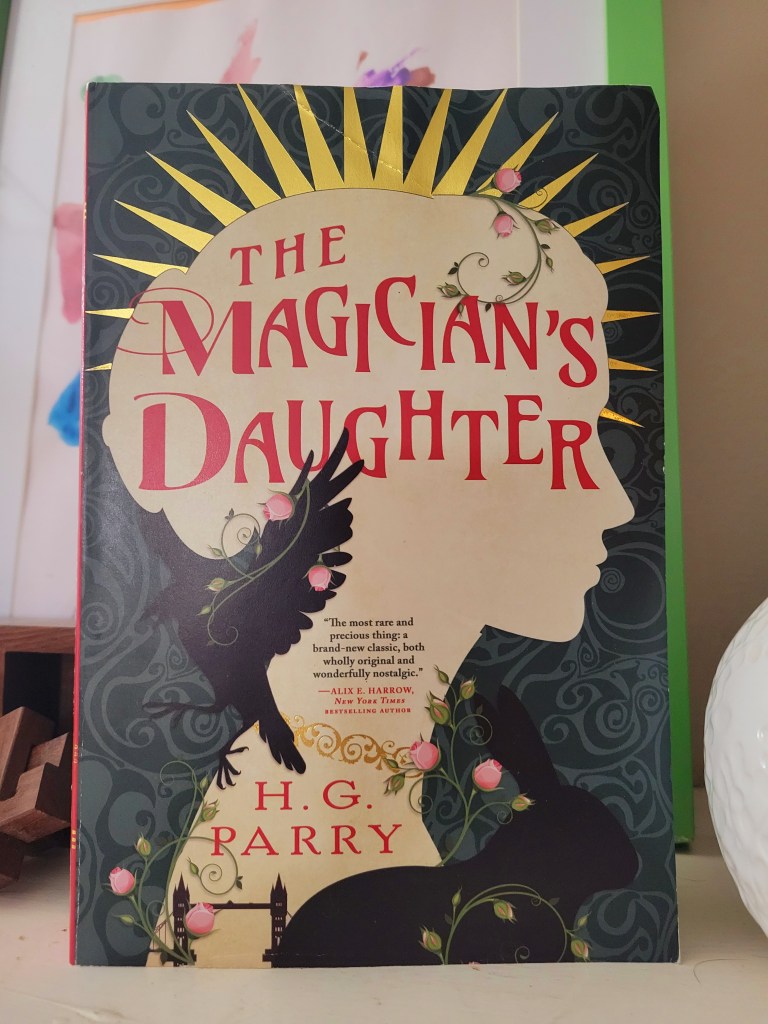
H.G. Parry’s The Magician’s Daughter (Redhook/Orbit 2023) is a very sweet, fairytale of a fantasy. The book will release on 28 Feb 2023, and I owe a huge thanks to the publisher for getting this early copy to me.  I greatly appreciate every book that comes my way.

Before I get into the review, can we talk about the cover?  Because it’s so positively literary and Victorian, and it’s absolutely perfect for the novel.  I just love it.  I want a print of it for my book room.

Biddy grows up on Hy-Brasil, an island full of magic and hidden from the world.  She’s raised by Rowan, a mage, and Hutch, his rabbit familiar.  Rowan possesses a ravenstone and can turn into a raven.  He spends countless nights on dangerous missions that Biddy is not privy to.  Biddy’s only real adventure comes from her books, of which she has plenty.

Rowan is a Robin Hood of a mage, stealing magic from the Council to give to the needy.  As his efforts grow more dangerous, Biddy’s life on the secret island becomes threatened.  Biddy isn’t a mage, but there is something magic within her.  It’s only a matter of time before she’s found.  Rowan decides to strike first.  A ruse is crafted to flesh out the Council members and figure out the magic in Biddy.  Biddy agrees to serve as bait, which proves quite the adventure as she’s taken from the island to the Rookwood Asylum for Destitute Girls, where she serves as a teacher.

Will the ruse work?  Can Rowan win against the Council? What does the magic in her heart mean, and who put the spell there?  And what will happen when it’s unlocked?

The Magician’s Daughter certainly brings other fantasy books to mind.  In some aspects, it’s Babel but make it a fairytale and not a bloody rebellion. In some, it reminds me of Harry Potter – the relationship between Morgaine, Rowan and Storm is very much an alternate universe of Lily, James and Severus.  Because this is a common story, echoes of those that come before are hard to ignore.

I wanted more character development. More magic. And more familiars. The sweetest relationship is between Hutch and Rowan, and we simply don’t get enough of the mage and his familiar.  This is Biddy’s story, and I couldn’t really connect to her.  But, oh how I loved that rabbit.

THE SEVEN MOONS OF MAALI ALMEIDA – Shehan Karunatilaka

“All stories are recycled and all stories are unfair. Many get luck, and many get misery. Many are born to homes with books, many grow up in the swamps of war.  In the end, all becomes dust. All stories conclude with a fade to black.”

“I was there to witness.  That is all. All those sunrises and all those massacres existed because I filmed them. Now, they are as dead as me.”

“Monsoons and full moons make all creatures stupid, especially silly boys in love.”

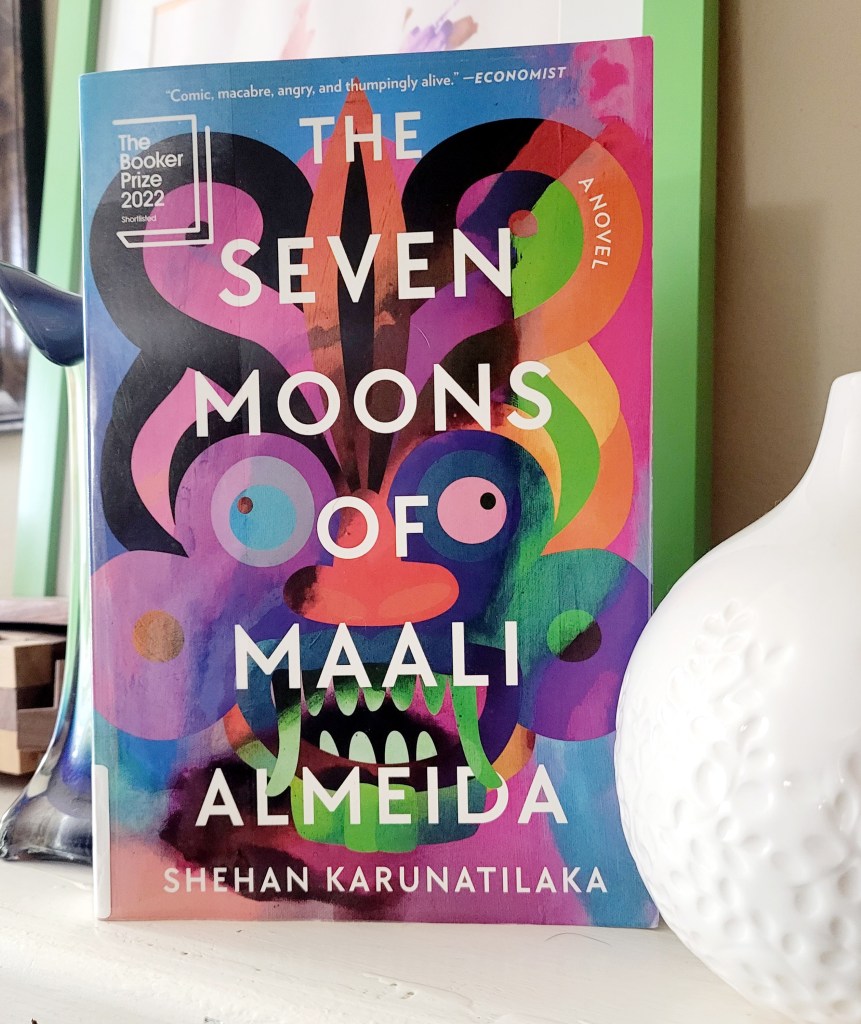
I’m still working my way through the 2022 Booker Longlist, and I finally got my hands on the winner.  Shehan Karunatilaka’s The Seven Moons of Maali Almeida (W.W. Norton & Company 2022) was well-deserving of the prestigious award.  While it may not have been my favorite of the bunch (Glory and Trust remain my top selections), it certainly comes close.

The novel is told in second person, a choice that is not only perfect for this ghost story, but is brilliantly executed.  The novel is also unapologetically cheeky (with Maali as your lead how could it not be?) while also devastatingly brutal as it chronicles the Sri Lankan civil war.  I read a review that mentioned Patrick Swayze’s Ghost and that’s an easy reference point that will quickly give readers from the western world an idea of the plot.  I’d say it’s All Dogs Go to Heaven meets Ghost meets Sri Lanka – and it’s near perfect.

Maali is (or was) a photographer, chronicling the atrocities within his country and selling them to the highest bidder.  He pledged no allegiance and pled the neutrality of a journalist when questioned.  A gambler with a chip on his shoulder when it comes to his parents, Maali has a love of pretty boys and isn’t exactly the most faithful of lovers.  From behind his camera, he has captured atrocity after atrocity. And his pictures are reason enough for someone to want him dead.  But who did it?  Who killed Maali and how can he exact revenge?

Maali has seven moons to find out who killed him and get his photographs in the hands of his best friend and her pretty boy cousin he’d loved the only way he could love.  The photographs have the potential to shine a light on Sri Lanka so bright that the rest of the world can’t just ignore it as they have been.  While he struggles to remember the events leading up to his death, he meets a fellow ghost who can whisper to the living.  But it comes at a cost, and a battle ensues over Maali’s soul during the seven days he’s been given to sort it out before going to The Light or joining Mahakali, the goddess of death and destruction.

It’s a beautiful novel about a beautiful boy who became a beautiful ghost and never stopped bearing witness.

(As of today’s date, homosexuality remains criminalized in Sri Lanka.  The government as recently as yesterday has stated they will support decriminalization and have encouraged introduction of a bill to that end.)

Booker count: 11 of 13

CASE STUDY – Graeme Macrae Burnet

“Perhaps it’s half truth, half fiction. But the real truth – the important truth – is that on this day, in this room, this is the story you chose to tell. Even if there is not an ounce of veracity in what you told me, that would still be true.”

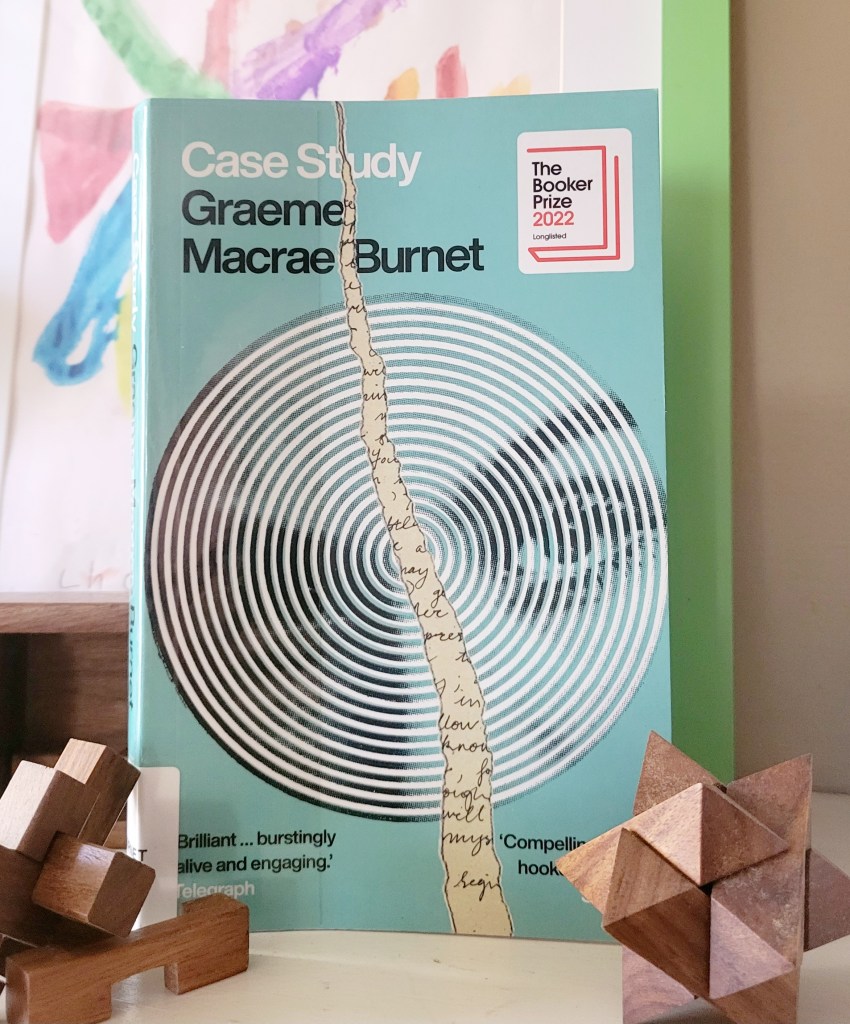
That quote pretty much sums up Graeme Macrae Burnet’s Case Study (Saraband 2022), which was longlisted for the 2022 Booker Prize.  The novel is a cheeky little thing, playing fast and loose with the reader when it comes to what is true and what is fiction.  At times, it runs the risk of thinking it is cleverer than it is, but it never really crosses that line.  Structurally and thematically, there are a lot of similarities with Trust, another 2022 Booker book.  I loved Trust – to me, it excelled with that story within a story and what can a person actually trust is true.  I’m honestly surprised they both made the list.

The long and short of Case Study?  An author with the initials GMB (cheeky, much?) is writing a book on the 1960s psychotherapist Collins Braithwaite, known for his questionable practices, lack of license, and book “Kill Your Self.” He receives an email from Martin Grey, a cousin of a woman who had been treated by Braithwaite and kept notebooks.  He offers GMB the notebooks.  What follows is pulled from GMB’s research and the notebooks, which are narrated by an anonymous woman.  This woman adopts the name Rebecca Smyth when she begins to see Braithwaite because she does not want him to know who she really is.  She’s really a former patient’s sister.  This unnamed narrator blames Braithwaite for her sister’s suicide, and she begins to see him as part of her “investigation.”

By the end of it, the reader is left with a questionable and slippery grasp on the truth.

Read the book.  I preferred Trust, but it’s worth a go.

Booker count: 10 of 13

THE MOST LIKELY CLUB – Elyssa Friedland

Elyssa Friedland’s The Most Likely Club (Berkley 2022) is a fun little romp about a group of childhood friends in their early forties who’ve realized life didn’t quite turn out as they imagined when they were on the cusp of adulthood.  The novel alternates between the four friends, Melissa, Tara, Priya, and Suki  – a group who, despite life and distance, have remained friends.  Imagine Sisterhood of the Traveling Pants but add twenty-five years.

At their 25th reunion, the women revisit the high school superlatives that had been bestowed on them by their classmates.  Only Suki has realized the success imagined when they were 18, and she’s too busy to even go to the reunion.  The other three women decide it’s not too late to accomplish those young adult dreams, or at least get back on the paths they envisioned.  With the superlatives as their guide (and a little booze to ignite them), they form the Most Likely Girls.  They will lift each other up, and accomplish great things.  But as Tara, Melissa, and Priya set out on their respective rocky paths forward, Suki’s world threatens to come crashing down.

It’s a fun novel about friendship between women.  Easy comparisons would be Sex and the City, Jennifer Weiner’s Little Earthquakes, and the more recent, Wahala by Nikki May.  These three all focus on the individual women and the collective group of friends, much like The Most Likely Club.  Friedland’s novel is not as snarky or posh as Sex and the City, not as thriller-y as Wahala, and not as powerful as Little Earthquakes, but it still scratches an itch for a candy book that isn’t just fluff.

There are some heavy subject matters with questionable treatment in the novel (sexual assault, grooming of a student by a teacher, body dysmorphia, eating disorders, breast cancer), but the novel never pretended to be something that it wasn’t – and that was a light read about friendship and how it’s never too late to chase one’s dreams.

Read this book. 

QUEEN OF THIEVES – Beezy Marsh

“After all, gangland was a man’s world.
That’s what they thought.
But us women, well, we knew different.
This is our story.”

Oh, what promise the prologue to Beezy Marsh’s Queen of Thieves (William Morrow 2022 – Originally published in Britain by Orion Dash 2021) held.  Oh, what a roaring disappointment.

The premise is great.  Inspired by a real life gang of women who ruled London after WWII, Queen of Thieves follows Alice, the leader of this all-female gang, and Nell, a young woman who joins the Forty Thieves after she finds herself unmarried and pregnant.  The novel alternates POV between Alice and Nell, with the meat of the story taking play June 1946 – March 1947.

Led by Alice, the group of girls steal from upscale department stores.  It’s a pretty detailed operation with multiple moving pieces, and a necessary loyalty built in.  The loyalty is due in part to fear – Alice has no qualms about carving a person’s skin up with her razor, lovingly named Ms. Tibbs.  When Alice sees Nell, she sees the possibilities.  Nell looks innocent and is clearly pregnant.  The department stores and cops were making the life of crime a bit more difficult, and someone like Nell would bring new opportunities.  The idea of money that could support her and her unborn child is appealing to Nell, and she gets a thrill from stealing.  She joins the Forty Thieves.

I wanted to love this novel.  I really did.  I think not focusing on Alice and her brother was a misstep, because there is a better story there.  I also think it could have used a content editor.  The writing is sloppy, and the characters are poorly defined, inconsistent, and often little more than caricatures.  (I couldn’t help but picture Daniel Day Lewis for Gangs of New York as Alice. haha)_The timeline is entirely unrealistic and clearly in error.

Nell is two months pregnant in June.  In June, she is sentenced and begins serving six months in jail.  She indicates that she is due at Christmas.  That tracks, the baby should be born about the time she is released.  She goes into labor in November.  She has the baby in February, while she is still in jail.  So, her six-month sentence became eight, and she was in labor from November to February.  In the month of February, she has a child, keeps the child with her for two weeks, gives the child up, and is released from prison two weeks later.  It is still February.  Still in shortest month of the year, she rejoins the Forty Thieves and gets sent on a job to Soho, where she auditions for a spot at a club and starts working.  It is still February.  She has sex in March twice and gets pregnant.  Again.  That baby is born in the Epilogue “just in time for Christmas 1947.”

Things like this are even more frustrating when there’s a good premise behind the book.  London’s gang of all women deserved so much better.

There is a published sequel; however, I will not be reading it.

DEMON COPPERHEAD – Barbara Kingsolver

“She liked to tease me that if we lived to a hundred, she would still be the one to get there first. Which was true. No credit given for all the extra miles that take you nowhere.”

Charles Dickens and his beloved David Copperfield inspired the phenomenal Barbara Kingsolver (I mean, have you read Animal Dreams or The Poisonwood Bible? Just brilliant.) to write an American bildungsroman that may be one of the best books I’ve read in a very long time.  Demon Copperhead (HarperCollins 2022) is devastatingly gorgeous and magically brutal in the same breath.  Set in Appalachia in the 1990s, smack dab in the heart of the opioid crisis, this novel leaves blood and grit in your teeth but hugs your heart something fierce.

Demon Copperhead was born to a teenage addict, and the novel opens with his birth.  As he is looking back on his childhood with his mother, there’s such an openness and forgiveness in his words and memories.  There are some things he won’t forgive her for, but the love he had for his mama, the mark she left on his life if nowhere else, leaves a mark on the reader.  And that’s Demon.  That’s how he sees those around them – with a light.

It’s a heartbreaking read about a very hard subject, but Kingsolver treats her characters, through Demon, with a respect that we haven’t seen in some other works centering on Appalachia.  This isn’t Deliverance or Hillbilly Elegy – this is a love letter to a place and a people who had a tough fucking row to hoe.  It’s also not trauma porn, despite a lot of trauma.  (The difference between Demon Copperhead and Betty is that Demon Copperhead is character driven and Betty is trauma driven.)

Demon is such a Dickensian character and is beautifully and completely rendered.  His voice is consistent throughout the novel, never losing its shine, and it will ring in your ears as if he were right next to you.  Charles Dickens had a favorite, and it was David Copperfield.  I have a favorite, and it is Demon Copperhead.

Read this book.

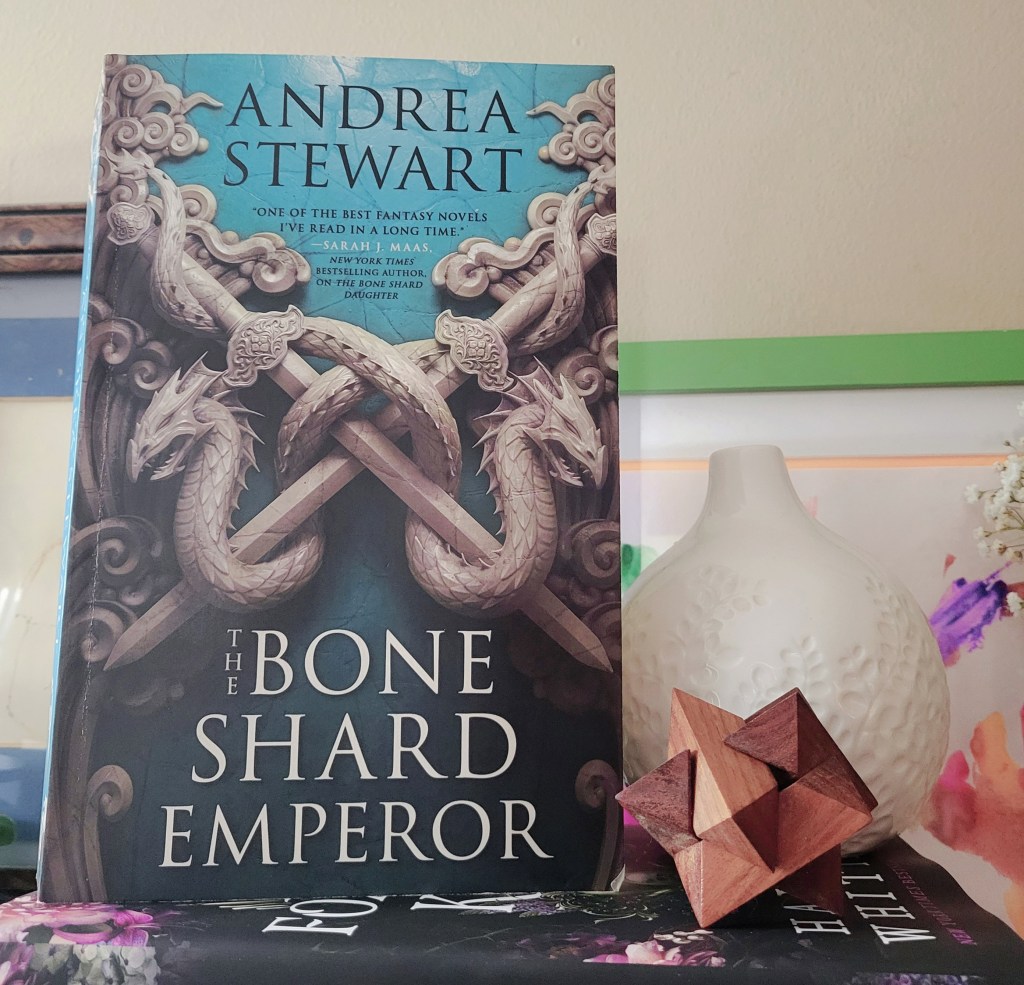
THE BONE SHARD DAUGHTER – Andrea Stewart

Orbit Books recently sent me Andrea Stewart’s The Drowning Empire trilogy in anticipation of the release of book three in April.  (A huge thanks for the gifted books!)  The first of the trilogy, The Bone Shard Daughter was released in 2020 and is Stewart’s debut. 

Holy smokes, what a debut.

The Bone Shard Daughter is Frankenstein meets Sir Kazuo Ishiguro meets epic fantasy – and the result is unique, delightful and all Stewart.  Where this novel excels is not only in its distinctiveness and world building, but in character development; there is so much heart and humanness to Stewart’s cast of players that they write themselves on your skin like family.

The novel follows Lin, the Emperor’s daughter, Jovis, a smuggler, Phalue, the Governor’s daughter, and Sand, a woman who lives her days on an island collecting mangoes and trying to remember life before the island. 

“Father told me I’m broken,” is the first line of the book.  Lin has lost her memories following a sickness.  She is to inherit the empire, but she must remember first.  Her father has brought in a foster son, Bayan, who he is training to take over the empire should Lin fail to recover.  The empire that is her legacy is one of bone shard magic and constructs.  In order to protect the citizens from the return of the Alanga, every child is forced to “tithe” a shard of bone from their skull at an annual festival.  Some don’t survive.  Those who do survive wait in dread for the day their shard is placed in a construct, and they become “shard sick” as their life drains unnaturally away to power the construct.  Constructs are crafted from parts of animals and sometimes humans.  Commands are etched on the shards and implanted in them.  Through the constructs, the Emperor rules his kingdom.  They do all the work while he stays behind locked doors, tinkering on private projects in rooms Lin cannot access.  Lin is the most artfully developed of characters.  From feeding nuts to the constructs to craving her father’s approval, Lin is a beautiful character.

Jovis is a smuggler and wanted by the Emperor, among others.  While on an island to engage in some illegal trading, he finds himself agreeing to save a child from the Tithing Festival. It’s good money, and he needs money to fund his quest to find out what happened to his wife.  While fleeing the island with the boy in tow, he saves a creature from the water.  The boy names it Mephisolou, after a sea serpent from folklore.  Jovis calls it Mephi.  Despite all his attempts not to care for the creature, it claims him.  For better or worse, the two become parts of each other, and Mephi joins him on his quest for information.  I absolutely love bad boy Jovis and Mephi.

Phalue is a daughter of privilege, but she’s more comfortable in armor than in the fancy clothes her father wants her to wear.  She used to be a bit a playboy, loving women and easily discarding them.  Then she fell for Ranami, a commoner who loathes Phalue’s father and how he rules his island.  While I appreciate the sapphism, Phalue’s sections are the weakest in the novel, and the relationship with Ranami is told not built.

Sand collects mangoes every day.  She doesn’t know why anymore than the others on the island know why they do what they do.  Memories are lost in a fog.  But one day, she falls while collecting mangoes.  She cuts her arm, and the fog lifts – if just for a moment.  Then everything changes.  Sand’s sections are brief, each building on the last.  As her memories become more than quickly forgotten flashes, Sand takes shape.

How the lives of these four connect is what drives the novel, and what makes it soar.  While I’ve seen some reviews that said the novel lagged, I couldn’t put it down.  Mephi, mystery, magic, and a healthy dose of revolution – what more could one ask for?

Read this book.

THE HOUSE OF EVE – Sadeqa Johnson

Some of y’all may remember that Sadeqa Johnson’s Yellow Wife was one of my top reads of 2021. (If you haven’t read it yet, you really should.) Johnson’s follow-up novel, The House of Eve (Simon & Schuster 2023) is just as poignant.  The novel will be out 7 Feb 2023, and I highly recommend you get your pre-order in.  (A huge thanks to the publisher for sending me this advanced copy!)

Set in the 1950s, the novel explores the two very different (but rather similar) lives of Eleanor and Ruby, two women whose journeys cross tracks in unexpected ways.

Ruby is a high school student in Philadelphia, clawing her way through the We Rise program and praying she’s one of the ones selected for a scholarship. Born to a teenager, Ruby didn’t know her grandmother wasn’t her actual mother until her grandmother becomes unable to care for her anymore and sends her to her mother.  Ruby never fully connects with her mother, who sees her as a rival, and she ends up living with her aunt, a woman who dresses like a man, loves who she wants, and takes no shit from anyone; and a woman who loves her fiercely. Ruby falls in love with a local Jewish boy.  And then Ruby becomes pregnant.

Eleanor is studying to be an archivist at Howard University.  She grew up just outside of Cleveland to hardworking parents who pinched and saved to get her to college.  While there, she falls in love with William, a light-skinned med student from a very affluent DC family. William’s mother, Rose, is not too keen on her son’s love interest – Rose thinks Eleanor is too dark and “from the wrong side of the tracks.”  And then Eleanor becomes pregnant.

The choices these two women make and the options available to them based on affluence and privilege does echo with some themes found in Yellow Wife.  I wrote the following in my review of Yellow Wife:

Based loosely on historical events, Yellow Wife is about the parts of life that are neither black nor white, neither right nor wrong. It’s about a shared history and the contradictions of human nature. More importantly, it’s about survival, family, and the choices we make.” 

This also rings true of The House of Eve, and Pheby, the heroine of Yellow Wife, even gets a mention in this work.

Read this book.

SPARE – Prince Harry

When I was a sophomore in high school, I watched two young boys walk behind their mother’s coffin. Theirs was a posh world of opulence, royalty and history.  These were young princes, the heir and the spare, to the Crown that had dominated the world, but in that moment, they were two brothers struggling with grief, confusion, and anger.  When I was a senior in high school, I’d taste the grief and anger of having a parent stolen from you – perhaps the only thing I shared with the two princes.  I followed the family with a slight interest after that – always wondering how their lives would be different if Princess Diana hadn’t died.  Harry was my favorite.  He was unpredictable, ran wild, and bucked against tradition – even through the media lens, you could see that 12 year old boy trying to find happiness, trying to find his spark again.  And he did.  In Meghan. As their relationship grew, and the media scrutiny became rabid and hateful, I began to pay closer attention.  And I fell in love with not only their love story, but with how Harry found his voice.

Spare (Random House 2023) is the story of a young prince, born to never be more than second-best or replacement parts, who found the love and family he thought had been buried with his mother.  And it’s the story of how he would give up the aristocratic world he was born in to protect what is precious to him.  To Harry, family is more important than the Institution, and that’s the legacy his mother left him.

Reviews of Spare are all over the place right now. Some people hate him with a passion that I will never understand other than to believe that the hatred is laced in centuries of colonialism and racism. Some people just don’t care.  Some people are fiercely devoted to the Crown and see this as a betrayal. And some people, like me, feel a connection to Harry and want to see him happy.  Read the reviews accordingly.  

I’m just going to touch briefly on the actual book itself. Divided into three sections (childhood, military service, Meg), it reads at times like a fever dream or a drunken stranger spilling his guts at a bar after too many pints. But there’s something endearing about this form of storytelling.  How he speeds through and glosses over painful sections, how emotions are hiding in every detailed description of a room, how he repeatedly wants to hug his Gran, how memories of his mother consistently flit about the pages.  (People are latching on to the Elizabeth Arden cream with reckless abandon and delight.  Me? I saw shaking honesty – grief and memory are powerful and uncontrollable monsters – you don’t get to choose when they show up.)

Harry delicately approaches making negative statements about his family, and the lion’s share of his hatred is for the media.  Where his family gets painted in a rather unfavorable shade is somewhat in the sibling rivalry with William and in Camilla’s questionable actions, but more so in how the family feeds the beast, sacrificing the spare for the sake of the Crown. Harry’s realization of it is there, but like many of the more painful sections, he glosses over it. To him, the villain is and always was the media.  (There is a heartbreaking recollection of looking at the police file from his mother’s accident and realizing that the bright spots in the photo are the flashes from all the cameras feasting on her body.)

Some key take aways? Harry has done a lot of work on himself.  He’s healed some generational traumas and found a healthy and happy relationship with himself. He’s set boundaries that preserve that happiness.  He can’t change the centuries of colonialism and stolen fortunes that built his family’s empire, but unlike other members of the royal family, he’s open to learning, open to listening, and open to change.

Spare is Harry’s successful attempt to reclaim his own narrative.  I applaud him for it, and I think his mother would as well.

*I intentionally took this photo with my amaryllis, a flower that has long stood for pride, strength and determination.  Stand tall, Harry.