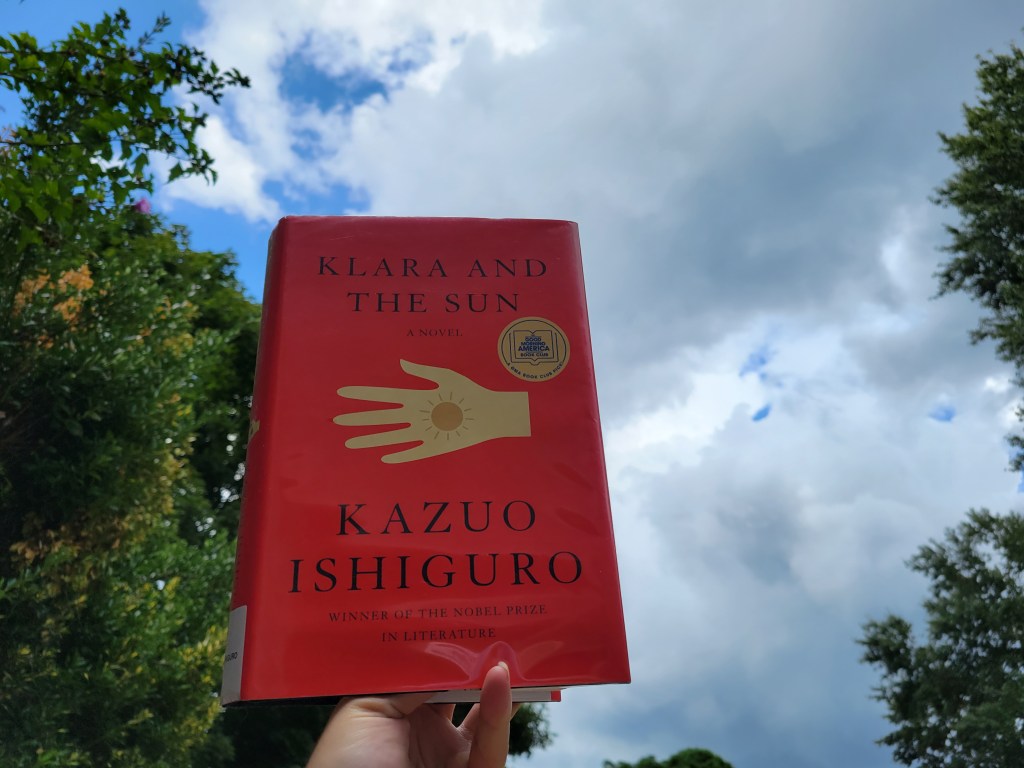
KLARA AND THE SUN – Kazuo Ishiguro

Kazuo Ishiguro may be the odds-on favorite for the 2021 Booker Prize, and understandably so.   Not only is he a previous winner (Remains of the Day 1989), he is arguably one of the most heralded contemporary English authors.  I don’t think anyone was surprised to see Klara and the Sun (Knopf 2021) make an appearance on the longlist.  I read and loved Remains of the Day decades ago, so I was looking forward to this one.

I don’t know what I was expecting, but it wasn’t Dystopian Science Fiction.  And what a fun surprise that was.  If you want to be surprised, stop reading now.  There will be some spoilers.

Klara is an AF, Artificial Friend, designed to entertain and keep children from becoming lonely.  These robots are made to look like children and come in various models, each fed by the Sun.  The novel opens in the AF store, where the reader is introduced to other AFs and the Manager all through Klara’s observant eyes.  This tunnel vision approach, also used in Remains of the Day, has been criticized by some, but the novel wouldn’t have been nearly as successful without it.

Klara is purchased to be the companion of Josie, a “lifted” but sick girl.  The wealthy have been able to “lift” their children – genetically editing them to make them smarter and more likely to succeed.  It’s a dangerous process not without risks, and the reason for Josie’s illness and the death of Josie’s sister.

  Klara is purchased as a friend and companion.  Josie’s mother has other, ethically questionable, intentions – a plan born of guilt and desperation.  Klara understands her assignment, and she also understands what Josie’s mother wants of her.  But Klara is no normal AF – and she resolves to save her Josie by calling on the Sun to heal her. 

Klara and the world of AFs immediately called to mind the 1980s sitcom Small Wonder and Vicki; however, the sitcom was lighthearted and full of warmth, and the ending of Klara and the Sun was a more realistic twist of the knife in my gut.  The first-person narration and Klara’s unreliable tunnel vision made it all the more impactful.

It’s not my personal favorite of the longlist, but gosh it’s certainly worthy.

Read this book.

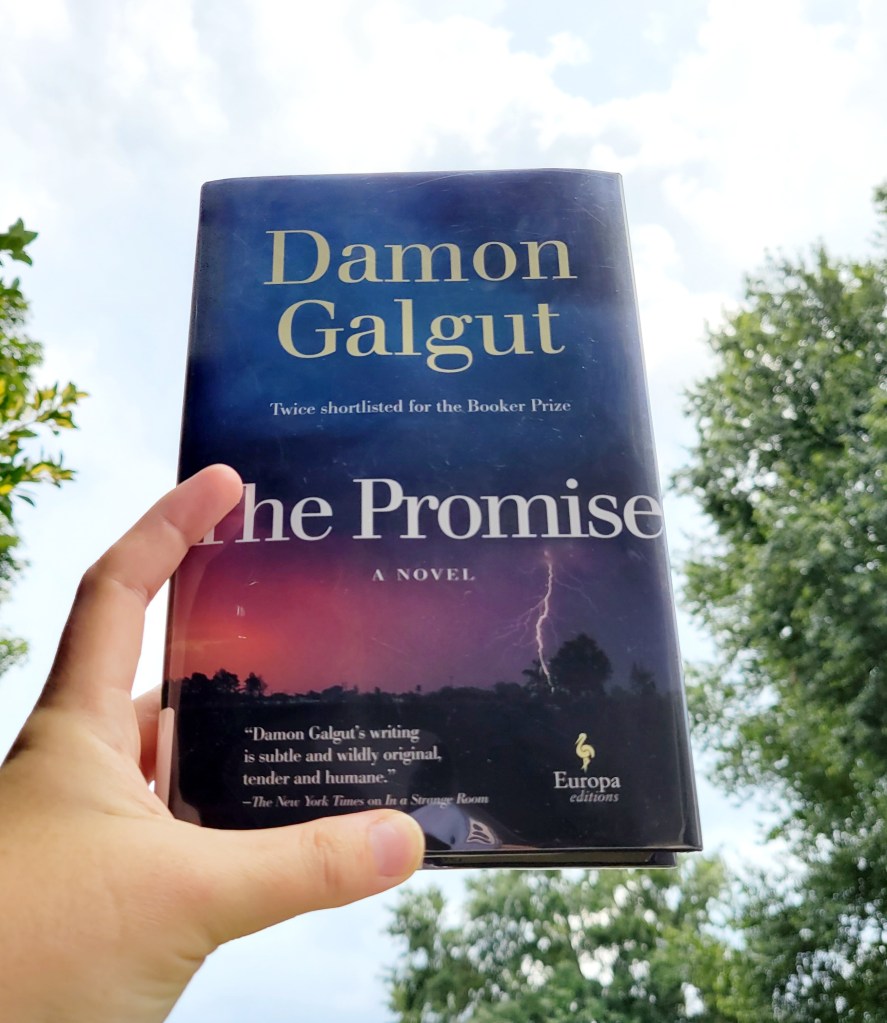
THE PROMISE – Damon Galgut

Hailed as “in every way equal to J.M. Coetzee” by Rian Malan, Damon Galgut is an author I was thrilled to see on the Booker longlist.  Shortlisted twice, Galgut’s work is a proven favorite among the Booker judges, and The Promise (Europa Editions 2021) very well could win it for him.  In the spirit of full disclosure, South African literature has always held a special place for me and when the author of My Traitor’s Heart references the author of one of my most favorite books (Disgrace), I’m apt to pay it a bit more attention.

With echoes of my beloved Nadine Gordimer and Coetzee, The Promise quickly went to the head of my Booker list.  The “white voice” in the time of apartheid is always going to recall these two prominent South African authors in my mind.  What I didn’t expect, was the echo of William Faulkner.   There’s a lot of Faulknerian aspects to the novel – the first section in particular murmurs reminders of As I Lay Dying – one scene seems a clear nod to the Southern writer when Anton, much like Vardaman, believes he has killed his mother.  Anton doesn’t believe his mother is a fish, but he does believe she was at the end of the barrel when he pulled the trigger.  She wasn’t – he didn’t kill his mother – but that early introduction to Anton defines the man he becomes in the decades that follow.

The novel is told in four sections: Ma, Pa, Astrid, and Anton.  Amor does not have a section, yet she is the glue that holds the novel together and the lightening that illuminates in the dark.  She’s a young girl when her mother dies, and she begins menstruating at the funeral.  As her mother was dying, she overheard her mother make her father promise something.  That promise carves a wedge between her and her father, and later between her and her siblings.

The novel begins during the mid-1980s, during apartheid.  The second section jumps forward to 1995, after the end of apartheid when the promise could finally have been realized had Amor’s siblings wanted to honor it.  The novel jumps forward again, to Mbeki’s second inauguration in 2004 and Astrid’s second marriage. Again, the promise could have realized.  But it wasn’t.  The novel jumps forward yet again and once more, Amor is set on ensuring the promise is finally kept.  She is firmly middle aged by this point, and her cycles have ceased. The novel comes full circle with a bolt of lightning, a death bed promise, a tortured history of colonization and racism, and the land she called home but couldn’t claim.

Read this book.

LIGHT PERPETUAL – Francis Spufford

Francis Spufford’s Light Perpetual (Scribner 2021) just oozes traditional Booker Prize type, so I’m not surprised it was longlisted.

The novel opens in 1944 at the Woolworths in South London.  The store is packed full of patrons because there are new cookpots available, something that war-torn England hasn’t seen in a long time.   A rocket rips through the store. When the dust settles, 168 are dead.  The rocket decimating this Woolworths and the cookpots the crowd had come to see are firmly rooted in history, but the five young children who are killed in the opening of Spufford’s novel are fictional – as is the rest of the story.

Spufford takes these five young children and reimagines a world where they didn’t die. 

“Come, other future.  Come, mercy not manifest in time; come knowledge not obtainable in time. Come, other chances. Come, unsounded deep.  Come, undivided light.   Come dust.”

The reader gets flashes of their lives, beginning in 1949 and running a lifetime until 2009.  The windows open on their worlds, and flashes of color and the pain of living pour out.  This isn’t a “happily ever after” story; it’s far too real for that.  It bleeds.  It cries.  It cuts.  But it also dreams and laughs.

It lives.

There are the twins, Jo and Val, whose lives take very different directions when they fall for the wrong men.  There’s Vern who just can’t shake the childhood nickname of vermin, and for good reason.  There’s Alec, the steady and reliable husband and father who devotes his life to print journalism and watches its demise.  And there’s Ben, whose demons live inside his head.

Through the years, the reader watches them live. Marriage.  Divorce.  Murder. Drugs. Mental institutes. Jail.  Music. Babies. Memories. Love.  The impact of their lives, snuffed out in 1944 and recast for a lifetime, shines in the mundane. 

Have you ever seen light reflecting off dust? It’s quite lovely.

“Come, dust.”

Read this book.

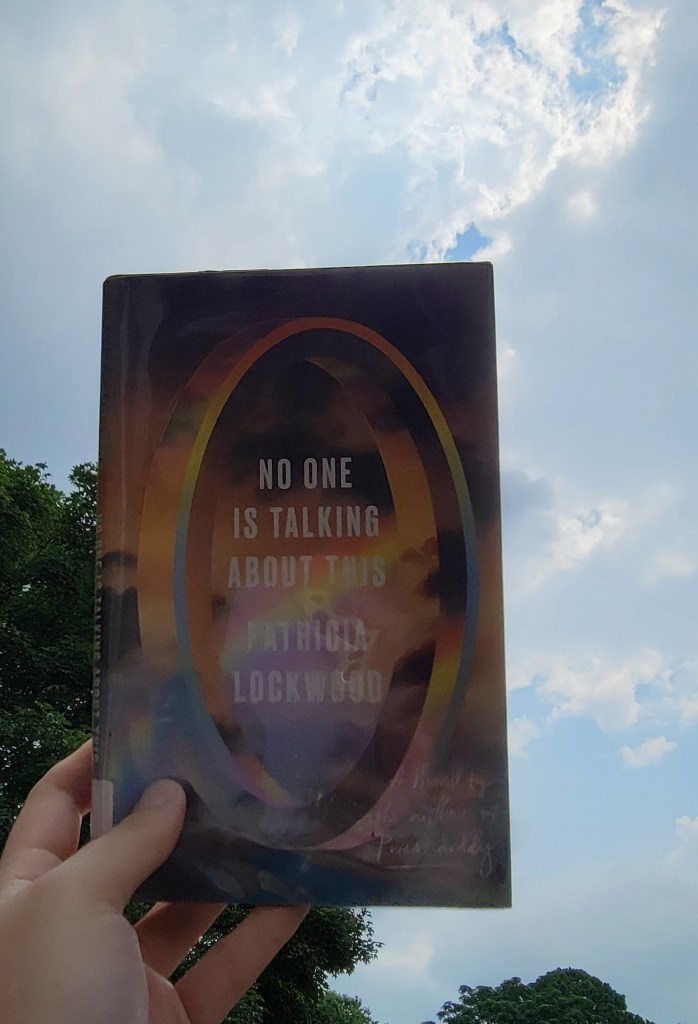
NO ONE IS TALKING ABOUT THIS – Patricia Lockwood

Can we talk about Patricia Lockwood’s No One is Talking About This (Riverhead Books 2021), because we all need to be. Longlisted for the 2021 Booker Prize, this is Lockwood’s first work of fiction and one of the best books I’ve read this year.

The narrator is a social media influencer who travels the world and constantly posts on the “Portal.”   The first half of the novel rolls along as if you’re scrolling through your Facebook feed or TikTok videos.  Snippets of her life are interwoven with more prominent memes and viral clips that most readers of a certain age would recognize.  (“It me.”)  BLM, white “wokeness,” the Trump presidency (though he is simply referred to as “the dictator”) and oppressive “pro-life” legislation work to date the novel as do the viral images/clips/stories that cycle through the Portal.

The first half is told in the fragmented, selective style of social media postings.  It’s funny. It’s irreverent. And it’s certainly unique.  We all scroll.  We know our memes.  We’ve all looked through photos of Jason Momoa.  We know our viral videos.  We know about the “importance” of “unique impressions.” And we have read countless “top tweets” or Buzzfeed articles about parents who think LOL means “lots of love” and that the eggplant emoji is for when you’re making eggplant for dinner.  We get it.  Lockwood is right there with us, and we’re just scrolling right along with her.  And it’s a hoot.

Then comes the second half of the novel, the half where life catches up with you and you have no choice but to put your phone down.  The narrator’s younger sister is pregnant and there’s something wrong with the baby.  The child is diagnosed in utero as having Proteus Syndrome, and everything slows down.  The Portal and the life curated on it for the world to see doesn’t matter anymore – all that matters is that baby.

“A minute means something to her, more than it means to us. We don’t know how long she has – I can give them to her, I can give her my minutes… What was I doing with them before?”

The second half of the novel is what happens offline.  The tears.  The prayers.  The heartbreak.  The anger.  The grief.  The loving.  And yes, the living.  It is raw and real – Lockwood excelling with her no tricks involved storytelling in such a way that my heart is still sitting in my throat.  When I saw the Acknowledgements at the end and read about Lockwood’s niece, Lena, I understand why her words had such an impact – it’s fiction, but Lockwood exposed her heart, all the broken shards and shattered light of the love she felt for Lena.

And I am thankful she did.

Put your phone down and do some living. 

Then read this book.

SECOND PLACE – Rachel Cusk

In January, I resolved to read the 2021 Booker Prize longlist.  The list was released last week, and I immediately put in my requests at the local library.  (That was another resolution – to use the library more.) Three of the books haven’t been released in the US yet or have limited distribution, which is a bummer, but five are currently in my house.  The shortlist will be announced on 9/14 and the winner will be announced on 11/3, so I have time.  Let’s do this.

I started Rachel Cusk’s Second Place (Farrar, Straus and Giroux 2021) with high hopes, but this 180-page novel is about 160 pages too long.  Had it been any longer, it likely would have been a very rare DNF for me.  The opening where the narrator meets the devil on a train in France and watches as he sexual assaults a child and does nothing set the stage for something that wholly under-delivered, but I’m not surprised it was longlisted as it oozes a certain Booker type – the type where the book clearly thinks too highly of itself.

The novel is narrated by a woman known only as M.  She’s middle-aged, whiny, and insufferable.  She addresses the novel to “Jeffers,” but the reader is never made privy to who Jeffers is.  He undoubtedly represents a very open nod to Mabel Dodge Luhan’s memoir of the time D.H. Lawrence stayed with her for a bit.  M’s second husband, Tony, is also a caricature of Luhan’s Native American husband, Tony.   The reason for a fictional retelling of Luhan’s memoir is a mystery to me, and I do not think it was successful.

The novel focuses on M’s obsession with the eccentric and difficult artist, L, as well as her desire to matter, to be seen.  She’s an author, but little is said of her books.  She’s a mother and a wife, but seemingly not very good at either.  Describing her dark-skinned husband as “more of an ugly than a good-looking man” and having difficulty communicating with him, M is primed for an obsession with an artist that could destroy her marriage.

She invites L to come stay with her and Tony at the “second place,” another home on their property set up for guests.  She thinks it would be good for his artistic creativity, and he eventually agrees.  But the man proves to be far less than the art that spoke so surely to her – he is a horrible, unkind man – and his interactions with M are far from the beautiful, seductive, passionate images M had visualized.

Cusk can clearly write, and there are some quite lovely passages and ideas in the work.  The jealousy directed at M’s daughter over the fear of completely disappearing and being replaced by a younger version of herself is a constant theme, humming as an undercurrent beneath the obsession with L, and represents some of the best writing of the short novel.  But there are far more misses than hits.

This is a hard pass for me and that’s a line I rarely draw.  Next.

THE DIRTY BOOK CLUB – Lisi Harrison

Lisi Harrison’s The Dirty Book Club (Gallery Books, 2017) is what happens when the Sisterhood of the Traveling Pants grows up and pants become erotic novels.  Embracing the bonds between women, The Dirty Book Club begins in 1962 when a group of friends start their own secret club, the aptly named Dirty Book Club.  The DBC is centered around books about sex and the own sex lives of the four original members.  The women seal the pact of secrecy with the smoke of their Lucky Strikes. 

M.J. befriends one of the original DBC members when she moves to California, but the friendship is short-lived as Gloria soon moves to Paris to honor another pact of the original DBC.  The move to Paris marks the time for a new set of members for the DBC.  The founding members pick their replacements, hand them the keys to the club, and a list of rules.  The four chosen women, M.J., Britt, Jules, and Addie, are little more than strangers and would never have organically created that friend group. 

Forced into the relationship by the four women who hand selected them,  the new members are wary of each other and reluctant to read the dirty books and share their deeply guarded secrets.  But the original DBC expected such resistance – each member has drafted a letter to correspond to a reading selection.  These letters, the insight into the women whose friendship has lasted over half of a century,  help form the bonds between M.J., Britt, Jules and Addie – bonds that strengthen over secrets and sex, love and loss, hope and heartbreak.

The erotica, significantly more taboo during the original DBC’s tenure, is the bridge that brings the four young women together, but it is their hearts and the need for female companionship that wraps around them and holds them in the club.

It’s a cute book.  It doesn’t put a lot of flesh on the bones of some pretty serious issues (abuse, alcoholism, depression, adultery, miscarriage), and that seems a bit of miss, but it’s a cute and easy read.

CLAP WHEN YOU LAND – Elizabeth Acevedo

Elizabeth Acevedo’s novel in verse, Clap When You Land (Harper Teen 2020), sings with beauty, love, loss, and family. Told in alternating views, the novel follows two teenagers whose father is killed in plane crash – neither knowing of the other’s existence.  But when the plane goes down and they must accept that their beloved Papi is dead, the secrets unravel.

Camino Rios lives in the Dominican Republic with her healer aunt.  She’s learned the Dominican ways at her aunt’s side, and she dreams of coming to the US to study to be a doctor.  Papi sends money that pays for her fancy private school and allows her and her tia to have certain luxuries, like a generator and plenty of food in the kitchen.  He visits every summer, carving out those precious months just for her.  She’s waiting alone at the airport for her father’s descent when she learns of the crash.

Yahaira Rios is Papi’s New York City daughter.  She’s extremely skilled at chess, but she’s stopped playing.  Her girlfriend, Dre, is her closest friend and sweetest love.  She doesn’t understand why her father leaves every summer or why she isn’t allowed to go to the Dominican with him.  She is angry with her father and doesn’t say a word when he leaves – her feelings bottled up tight inside, always the chess player even when she’s not playing the game.  She’s sitting in the cafeteria when she’s called to the office and told of the crash.

And with the words “no survivors,” Papi’s two worlds, and his two beautiful daughters, collide, and the duality of his existence is made known to those who loved him most – a duality everyone but the girls already knew. 

Laced with grief and grit, anger and acceptance, beauty and bitterness – this tale of two sisters who lose their father and find each other will linger on your lips like a first kiss or that first bite of a fruit in season.

Read this book.

BLACK SUN – Rebecca Roanhorse

Rebecca Roanhorse’s Black Sun (SAGA PRESS 2020) was one of last year’s hotly anticipated releases, and I can see why.  Inspired by various pre-Columbus American cultures, this epic fantasy is full strong female characters, magic, politics, and prophecies.  It is the first of the Between Earth and Sky series, and Fevered Star is slated for publication on April 19, 2022.  (You better believe that’s a preorder!) 

Black Sun features numerous LGBTQ+ characters, and what is remarkable is how their “queerness” isn’t a plot device.  Characters like The Knife, who uses the pronouns xe/xir, and the healer who was born a man but is now a woman,just are.  They weave in and out of the story, their sexuality no different a descriptor than their eye color.  (A quick toe-tip in history would let you know that the “sin of queerness” is a very “White Western World” construct that was a tool of colonization and Christianity, so it shouldn’t be surprising that in this world Roanhorse crafted that was inspired by pre-Columbus American cultures sexuality just is.)

 The novel opens with “Today he would become a god.  His mother told him so.”  Serapio’s mother scars his skin with the marks of her people, feeds him poison, and sews his eyes shut.  One of the last things he sees with his own eyes is the crow god eating the sun.

The opening is set ten years before the Convergence, the time when Serapio will fulfill the prophecy of his people, the Carrion Crow, during a winter solstice that will collide with the solar eclipse – when the sun will be at its weakest.

Weeks before the Convergence, Xiala is bailed out of jail following a questionable drunken sexual encounter that a woman’s husband did not approve of and made captain of the ship that will carry Serapio to Tova.  Xiala is Teek, a magical daughter of the water.  (Think mermaid and siren.)  She senses the magic in Serapio, and the water and the sky become companions.

Meanwhile, in Tova, Naranpa, the Sun Priestess, is preparing for the winter solstice.  She is a Dry Earther, and many within the Sky Made Clans do not believe she should have been made a Watcher.  She is challenged by some of the other Watchers and affluent people from the Sky Made clans, Golden Eagle in particular.  Her position and her very life are being threatened.  After a failed assassination attempt and the death of the matron of Carrion Crow, the earth runs red.

The murderous political situation has left Tova vulnerable and ripe for Serapio to fulfill his destiny as the sky goes dark.

Black Sun  is a wholly original, fantastically crafted epic that will etch itself into your skin like the haahan of the Carrion Crow. 

Read this book.

THE STILLNESS BEFORE THE START – Jennifer Ann Shore

If you’re looking for a well-written YA romance that is sweet with endearing characters, look no further than Jennifer Ann Shore’s The Stillness Before the Start (2020).  Shore is phenomenal at capturing the voices of teenage girls who are strong and confident while still figuring life out.  I don’t read this genre often, but I will always make an exception for Shore because of her female characters.  Metallic Red remains my favorite Shore novel, largely because of Mina, but The Stillness Before the Start and Harper Reed are a very close second.

Harper is a high school senior who is accustomed to planning her every move.  To date, she’s been wholly successful at it; she’s going to be valedictorian, she’s going to win the scholarships, and she’s going to be able to pursue her dreams.  Her dreams include James, the best friend who is as close as family.  Harper is playing the long game, and she plans for her relationship with James to move beyond friendship once in college because high school sweethearts never last.

Enter Dylan Archer.  He’s gorgeous, rich, and James’s sworn enemy.  What could he possibly want with Harper?  When he asks for her help in AP English, she can’t say no; she loves English far more than she dislikes Dylan.  As she gets closer to Dylan, she begins to see that she can’t plan for everything and that maybe the things everyone thinks she should want aren’t the things she actually does want.  Dylan shows her the contours of her heart.

The Stillness Before the Start made me nostalgic for 1990s teen rom coms – She’s All That and 10 Things I Hate About You in particular.  It’s a connection that isn’t lost on Shore, who openly nods to these sweet movies of my teenage years.

The Stillness Before the Start is a sweet teen romance – a candy read that features a lot of candy (there’s always candy in Shore’s novels!).  This feel-good read is perfect for folks who want believable characters, and a little more sweetness and little less angst in their teen romances.  I’m sure you’ll love Harper and her defiant curls as much as I do.

Read this book.

THE OTHER BLACK GIRL – Zakiya Dalila Harris

Zakiya Dalila Harris’s The Other Black Girl (Atria Books, 2021) is a surprising, unsettling, laugh out loud, edge of your seat sort of read that comfortably sets you down one path before abruptly shifting gears and leaving the reader gulping up each page to the end in what becomes one hell of an unexpected ride.  I had not read any reviews of the book prior to reading, and I strongly recommend you avoid spoilers – you need to come at it blind to fully appreciate its genius. Because of that, I’m not really going to go into much detail, especially details from the latter half of the book.

It was an uncomfortable read for me because I’m white and I read it from a place of privilege.  While I didn’t work at a publishing house, I did briefly intern at one.  And #publishingsowhite was a thing long before there was a hashtag.  (In my younger days, that was a pound sign, y’all.)  It’s a timely read.  The fact that it made me uncomfortable is a good thing, and it’s part of the power of this novel – it unapologetically is a #blackgirlmagic novel that doesn’t water itself down too much to be “palatable” for white readers.  And that’s the voice we all need.

Nella is the only black employee at an affluent publishing company.  She’s been trying to get her company to pursue more diverse employees and authors, but there hasn’t been much forward movement.  And then she smells it – cocoa butter.  She can barely contain her excitement; they’re interviewing a black girl.  When they hire Hazel, Nella is ecstatic.  Suddenly, she’s not nearly as alone, and the two women connect on a level that only those with shared experiences can.  Or so Nella thinks.  But then someone starts leaving her notes, telling her to leave Wagner.  Is it Hazel?  Is there only room for one black girl? Is Nella just paranoid and losing her mind?

I really want to talk about hair and the historical and cultural importance of it, but I’m not.  Just know that what Harris does with hair is brilliant.  The Other Black Girl is not a perfect read, and it stumbles in some areas, but where it excels more than makes up for the stumbles.  I want more.

Read this book.