YES, YOUR MAJESTY – Jennifer Ann Shore

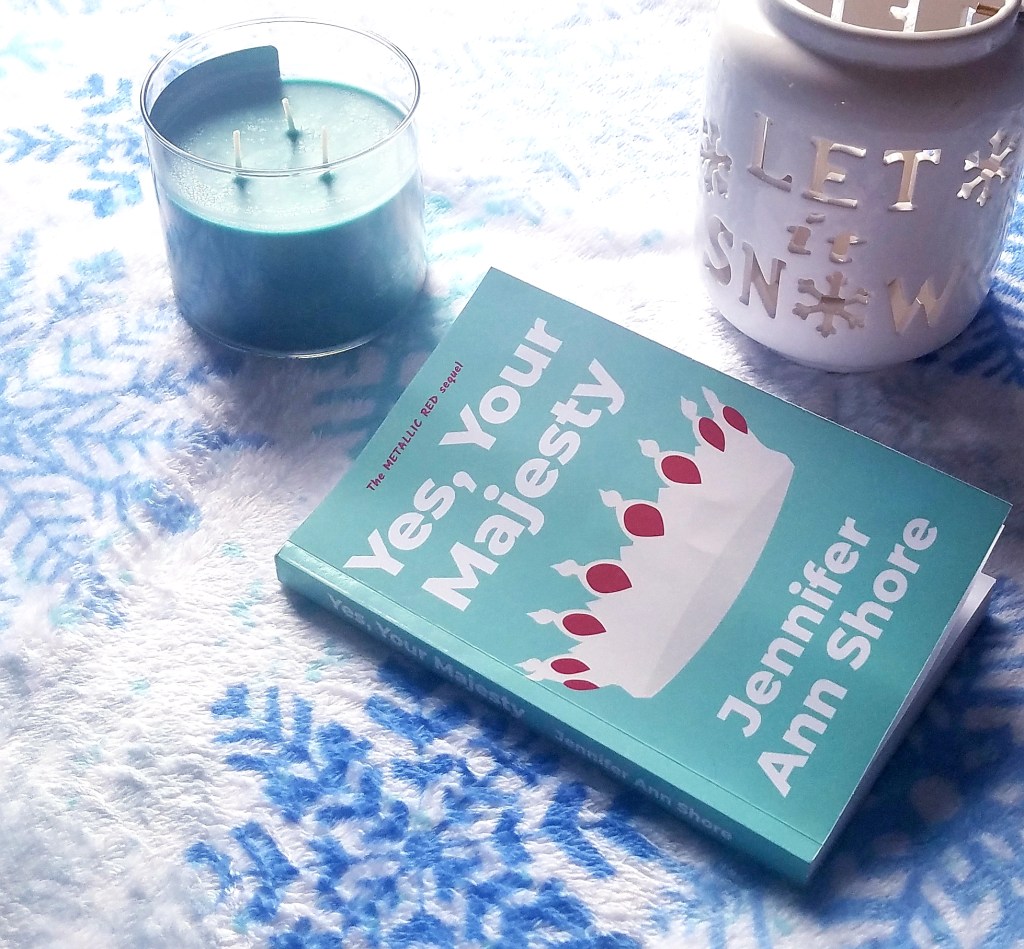
*Snow has zero to do with this book. Just wishful thinking on my part for a snow day. 🙂

I read Metallic Red (2020) by Jennifer Ann Shore back in October, and I absolutely adored it.  When the sequel, Yes, Your Majesty, became available for pre-order, I didn’t hesitate; I was eager to get back to Mina’s world.  Mina, a half-human / half-vampire, had just become Queen of Appalachia at the close of Metallic Red and how that would impact relationships with humans, her parents, and the royals was something I couldn’t stop thinking about.

The novel opens with Mina watching Charlie and Eloise graduate.  She is far removed from the festivities, watching from behind a fence with two bodyguards.  It immediately sets the tone for the novel; Mina, hardened by the actions of her parents and the death of her uncle, has become more of a vampire than she’s ever appeared before.  She’s closed off, overwhelmed, and guarded.  Much like Metallic Red was written in a style that reflected the split existence Mina was living, Yes, Your Majesty shivers with a coldness of responsibility that has settled over Mina.

I wanted more.  I wanted Mina to embrace the human-side a bit more and give the reader a glimpse into her thought process over the criminal actions of her father and the subsequent banishment of both her parents.  I wanted more of the struggle within Mina between the human world and the vampire world, more importantly between Charlie and Theo.  The book steamrolls quickly into the choice having been made without really appearing on the pages.  I think that was a missed opportunity.  I would have enjoyed seeing Yes, Your Majesty focus on the unveiling of vampires to humans, Mina’s early stumbles as a royal and with other royals, the choice between Charlie and Theo, and an introduction to the debt owed to the witches.  The hunt for the 300-year-old vampire could have been fleshed into a third book that I would have read with glee.  (That’s partly because I’m not ready to say goodbye to Mina and her mixed group of friends.)

That said, I still loved this novel. Shore has given her readers a female teenager whose life and actions aren’t determined by a desire to win the affections of a man.  In fact, Mina alienates the men in her life as she rises to the challenge of being queen.  That balance is something Mina struggles with throughout the novel, and I was ecstatic to see that she finds a way to balance her personal relationships with her business endeavors without forsaking herself.  The social commentary is strong within this novel. Shore touches on gender roles, US healthcare, discrimination, and privilege by using the voices of her young and bold characters.  It’s an excellent way to avoid “preachiness” while building memorable characters.

I hope this isn’t the last I see of Mina and Eloise, but if it is, this was a really fun ride.

NEXT YEAR IN HAVANA – Chanel Cleeton

I picked up Chanel Cleeton’s Next Year in Havana (BERKLEY 2018) a few months ago because of the cover and the title.  While I wish the “Reese’s Book Club” label wasn’t on it, this cover, in particular the colors, is quite captivating; the fact that the story itself outshines the cover is high praise.  Next Year in Havana is a delicious historical fiction novel that doesn’t have its heart squeezed out by a heavy-handed romance plot – and that’s my sweet spot for historical fiction.

Running dual timelines, the novel follows Elisa, the 19-year-old daughter of a wealthy sugar baron, who finds herself in love with a revolutionary who stands for everything her family isn’t, and her granddaughter, Marisol, who is going to Cuba to spread her ashes.  Elisa raised Marisol, filling her head with the stories and songs of her beloved home.  It is Elisa’s wish that her ashes be spread in Cuba.  She doesn’t tell Marisol where, only that Marisol will know.  Marisol, with her grandmother’s ashes hidden in her luggage, enters the country she feels she already knows only to learn Cuba isn’t exactly like the one in grandmother’s stories and that her grandmother wasn’t exactly the woman she was led to believe.

Elisa had buried her love and her secrets in a box in the same yard her father had buried the family’s riches before fleeing to Florida.  Both she and her father hoped to return to claim them one day.  Neither would, leaving their secrets to be held by Cuba until delivered to their rightful heir.  For Elisa’s box, that’s Marisol.  Elisa’s oldest friend (and Marisol’s host) gives her the box that she’d helped Elisa bury so many years ago.  With the box, Marisol is given a warning not to judge Elisa too harshly.  Confronted with her grandmother’s surprising past, Marisol sets out to find more about the revolutionary who’d claimed her grandmother’s heart. 

This is the story of two people from different sides of a revolution who fell in love in 1958.  In 2017, the domino effect of that love is finally realized.  It’s a love story, but it’s also story of Cuba and family.  It’s a story of revolution and displacement.  It’s a story of secrets and survival.

It’s a lovely read.

THREE DARK CROWNS – Kendare Blake

“I will kill my sisters just as easily, Natalia,” Katherine says.  “I promise.  Though perhaps when I am finished, they will not look like they are sleeping.”

Kendare Blake’s Three Dark Crowns (HarperTeen 2016) has been on my radar for a few years, but it only recently made its way to my physical TBR.  I enjoy YA fantasy, and I tend to use them as comforting candy reads and palate cleansers.  (That’s not saying they’re all sweet and shallow by any means.)   Three Dark Crowns is one heck of an intense fantastical ride that is far from charming and teeters on the overly dramatic – but it sure is fun.

The island of Fennbirn is a magical place set apart from the mainland.  Ruled by the Goddess, there is a queen who will birth triplets.  At birth, the talents of the triplets are named by the queen before she leaves the island with her consort.  Only one of the triplets will become rule, and she will be crowned after killing the other two.  The triplets are separated as children, raised within their talents, and the killing starts following their 16th birthday.

Katherine is the poisoner queen, and poisoner queens have ruled for a hundred years.  The only problem is Katherine isn’t that great at it. She’s excellent at poisoning, but awful at being poisoned.  Despite years of training, she has not built up the strength or resistance expected.

Arsinoe is the naturalist queen.  Rough and ready like a feral beast, she runs with Jules and Jules’s familiar Camden.  Jules is one of the strongest naturalists in years, as evidenced by her big cat familiar.  Arsinoe’s familiar has yet to come to her.  Much like Katherine is an awful poisoner, she’s not great at being a naturalist.

Mirabella, backed by the Temple, is the elemental queen.  She is powerful, commanding storms with ease.  All expect her to defeat her sisters.  It’s why the Temple has backed her.  They want control, and Mirabella is by far the strongest in her gifts.

Can three sisters raised to kill each other learn to trust each other? Can the Temple be stopped?  Will Arsinoe’s and Katherine’s gifts awaken in time?  What exactly is the cost of low magic?  The first in the series leaves the reader with more questions than answers, but a thirst for the rest of the story.

It’s a hell of a fun fantasy soap opera.

GLAMOUR GIRLS – Marty Wingate

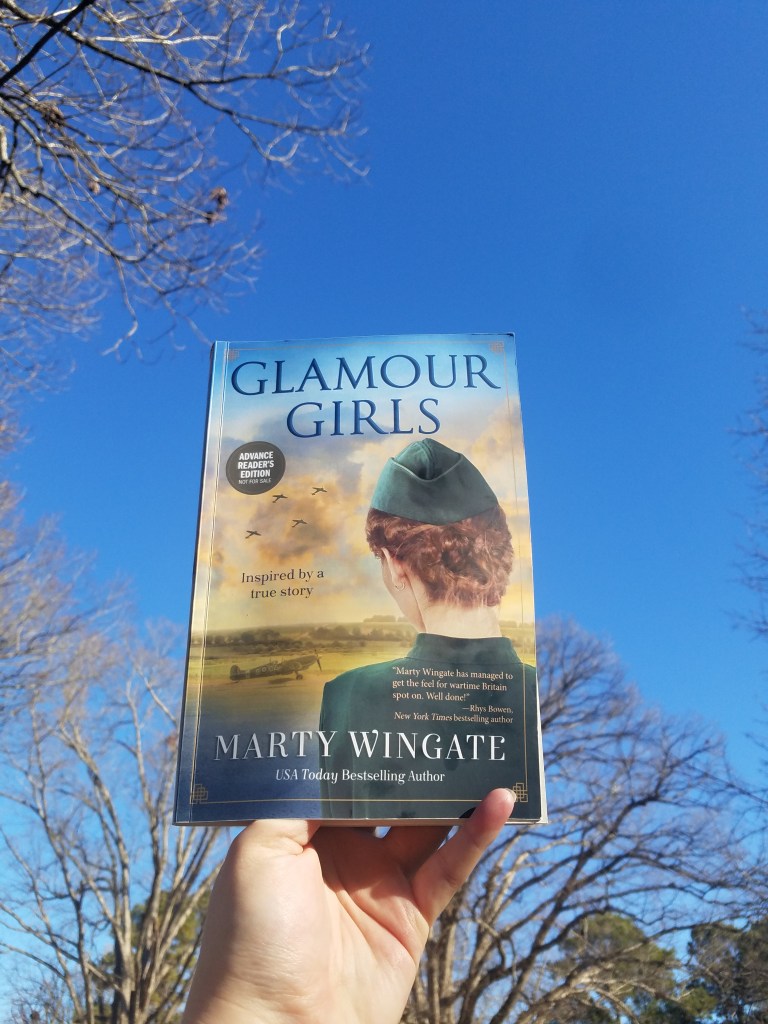
My “women at war” reading list has continued into 2021, finding me in England during WWII with Marty Wingate’s Glamour Girls (January 12, 2021, Alcove Press).  Wingate, a cozy mystery writer, slid quite easily into the historical genre, and Glamour Girls is a quick and easy read with much of the violence of war (and pleasures of sex) happening off page.  In addition to war-time depictions, Wingate does grapple with rather heavy topics of the time (homosexuality, premarital sex, children born outside of wedlock, gender norms, societal norms, etc.); but her tone remains light and any conflict is brief and readily resolved, a formula to her writing that is very much reminiscent of a comfortable cozy.

The novel centers around Rosalie (Rags to her brothers) Wright, a young girl who longs to leave the farm life for the skies.  For her eleventh birthday, she convinces her adoring father to take her to the Flying Circus.  He pays for her to go up twice, and she is hooked.  Her father promises her flying lesson when she is old enough.  For the next several years, she saves her money and, much to her mother’s chagrin, never gives up on her dream of being a pilot.  When the novel opens, she’s had several lessons but has been grounded just a few flight hours short of getting her license due to the war; her instructor says the planes will be needed for things a bit more important than teaching a girl to fly.  Rosalie’s nearly given up until she reads an article about Pauline Grower, a pilot who had been appointed to the Women’s Division of the Air Transport Auxiliary – the head of the women ferry pilots who assist war efforts by ferrying planes to where the Royal Air Force needs them.  She’s initially denied due to her incomplete experience, but through sheer determination and grit, she’s admitted.

The women ferry pilots, known as Glamour Girls or Attagirls, are a remarkable lot – both the fictional women in Wingate’s novel, and the very real women who inspired the novel.  These women would fly numerous hours a day, ferrying planes to where they were needed.  Once they landed, they might have enough time for a cup of tea before they were up in the skies again.  They weren’t trained on all the planes, but they flew all the planes.  Their knowledge came from Ferry Pilots Notes, with new pages being added as new planes joined the war.  The women had to fly the planes low, their only navigation a knowledge of English typography and their own eyesight.  The planes were unarmed, and the women would have to use their skill and quick-thinking to maneuver away from enemy planes and other dangers.  Often the planes being ferried needed repairs, rendering them not the safest.  Engines cut midflight and emergency landings were a common occurrence in the open fields of the English countryside.  These women pilots were phenomenal, taking to the skies to risk their very lives for home and country despite being doubted and disrespected by many.

Rosalie loves what she does; she is never more comfortable than she is in the skies.  Through her experiences as a ferry pilot and her relationships with other pilots, including the brief love triangle with Snug and Alan Chersey, Rosalie finds her wings and her voice.  It’s an uplifting story about a remarkable woman who came running when needed.

Glamour Girls is a light read about a heavy time in history.  Inspired by a true story, it shines a light on the bravery and joy of the Attagirls, as well as the risks and sacrifices they took for home and country.  A huge thank you to Alcove Press for getting this ARC into my hands.  The novel is available for pre-order now and will be released on January 12, 2021.   I would recommend this novel to fans of historical fiction as well as fans of sweet romance and cozy mysteries.  It’s a comforting candy of a read that reminds us how resilient and amazing women truly are.

YELLOW WIFE – Sadeqa Johnson

I love a good historical novel, particularly a well-researched novel that stands out both for its writing style and for a unique story that doesn’t feel regurgitated.  While I admittedly gravitate more toward historical fiction with hints of magical realism (Remembrance and Conjure Women from last year being excellent examples), Sadeqa Johnson’s Yellow Wife (1/12/2021) was a highly anticipated read for me.  I was absolutely floored when Simon & Schuster sent this gorgeous ARC several months ago, and I’d been waiting for the perfect time to savor it.  And savor it I did.

Despite being a slave, Pheby Delores Brown was born into a world that treated her quite a bit differently than it did the darker slaves that called the plantation home.  The cherished mulatto and the daughter of a highly respected medicine woman, she was consistently reminded that she was descended from Cameroon royalty and a slave in name only.  The Master’s sister doted on her, teaching her to play the piano and read – treating her more like a beloved niece than a house slave.  The Master was also a bit smitten with the beautiful girl.  He promised her and her mother that he would give her freedom when she turned eighteen.  Once free, she could go North and further her education. 

But the Master’s wife isn’t exactly keen on Pheby or her beautiful mother.  Armed with power and jealousy, Missus Delphina snatches the dream and breaks the promises made by her husband; Pheby is taken to Devil’s Half Acre, a notorious slave jail in Richmond, to be sold.  There, her delicate upbringing and light skin catch the eye of the Jailer and life pivots yet again.  While she is treated much differently than many others who pass through Devil’s Half Acre, Pheby remains a slave and her existence (and happiness) is subject to the whims of a white man known as “Devil” and “Bully.”

Based loosely on historical events, Yellow Wife is about the parts of life that are neither black nor white, neither right nor wrong.  It’s about a shared history and the contradictions of human nature.   More importantly, it’s about survival, family, and the choices we make. 

Read this book.

AND THE MOUNTAINS ECHOED – Khaled Hosseini

I don’t know how I’ve managed to go so long without reading anything by Khaled Hosseini, but here I am in 2021 reviewing my first book by this master storyteller.  And the Mountains Echoed (Riverhead Books 2013) is a novel I am unlikely to forget in this lifetime or the next.  The decisions the characters were forced to make out of love and/or necessity, a country thrust into decades of chaos and uncertainty, a fragmented people trying to reclaim lost lives and memories…  This novel, the broken and the beautiful, will linger in your memory like the bits to a nursery rhyme half-remembered.

The novel opens in Kabul, Afghanistan.  It’s 1952 and ten-year old Abdullah and his little sister, Pari, are each other’s worlds.  But life is hard, and the family is struggling.  A choice is made that will forever alter both of their lives; its impact ricocheting for decades from Kabul to Paris, Tinos, and even San Francisco.

It’s a story of family and a story of survival.  Abdullah’s father makes the impossible of decisions to save the rest of his family.  He tries to explain it to Abdullah.  That sometimes one has to cut off a finger to keep the hand, but Abdullah will never forgive him.  His childhood is scarred by loss.

Abdullah’s stepmother has her own demons and split-second decisions that altered her life’s course.  Her brother, Nabi, a central character in the novel, also must deal with the repercussions of a decision that he orchestrated and forever changed his life and his family’s – a decision that destroyed one family but created another.  One that was motivated but a love he’d never realize and supported by yet another love he couldn’t return.

The novel spans from 1952, with a few flashbacks to earlier years, to 2010.  Near the end of the book, an old man lost to dementia sings the first two lines of a nursery rhyme in Farsi and a woman finishes the forgotten verse.

“I found a sad little fairy
Beneath the shade of a paper tree.
I know a sad little fairy
Who was blown away by the wind one night.”

That scene, and the tightening of my throat that it caused, have forever etched this novel in my heart. 

Read this book.  

THE GIRL WHO DRANK THE MOON – Kelly Barnhill

I read forty-seven books in 2020, and my last read of the year ended up one of my top two.  I knew I’d like Kelly Barnhill’s The Girl Who Drank the Moon (Algonquin Young Readers, 2016), but I didn’t anticipate it even being in my top five.  Yet I found this novel of an “enmagicked” girl, a Perfectly Tiny Dragon, a good witch and a bad one, a Swamp Monster poet, and what it means to be a family as enchanting as the moon.

The premise of a child sacrificed for the safety and well-being of a community is not uncommon in fairytales and folktales, and that is the framework we find ourselves in.  The people of the Protectorate, a sad little place, sacrifice a baby every year to “the witch” so that she will leave the town alone.  The “offering” is a centuries old rouse intended to keep the elders in power; there is no witch.  Well, there is, but Xan is very much a good witch and nothing like the lies propagated by the elders.  Unknown to the townsfolks and the elders, she takes the yearly sacrifices to other towns where they are loved by families who can’t have children. 

But then comes the beautiful black-haired baby.  Xan doesn’t pay attention when letting her feed on starlight, and the girl drinks the moon.  She becomes “enmagicked” and Xan, more than anyone, knows the difficulties of a magical child.  She decides to raise girl.  She names the baby Luna and takes her home.  There, they, along with a Swamp Monster named Glerk and a Perfectly Tiny Dragon named Fyrian, are a family.

As Xan believed the babies were abandoned, she had no way of knowing that locked in a Tower, a mother’s madness grew.  She also had no way of knowing that a young man who had been present when Luna was taken from her mother has decided to kill the witch and save his people.  Meanwhile, history is burning to repeat itself as a dormant volcano begins to stir.

The Girl Who Drank the Moon is beautifully and fantastically told.  It reminds me, as I hope it does you, that we are never too old for fairytales or magic or a Perfectly Tiny Dragon that can fit in our pockets.

Read this book.

THE NEW WILDERNESS – Diane Cook

Diane Cook’s The New Wilderness (Harper (August 11, 2020)) rounds out my 2020 Booker Prize shortlist selections.  This book has been heralded as the “environmental novel of our time” by Booker judge Lemn Sissay, but I’d like to think our time could do better.  I think I’ve actually read better.  (Barbara Kingsolver, anyone?)

Cook is a talented writer and the premise of the novel is certainly intriguing, but it comes off the rails pretty early on.  It’s a fragment puzzle of a book with characters that are inconsistently portrayed.  Those were some of the serious hiccups that held me back from fully enjoying a premise that I’ve dubbed The Hunger Games meets Divergent for adults.  The dystopian game has been so strong in the YA world and so over done as of late, that I can’t help but wonder if this was initially intended for a younger audience and then reworked.  That would explain some of the more jarring aspects with both Bea and Agnes.

The novel is set in a future where humans have destroyed much of the natural world except for the Wilderness State, a protected area of land upon which humans are not allowed.  A study is initiated between the government, scholars, and scientists to see if humans can return to nature without destroying it.  Bea, with a sickly child who needs “clean air” to survive, and Glen build up a team.  Glen wants to go because of the science behind it.  He’s a scholar with the heart of poet.  Bea wants to go because it’s the only chance to save her daughter.  A group of twenty are led into the Wilderness State with limited possessions and a lot of rules.  They’re certainly not the qualified bunch of “survivalists” Glen envisioned, but it was hard enough to get twenty warm bodies to volunteer at all.  

Agnes becomes healthy and feral in the Wilderness state.  With little memory of the City, she’s quickly able to adapt.  She learns to read the signs of the animals to determine where to go, what to eat, and when to be afraid.  Despite her age, she earns the respect of those within the Community and becomes a leader who briefly breaks out of her mother’s shadow. 

Man versus Nature and Man versus Man are two of the most common conflicts in literature, and Cook dabbles with both but neither seems fully developed.  The nature versus nurture conflict is more defined but still a touch incomplete, leaving the reader with frayed edges and abandoned subplots.  The characters were unlikeable and inconsistent, and the chronology was contradictory, especially when Agnes took the reins.  It was quite the disappointment.

SHUGGIE BAIN – Douglas Stuart

He wanted to crush her with his secrets the way she had once done him with hers. “What’s wrong with me, Mammy?” He asked quietly.

262

Douglas Stuart’s debut novel, Shuggie Bain (Grove Press, 2020) was recently awarded the highly coveted Booker Prize.  It’s my favorite book award, and I try and read some of the selections from the long list each year.  This year, I gravitated toward the shortlist.  Shuggie Bain is my third from that list, and while I still think The Shadow King should have received the award, I can certainly appreciate why Shuggie Bain won.  This is not a book I will soon forget.

If I call this novel the fictional and Scottish Angela’s Ashes, you will one hundred percent understand how weighty this novel of addiction, family, and sexuality is.  In the same breath, let me tell you this is not just another Angela’s Ashes and it doesn’t deserve any sort of “been there, read that” brush aside.  Set in 1980s Glasgow, Shuggie Bain hits like a punch or a hard kiss under a cold rain.

Stuart did a masterful job creating broken and beautiful characters, particularly in Agnes, and this book rings clear like the bells on Christmas day.  Agnes has dreams, but time and life and men keep getting in the way.  She leaves her first husband, a dependable (boring) Catholic, for Shuggie, a handsome cabbie with promises of a new life and all she’s ever wanted.  In a flashback, we learn that she was supposed to leave Catherine and Leek behind, but she couldn’t do it; Agnes could never walk away from her children.  Big Shug’s promises are empty, but the bottles of booze aren’t.  Agnes attempts to drown her demons and all of her shattered dreams in cans of lager and bottles of vodka.  It works only until the alcohol is out of her system and the weight of her reality comes crashing down.  It’s a heartbreaking portrayal of addiction and despair, worsened by co-dependent and abusive relationships.

Shuggie, the youngest of Agnes’s children, has his own demons.  He is “no right” as everyone likes to say.  As he mothers his mother, he struggles with his secrets and his truths.  He wants so desperately to be “normal,”, but he’s a boy who doesn’t like boy things.  He prefers dollies and fruity scented ponies to footballs and fishing.  Agnes believes it is because his father is a sorry excuse of man who left them all.  She begs a man in the neighborhood to spend time with her son, to take him fishing and do boy things with him.  The man uses her, promising to teach the boy how to fish, but it’s just words to barter for her body.  Each time a man pushed inside Agnes, Shuggie’s heart (and mine) broke a little more.

 This novel is wrapped in bruise, and it smells like day old beer and stale smoke. I’m still not quite sure how I feel about it.  It’s not a book I would recommend to everyone, but I would certainly recommend it. 

I AM NOT YOUR PERFECT MEXICAN DAUGHTER – Erika Sánchez

“But how do we live with these secrets locked within us? How do we tie our shoes, brush our hair, drink coffee, wash the dishes, and go to sleep, pretending everything is fine?”

(284-285)

Once upon a time, I was an immigration attorney.  Many of my clients were “undocumented” or had “undocumented” parents.  The point of that is to say that Erika Sánchez’s I Am Not Your Perfect Mexican Daughter hit a little differently for me.  I’ve met Julia and her family.  I’ve represented them in immigration court. While I haven’t lived it, I’ve seen the nervousness and uncertainty of a child thrust between two identities.  I Am Not Your Perfect Mexican Daughter should be required reading in every high school across America.

Julia is a mouthy but academically gifted teenager who dreams of being a famous writer in New York.  Unlike her “perfect” sister, Olga, Julia wants to get far away from her family.  Her parents just don’t understand her.  They don’t approve of her friends, the way she dresses, or her dreams.  “You should be more like your sister,” they say.   Neat.  Tidy.  A good cook.  A perfect Mexican daughter ready to step into the role of perfect Mexican wife.  But Olga’s dead, and her family is left broken.

Julia blames herself for her sister’s death.  If she had been a better daughter, her sister wouldn’t have been taking the bus.  The guilt eats at her.  At night, she sneaks into her sister room and sleeps in her sister’s bed.  In her attempts to bring herself closer to her sister and find closure, she discovers that maybe Olga wasn’t as perfect as she appeared.  Julia becomes obsessed with the mystery, obsessed with finding Olga’s secrets and revealing her as less than perfect to her devastated parents.

Depression wraps itself around Julia, filling her head with guilt and thoughts of inadequacy.  Her parents are so consumed with their own grief, they don’t notice their remaining daughter has spiraled to a place many don’t come back from until its almost too late. 

After a failed suicide attempt and a brief hospitalization, her parents decide to send Julia to Mexico.  She hasn’t visited her family in years, and she’s never gone without Olga.  Her parents are undocumented and it’s too risky for them to leave the US, so she goes on her own.  There, in the warmth of her Mexican family and with the help of the medication she’s been placed on, Julia begins to heal.  While in Mexico, she’s faced with a reality of her parents’ shared history that had long been kept a secret.  She begins to realize that some secrets should never be said out loud.

I Am Not Your Perfect Mexican Daughter isn’t a fairytale.  It’s gritty, but it’s real.  Julia is whiney and ungrateful; in short, she’s every other teenager.  That commonality and Julia’s snarky voice brings levity to rather serious situations.  It’s a relatable and extremely well-done young adult novel.

Read this book.