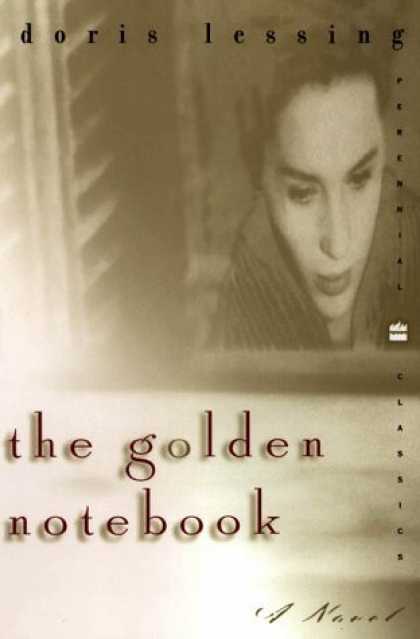
Doris Lessing (b. 1919) is one of what I call my white voices in Africa, but that’s not how she was first introduced to me. My introduction to Lessing was with Briefing for a Descent into Hell (1971), which had nothing to do with Africa and everything to do with a man’s mental breakdown. The novel has different settings: the fantasy realm created by the crazy and the real world of the mental hospital. It was most certainly an interesting and odd read. When my studies turned to African literature, I found myself with Lessing’s first novel, The Grass is Singing (1950). Set in Rhodesia, this novel is a far cry from Briefing for a Descent into Hell and deals with a failed marriage, racial tensions, white & black sexuality, and the dynamics of a master/servant relationship in an evolving world. More recently, I was informed that as “a woman” and a supposedly well-read one at that, I needed to read The Golden Notebook (1962). I knew it was Lessing’s most famous work, so it wasn’t a hard sale. Its 635 page count made it even more appealing as I do like big books and I cannot lie. In short, The Golden Notebook is Briefing for a Descent into Hell intermingled with The Grass is Singing. (Yes, I know it was published in between the two, but for my purposes it seems to be a mix of the first two Lessing novels I encountered.)
There are two introductions in my edition – one from 1993 and one from 1971. Unlike most people, I actually read the introductions. The introduction from 1993 is Lessing discussing the impact the novel has had on women (and men) worldwide – as of the 1993 introduction, a short run had been printed in China. This instantly turned me off. The introduction from 1971 turned me off even more. In that introduction, she essentially bashes reviewers and readers for not understanding the novel and attempts to explain her process to them. For once, the introduction (in this case, introductions) did not enhance the reading experience; however, she does make one statement that I both agree and disagree with.
“There is only one way to read, which is to browse the libraries and bookshops, picking up books that attract you, reading only those, dropping them when they bore you, skipping the parts that drag – and never, never reading anything because you feel you ought, or because it is part of a trend or movement. Remember that the book which bores you when you are twenty or thirty will open doors for you when you are forty or fifty – and vice versa. Don’t read a book out of its right time for you…”
The passage went on to bash scholars who spend too much time on one novel or one author, but I’ll ignore that for now. (Remember that your bookslut has also dabbled in the scholarly.) The funny thing is I read Lessing’s novel because I felt obligated, because I was made to feel obligated. Obligations and the fact that I may have read it when it wasn’t the right time for me aside, I can see why The Golden Notebook is considered Lessing’s greatest work. The themes and forms used to weave the story are daring, chaotic, and perfect.
The novel focuses on Anna Wulf, a writer quickly elevated to fame with the publication of her first novel (a novel about Africa) and dealing with writer’s block. (Sound familiar? I think this novel is a little masturbatory in nature – a lot of Lessing in Anna. But Lessing is doing it on purpose – she actually mocks the process by having Anna clearly put herself in the story of she’s writing about Ella.) Anna keeps four notebooks: a black one in which she records the African experiences of her younger years; a red one in which she keeps track of her political life – Anna is/was a Communist; a yellow one in which she develops story ideas; and a blue one that serves as her diary. She believes that to keep her life from spiraling into a chaotic mess, she needs to keep the parts of her life separate. She soon realizes that by fragmenting herself off, she is succeeding in driving herself crazy. She attempts to join all these pieces of her existence in one book – the golden notebook.
Everyone keeps telling Anna that she needs to write again, that she needs to do another novel. Mother Sugar, her shrink/witch doctor tells her she needs to write her experiences. The parts of The Golden Notebook called “Free Women” make up the novel that Anna actually writes. It’s an interesting form because the reader gets all the background, all the journal entries, that served as the foundation of “Free Women.” Throughout the process, the reader gets to watch Anna completely unravel and rise, finally free. She becomes sane through insanity. It’s a bildungsroman for a middle-aged woman.
The novel opens with: “The two women were alone in the London flat.” The reader later learns that these are the lines Anna’s final lover in the novel tells her that she must use to start the novel. The two women are Anna and Molly, her former Communist/actress/loud and overbearing friend. Anna and Molly are different yet the same, and their friendship seems to be defined by their role as “free women” – women belonging to no man. When their friendship suffers, things are quickly corrected by discussing men and/or sex or politics (though political thought oft leads to arguments). While both women are “free,” they both seemingly want to be “kept.”
Anna seems to be the perpetual mistress – men seem to love to fuck her, love her independence, and love the fact that they can return to their wives with nearly no drama. This eats at Anna – it’s not a role she wants to play. One of her married men, Paul, left her after many years of continuing the affair and this abandonment and rejection hurt her far worse than her prior divorce. She realizes nearly a year after he leaves that her entire personality has changed because of him.
“My deep emotions, my real ones, are to do with my relationship with a man. One man. But I don’t live that kind of life, and I know few women who do. So what I feel is irrelevant and silly… I am always coming to the conclusion that my real emotions are foolish, I am always having, as it were, to cancel myself out” (300).
Paul destroys Anna and he is a very clear catalyst into her spiral into insanity.
Anna puts a lot of her feelings into her story with Ella. At one point, she writes about Ella going to visit her father. Her father tells her that her mother had been horrible in bed and that he’d sought satisfaction in the beds of others. He then tells her that she is obviously not like her mother, that she is a “modern woman.” He also tells her that people need to be left in solitude so as not to destroy each other. “People are just cannibals unless they leave each other alone… And good luck to you. We can’t help each other. People don’t help each other, they are better apart,” he tells her (444-445). With a father figure like that, even for Anna’s fictional Ella, one can’t help but wonder the effect of the father on the daughter. To complicate matters further, Anna’s daughter has an absentee father as well. Does the father figure (or lack of a good father figure) contribute to the “modern woman” phenomenon?
Near the end of her relationship with Saul Green, the crazy American that finally drives her to madness and gets her to write again, Anna’s entire life revolves around the man. She becomes a crazy, jealous, angry, bitter woman and can feel the old Anna, the real Anna, struggling to get out and back in control. This portion of the book was very painful for me to read. I feel like most women I know have fallen in love at the expense of their own identities and to watch it happen, to watch him tear her down to build her up and love her, make love to her, and see how happy just that simple act makes her and then watch the sick carousel start again… It made me nauseous because I’ve been there, maybe I’m there now. I said earlier that I thought I read this book before I was ready – and I say that because of how the last portion of the novel made me feel.
The conclusion of the novel is Anna’s conclusion to “Free Women” – the relationship with Saul is inconsequential in her novel – even his name has changed and he personifies many of Anna’s other failed relationships. This male, named Milt in Anna’s novel, tells her that he can only make love with someone he doesn’t love, with someone he doesn’t have to stay with. Anna starts to cry.
“Anna let herself fall back on the pillows, and lay silent. He sat hunched up, near her, plucking at his lips, rueful, intelligent, determined.
‘What makes you think that on the morning of the second day I won’t say: I want you to stay with me.’
He said carefully, ‘You’re too intelligent.’
Anna said, resenting the carefulness: ‘That will be my epitaph. Here lies Anna Wulf, who was always too intelligent. She let them go.’ (628)
‘What makes you think that on the morning of the second day I won’t say: I want you to stay with me.’
He said carefully, ‘You’re too intelligent.’
Anna said, resenting the carefulness: ‘That will be my epitaph. Here lies Anna Wulf, who was always too intelligent. She let them go.’ (628)
And Anna does let them go. And somehow she finds herself. She is able to write again and Saul is a huge part of that. I suppose one could argue that what broke her is what fixes her in the end. I’m sure that will anger feminists who would rather say she fixes herself, but the role of men in her entire existence is one that cannot be denied. In the end, the perpetual mistress gets a job working with other peoples’ marriages and Molly gets married. The novel, both Anna’s and Lessing’s, ends with “The two women kissed and separated” (635).
I realize this is a chaotic and not well-developed review, but it some ways it seems fitting. Did this novel change my life? Maybe. I am prone to getting disgruntled when a book seems to hold a mirror up to my life, but that is a good sign for a good writer.
Is it the great feminist tome? No. And I can see why Lessing gets annoyed when it gets pegged as such. I would recommend it to a select few – but I’d suggest The Grass is Singing over it and I suggest Gordimer over all Lessing.


 A Girl Named Tommi