LITTLE BEACH STREET BAKERY – Jenny Colgan

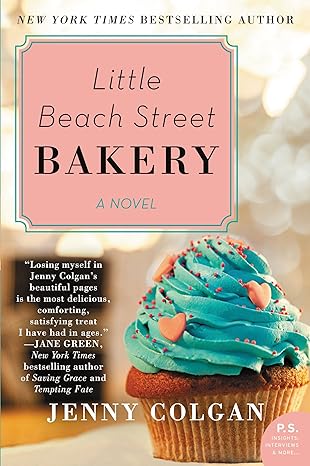
This review is a bit late, but hey, better late than never, right? I listened to my first Jenny Colgan novel a few weeks ago, Little Beach Street Bakery (2014), and while I enjoyed the story and found it cute, the audio does the experience absolutely no favors.

The narration took me completely out of the story, aging the characters significantly more than they are which does create a bit of a disconnect, and that voice for the American…. what even was that? Does no one know what someone from Georgia sounds like? I would have stopped listening because it was painful, but I’m no quitter.  The point of this little rant? Read the book, but don’t bother with the audio.

Wait. Rant not over. Why is there a cupcake on the cover? She bakes bread. Did the cover designer even read the book?!?

Okay. Rant now over.

The book is cute. There is some questionable treatment of cheating and moments that make you really not care for Polly, our leading lady, but there are some fun moments – mostly involving a puffin that becomes a pet while Polly gets her life together.

It’s a good candy book.

OATHBRINGER – Brandon Sanderson

“We could just skip the boring part.”

“Skip?” Wit said, aghast. “Skip part of a story?”… “You wound me.”

I’ve said before and I still believe that Wit/Hoid is Sanderson in his works. This particular quote comes at a point in Oathbringer (Tor 2017) where I was starting to get over the story – I just wanted to be done.  Dare I say, I was bored, and I really wanted to skip some parts.  Then Wit steps in to call me out. Get out of my head, Sanderson.

2025 is my year of Sanderson. To date, I have read five Sanderson novels. Oathbringer is my least favorite.  That doesn’t mean it’s bad by any stretch of the imagination, it just didn’t hit the same. I am extremely glad I read Edgedancer and Warbreaker before because Lift and Azure give me such joy in Oathbringer when they show up.

Our main players are still there. Kal and Bridge Four take a bit of a back seat to Shallan (and Veil and Radiant) as she struggles with her identity. Bridge Four will gut you though – with Moash, Teft, and Rock breaking your heart. (I really thought I was going to see Moash’s redemption arc in this one. Color me heartbroken.) We get to visit Shadesmar, which is a terrifying and intriguing place. And we get a lot of Dalinar’s past – and it’s not a pretty past. More evident than in the first two of the series, all our leading ladies and gentlemen have to confront their pasts – and there are some wicked skeletons in those closets.  (Why won’t he say the words?!?!!) And folks die. Unexpectedly.  Oh and the moment between Renarin and Jasnah? What does it mean for Renarin? Will Jasnah keep those secrets? Oh yeah, Jasnah is back. And back in a BIG way.  Meet your queen.

I do not regret going on this journey.  And even though I found Oathbringer a bit more of a slug, I would 100% recommend embarking on this journey.

SMALL COUNTRY – Gaël Faye

“I was born with this story. It ran in my blood. I belonged to it.”

Current installment of Tommi Reads the World – we’re still in the Bs.

Country: Burundi
Title: Small Country
Author: Gaël Faye
Language: French
Translator: Sarah Ardizzone
Publisher: Éditions Grasset 2016; English translation published by Hogarth 2018

Bordering Rwanda, Burundi is a small African country embroiled in political unrest and violence.  A decade-long civil war began in 1993 when the country’s first democratically elected president (Hutu)   was assassinated by Tutsi opposition in the military.  The conflicts between the two ethnic groups, Hutu and Tutsi, had long been exploited by the western world, and ultimately came to a head in the 1990s.  This is the country  Gaël Faye was born to in 1982, and the country he had to flee at age 13. 

Small Country is Faye’s story of ten-year-old Gabriel, whose childhood is stolen when the country he loves erupts into chaos; and while short, it is mighty. Gabriel’s mother is from Rwanda, having fled genocide and escaping to Burundi.  Gabriel’s father is a white Frenchman, clinging to the privileges remaining from Belgium’s colonial rule. First, Gabriel’s home life is upended when his parents separate. Then his country weeps and bleeds as his childhood is taken in the time it takes to spark a flame.

 Faye has ripped his chest open to show us how he bleeds, to highlight the nervous condition of the exiled, to scream of a lost childhood, a lost country, and the lost lives.  This novel positively blew me away; it’s likely my favorite thus far in my “Tommi Reads the World” list.

Read this book.

TIME SHELTER – Georgi Gospodinov

“Now, there’s everything you need to for a true beginning  – bad dreams, war, and a headache.”

“I had already lived through what was to come.”

Current installment of Tommi Reads the World – we’re still in the Bs.

Country: Bulgaria
Title: Time Shelter
Author: Georgi Gospodinov
Language: Bulgarian
Translator: Angela Rodel
Publisher: Liveright Publishing Company 2022 (originally published 2020)

Georgi Gospondinov’s Time Shelter, translated by Angela Rodel, was the winner of the 2023 International Booker Prize, marking the first time a Bulgarian novel won the prestigious award. (Most of you know I read the Booker Prize longlist every year; I’ve not added the International Booker Prize longlist to those endeavors. Yet.)

Time Shelter is a unique sci-fi novel that barrels headfirst into a dystopian future while also giving us a Bulgarian history lesson.  The translation is perfection – the novel smooth gliding without any stiltedness that sometimes comes from translations.  And the writing is simply stunning. This is an extremely well-written, well-crafted, and well-developed story. It’s witty, darkly humored, but also soft and comforting, like toast. I can see how it won the International Booker Prize.

The novel centers around “clinics” for memory loss patients, primarily Alzheimer’s patients. These “clinics” are “time shelters” – the shelters being more akin to time capsules that provide protection like bomb shelters. Patients are placed in “clinics” that are entirely composed of things from a time they remember. (Right down to the cigarettes they smoke and the news that’s delivered.) The 1960s are heavily featured, but so is the time just before WWII. The success of these clinics results in the world cashing in – countries are voting on which decade they should “rejoin” and what began as a treatment center becomes a profitable (and dangerous) reenactment movement.  To quote Taylor Swift, “I think I’ve seen this film before, and I didn’t like the ending.”

Read this book.

WILD DARK SHORE – Charlotte McConaghy

“I loved a landscape and watched it burn.”

I really enjoyed Charlotte McConaghy’s Once There Were Wolves (2021), and Migrations (2020) has been sitting on my TBR cart for years, so picking Wild Dark Shore ( Flatiron Books 2025) as my BOTM selection was a no brainer.  I was a bit concerned that it would fall into the “trauma porn” category that I found Once There Were Wolves teetering into (not my fav), but I think WDS delicately dances around it a bit more, resulting in that five-star read I wouldn’t give Once There Were Wolves.

The page count of 298 is misleading; this is an extremely short novel, rapidly propelled forward by short sections. I read it in one sitting before bed, and yes, I did cry.  The part that was my undoing?

“I will go back with your body now. This beautiful body. This strong body that endured all it could. I will stay with it, I will wash it and wrap it and hold it as we leave this place. I will carry it across the sea, and I will return it to your land, to live among the snow gums. It is just a body but it was yours, and beloved.”

Now, I’m not going to tell you who was speaking or who they were talking about, because I’m not spoiling this novel.  But people die.

This is the novel of the Salt family, Dominic and his three children, Fen, Raffy, and Orly. They are all that remain on what had once been a research island that houses a seed vault. The researchers have left and Dominic, as caretaker, is tasked with packing up the seeds to be moved. The sea is reclaiming the land, and it is no longer safe. One night, a body catches Fen’s eye.  It’s breathing.  They pull Rowan from the sea, and the four become five. But Rowan has a secret – she’s there looking for her researcher husband. The Salts have their own secrets, including what happened to her husband.

The island teems with wildlife, a history of poaching a trauma that still soaks the land. The Salts all have their own relationships to the island – some with the animals, some with the seeds, and some with the ghosts that inhabit its shores. It’s an island of skeletons and secrets, blood and bonds, lies and loyalties. Rowan, despite her attempts not to, develops her own relationship with the island.  And the Salts.

It’s a novel of motherhood and choices, mistakes, misunderstandings, and forgiveness. Of turning trauma into something still broken but beautiful. And that ending, while many will hate it, is perfection.  Because a choice has to be made, and that choice both shatters and heals.

Read this book.

OATHBOUND – Tracy Deonn

“What is a bargain if not an oath? And what is an oath if not a promise with a price? Call these what you will. All are cut from the same cloth -a cloth woven of intention, will, and sacrifice.”

The long-awaited third installment of Tracy Deonn’s remarkable The Legendborn Cycle was released this past Tuesday.  I finished Oathbound (Simon & Schuster 2025) on Wednesday; I could not put it down. I said previously that Bloodmarked “is soaked in grief and anger, with legends and lore at the crossroads where history tends to be remembered by those with the most power and a different history rests in the roots and blook-soaked soil.” In my review of the second installment, I echoed back to my review of Legendborn, stating:

“Deonn boldly stares down the traditional fantasy canon while giving the reader an Arthurian legend unlike anything Tennyson or Malory could have imagined.  She gives her reader Merlin and the magic expected from the likes of a kingsmage.  But she also gives us rootcraft and generational power.  She gives us Bree.”

And she keeps giving us Bree.  And while the grief and anger remain in Oathbound, there is a resilience, a relentlessness, a reckoning that roars.  Deonn continues to throw the canon on its head, which I love.  And while I anticipated that book three would give us more of the Morgaines, which it does, it gives us more bonds of loyalty, maternal connections, and reminds us that no man, or woman, is an island.  Bree has to lose herself entirely to find herself. So does Nick.  So does Sel.

And that ending, with Bree, Nick and Sel as that triangle, tells me this round table is about to be shattered even more – King Arthur needed his knights; Bree needs her people. I’m not going to say anything more because this book, from its layout to its plot, needs to be experienced.   But know this book was unexpected and somehow exactly right.

And yes, we’re back at Carolina and also in Asheville.  The books still feel like home.

WRITTEN IN BLACK – KH Lim

“There’s a Malay word called geram, and it describes a feeling that no English term I know could properly communicate. Imagine the worst itch in the world, an itch one hundred times worse than the itchiest bite that the itchiest mosquito could ever give you, but that it’s inside you, stirring up all your internal organs and agitating them to the point where you’re on the verge of clawing and tearing them out with your bare hands if only to make it stop.”

Current installment of Tommi Reads the World – we’re still in the Bs.

Country: Brunei
Title: Written in Black
Author: KH Lim
Language: English
Translator: N/A
Publisher: Monsoon Books 2014

There are not a lot of novels coming out of Brunei. Literary tradition in this small Asian country consists of oral storytelling, poetry, and epics, and while there does seem to be an active and exciting effort to make Brunei’s literature more readily available, my options were extremely limited.  Written in Black is set in Brunei. KH Lim was born and raised in Brunei, and he is currently a medical doctor in Singapore.  In the acknowledgements, he welcomes readers to learn more about Brunei utilizing other resources (as his book is not intended to nor should it be our sole education) or visiting the country.

The novel is a brief snapshot in the life of Jonathan, a ten-year-old boy whose grandfather has just died.  The cover is a bit misleading because it would appear he floats down a river in casket, and while there is an “escape” via caskets, it’s not down a river. The name derives from Jonathan’s preference (possibly obsession) with writing in black ink. His teacher insists on blue, but Jonathan prefers black.  Particularly from his G2 pen.  (I get that.  I love a G2.)  He is a Huckleberry Finn loving middle child who gets into a bit of trouble, but usually always for the right reasons. His mother has left them, and no one is really being honest about why and when or even if she’ll be back.  His older brother has been kicked out of the home.  And now, his grandfather has died.  Jonathan, along with his sister and younger brother, must attend the funeral.

Jonathan goes on a “quest” to find his brother and bring him to the funeral.  Along the way, he meets a few unsavory characters, including glue sniffing poklans, which he likens to the pirates of Brunei’s past. It’s a bit of a funny epic that hints at Huck while still being very much Brunei.

I look forward to seeing more literature out of Brunei.

DEATH OF THE AUTHOR – Nnedi Okorafor

“Tomorrow is where my hope lives. I can’t be normal, so I’ll be something else.”

“I will spread the word like a virus.”

All aboard the hype train – Choo! Choo! Nnedi Okorafor’s Death of the Author (William Morrow 2025) is a beautiful marriage of literary fiction and science fiction that scratches a particular itch. If you’re new here, hello.  If you’re not, you know I love genre-blending, hard to pin down and label books, particularly if the writing is sharp and fun. I’m not new to Okorafor as I’m familiar with The Nsibidi Scripts series, but this is the first non-middle grade Okorafor for me.  I loved it.  There’s something that made me think of Thomas Pynchon’s V., but my most recent robot read was, of course, Klara and the Sun – that’s a good comparison namely because it is heavy on the lit fic as well.

Death of the Author is a book within a book.  Zelu, a paraplegic author, has written a remarkable novel, called Rusted Robots. This novel, unlike her previous works, gives her insta fame and insta cash.  She becomes an international sensation.  In addition to the book within a book, there are also interviews with Zelu’s family members and loved ones.  Rusted Robots unfolds on the pages in snippets as Zelu’s life takes on a new trajectory following its publication.

There’s a lot to unpack with the novel. Zelu is an outsider.  She is Nigerian American, her parents are Igbo and Yoruba, which already makes her a curiosity in both America and Nigeria.  Added to that, she is paralyzed as a child and confined to a wheelchair.  There are issues of colonialism, ableism, fealty, tokenism, cancel culture, generational trauma, and the nervous conditions of the diaspora.  And then there’s Rusted Robots, a world where humans are extinct and robots roam Lagos, the two primary groups being Humes (who look like humans) and Ghosts, who don’t need a body.  Both stories will test loyalties and love, define and redefine “family,” and push boundaries.  And they bleed into each other in the most exciting ways.

This is a novel that needs to unfold in its own time, revealing its secrets when you read it.  As such, I’m not going to say much more.  Except for be prepared to want egusi soup and fufu.

Read this book.

WE ALL LOVED COWBOYS – Carol Bensimon

“All great ideas seem like bad ones at some point.”

Current installment of Tommi Reads the World – we’re still in the Bs.

Country: Brazil
Title: We All Loved Cowboys
Author: Carol Bensimon
Language: Portuguese
Translator: Beth Fowler
Publisher: Companhia das Letras 2013; English translation, Transit Books 2018

We All Loved Cowboys is a queer, coming of age novel that both seems too short and too long. It’s a slim volume that flashes between present and past, sometimes without warning, but is centered primarily on a road trip between ex-lovers who haven’t seen each other in years. Cora is bisexual but primarily attracted to women – typically straight women.  Julia is closeted.  Their relationship is one of secrets and shadows, lovemaking in the dark or hurried in public restrooms. Cora never felt good enough, and Julia was never fully invested in the relationship.  With one foot always half out of the door, Julia made arrangements to move to Canada without even bringing it up to Cora until it was done. That is what broke their relationship, which had become essentially friends with secreted benefits. But a chance conversation, a moment of weakness in both women, and suddenly plans are made to meet back in Brazil (Cora’s been living in Paris) for the road trip they’d always talked about going on. What could possibly go wrong?

Both women have grown up during the few years that separated them, but there is still resentment, anger, frustration, passion, and love between the two. Can they figure it out before their road trip comes to an end?

EDGEDANCER – Brandon Sanderson

“I gots magic spit.”

You’re likely going to get sick of me talking about Brandon Sanderson, but, as you’re aware, it is indeed the year of Sanderson.  My second February selection is Edgedancer, a “novella” (though arguably more of a novel) that is part of The StormLight Archive.  I believe it’s best referred to as #2.5, fitting neatly between Words of Radiance and Oathbringer, that brings us back to an “Interlude” in Words involving a young street urchin named Lift. Lift is smart-mouthed, uncouth, and forever hungry.  And yeah, she “Awesome”  because she is, of course, a Radiant.  Bound a child, Lift’s spren, Wyndle, assumes a bit more a babysitting role with her, his frustration and disappointment a mask for the feelings he has readily developed for the young girl.  She doesn’t know the rules, and he can’t tell her.  So, he just has to make sure she doesn’t kill them both.

A man with a shardblade, an executioner known as Darkness, is seeking her and others like her out; his mission, while tied to that of the Assassin in White’s, is a little different.  He is trying to stop the return of the Radiants; he just doesn’t understand he is too late.

Edgedancer is a bit different because it’s much shorter, a snapshot of moment for this Radiant, a little more juvenile, and Lift is an extremely annoying (and lovable) child. I’m fascinated that her powers are fed by literal food not stormlight, making her a bit of an oddity. She’s nomadic, never wanting to stay in one place long, and struggling with choices she made, expectations, a power that is still a mystery to her, and a hunger that gnaws at her.

Sanderson better not make her and Wyndle a casualty of the storm.