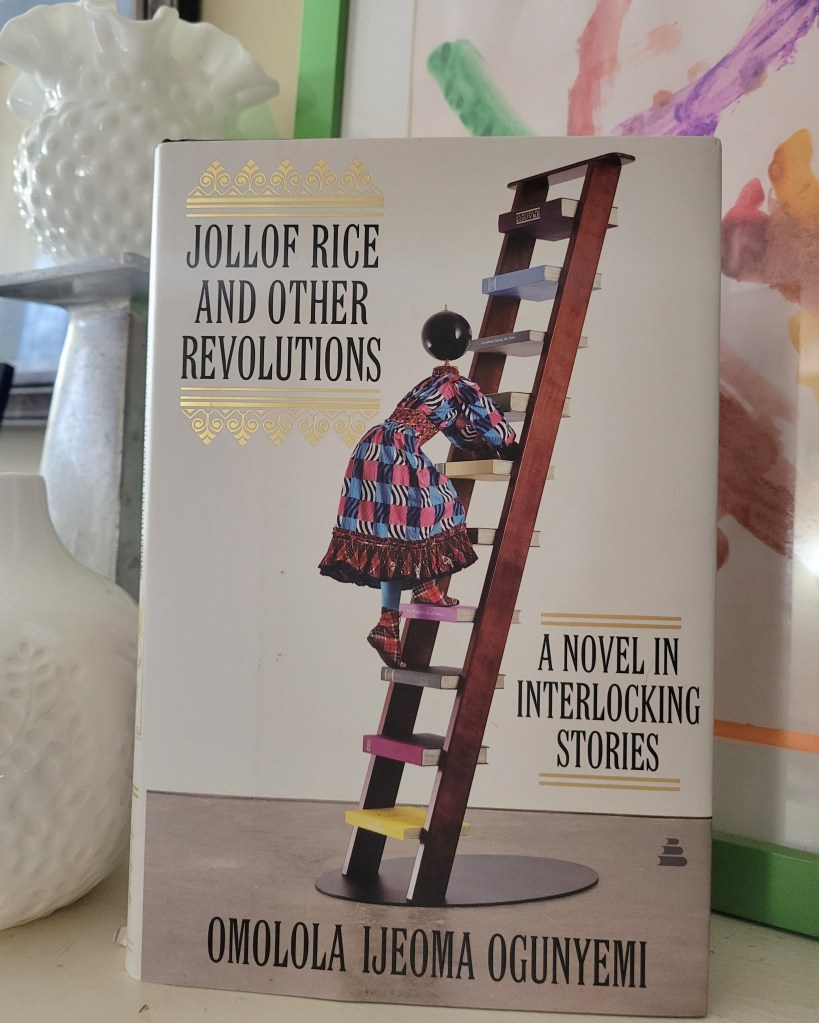
“…oga dinma, oga dinma, it will be okay. Today. Tomorrow. Someday.”
Omolola Ijeoma Ogunyemi’s Jollof Rice and Other Revolutions: A Novel in Interlocking Stories (Amistad 2022) is my favorite kind of short story collections – the kind where the stories weave in and out of each other, building the reader’s connection to a full cast of characters. With themes of infertility and child loss through both death and distance, the collection is primarily one of women. (With the exception of “Reflections from the Hood of a Car,” which centers on police brutality and discrimination in Nigeria and later the US.) At its heart, are Nonso, Remi, Aisha, and Solape – four young friends in boarding school. Two are involved in a revolution. Two are arrested. One dies. Their young attempt to effectuate change at their school and the consequences that spill from it touch their lives as they grow up.
My favorite story is likely the first – “Fodo’s Better Half,” which is set years before the incident at the school and involves a beautiful and talented woman who is infertile but who greatly desires to have a family. Her outside the box approach clashes with the Western world’s growing hold on her country, and she flees with Uchenna, a boy she considers her son who is of no blood relation. (Uchenna is Nonso’s uncle and he appears in another story as a much older, and richer, man.) “Goody Goody,” about a mother’s aging grief and how she holds on to the memory of her daughter is also a favorite. The last story, “Messengerna,” is an interesting departure from the other stories as it takes a rather futuristic and bleak look at America in 2050; it’s an interesting book end to the collection that starts in 1897.
I’m trying to make a better effort to read more short story collections, and interlocking remains my favorite way to go unless I’m going to piecemeal a collection. Since, I don’t read in short bursts, that doesn’t work best for me. I really enjoy Nigerian literature (though it will always make me hungry!), and this was a very “easy” collection. While I’d have loved to see hundreds of pages of Nonso, Remi, Aisha, and Solape, I know that wasn’t the intent here. For a short story collection, this was well done as is.
Read this book.
 A Girl Named Tommi