“You liked animals, too, Helen. They are dreams made of flesh.”
I loved Yann Martel’s Life of Pi. I read it while traveling to Cambodia back in 2003, and that paperback remains one of my most prized possessions. When I run my thumb over the red-dirt stained edges, I’m immediately transported back to when I read it. My memories bled into the story and have been stored there, and that makes my copy priceless.
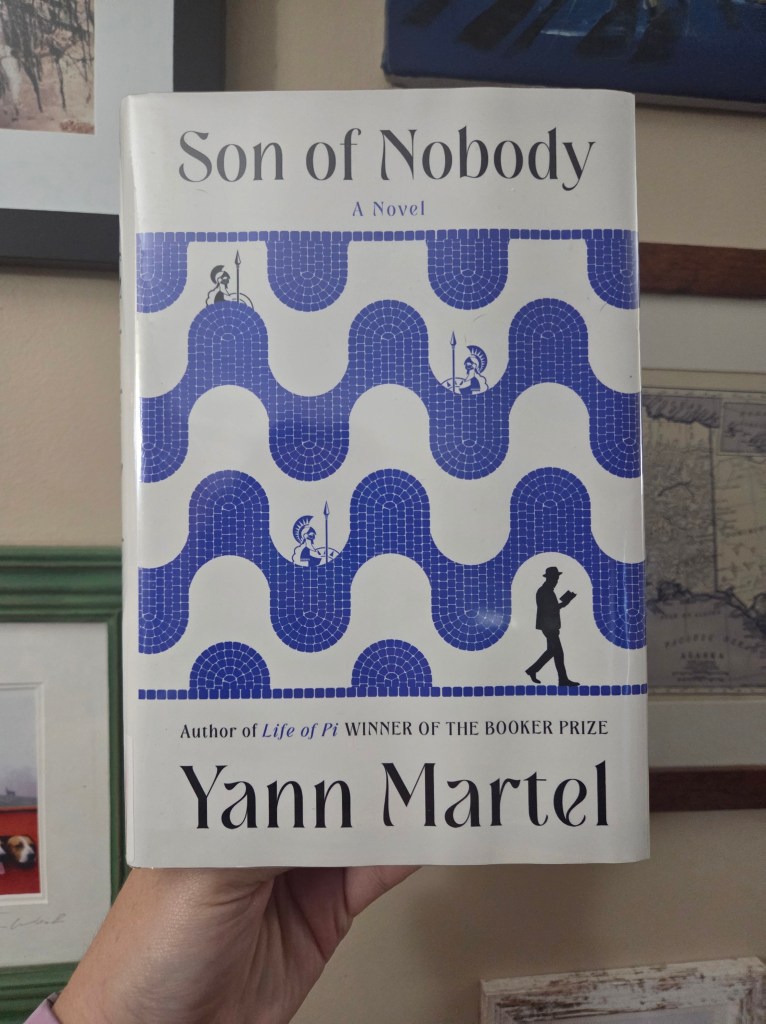
I haven’t been nearly as smitten with Martel’s later works, but that didn’t stop me from eagerly anticipating his 2026 release. In so many ways, Son of Nobody (W.W. Norton 2026) is a grown-up Life of Pi, and I loved it. It’s not like Life of Pi and it’s doubtful to have even remotely a fraction of the commercial appeal that novel had, but Son of Nobody is brilliant. Structurally, it’s similar to Life of Pi in that two stories are being told and that truth and fiction blend but the role of storytelling and narration in Life of Pi dealt with survival, whereas here, the blend of the two in the narration deals with loss. I also think Martel’s frequent use of animals in Son of Nobody isn’t just because the narrator is telling a story to his young daughter and “children like animals” – I think it’s a nod to Life of Pi and its roaring success.
Son of Nobody is set-up as a scholarly publication, with a “translated Greek epic” taking up the top half of the page and the story of the scholar unfolding in the “footnotes” at the bottom. I really think this should be read in print to fully appreciate that setup.
Harlow Donne is our scholar, and he’s gone to Oxford where he is translating and interpreting an Ancient Greek epic about a commoner, Psoas, who leaves his wife and children behind to fight at Troy. Harlow has left his wife and daughter, Helen, to further his studies at the prestigious Magdalen College of Oxford University. (I studied Shakespeare at St. Edmund Hall of Oxford – perhaps that’s why this one settled in my bones as it did.)
As he translates the Greek epic, tragedy strikes. Harlow begins to take certain liberties with his translation, bending a narrative that is so formed by grief, guilt, and his love for Helen. The outcome is a literary feat that has heart. I would not be surprised if this novel sees a return of Martel to the Booker longlist.

