“If my geese ever dream, they alone know that the world will never be allowed even a glimpse of those dreams, and they alone know the world has no right to judge them. I live like my geese.”
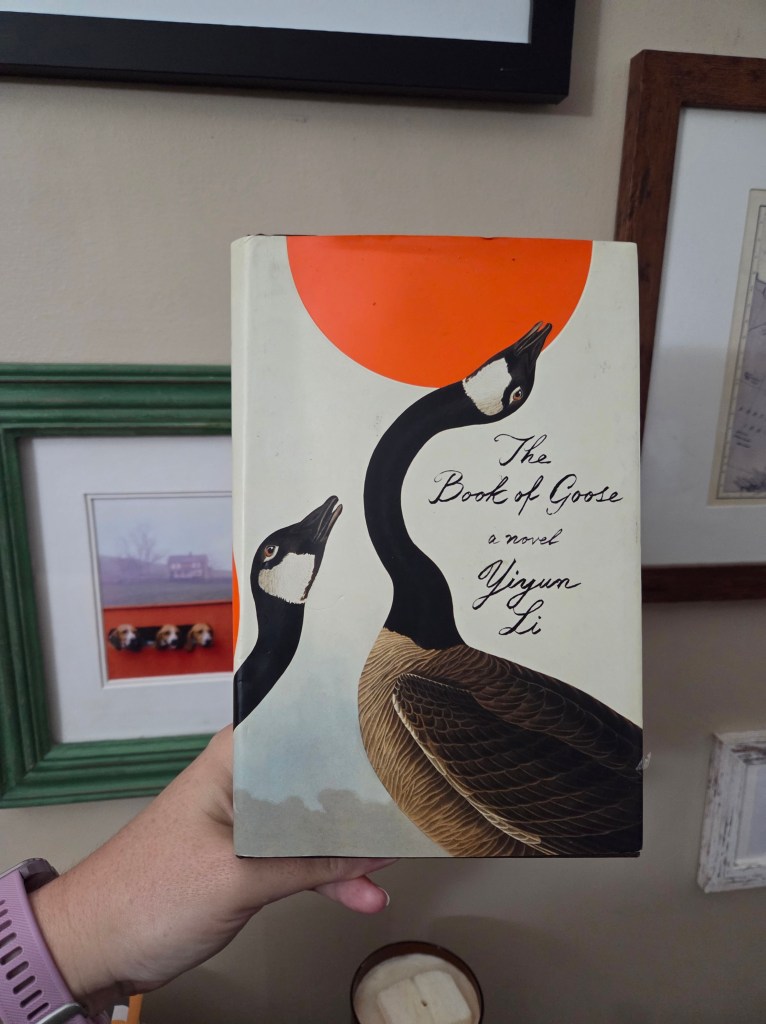
Despite this being my “library” year, I am getting to some of the books on my physical TBR when there is a lull in holds. Yiyun Li’s The Book of Goose (Farrar, Straus and Giroux 2022) was one where the cover and blurbs first caught my attention. And while I think the novel is beautifully crafted and the writing is just exquisite, I am going to complain about the cover choice. It’s another situation where I wonder if the cover designer even read the book or just saw “goose” and said, “these Canada geese would be perfect.” Spoiler – they’re not. Again, I love the art – just not for this book.
Canada geese are not domesticated. They are also not native to France. Even though Agnes is living in America when she’s telling this story of her childhood and she is raising geese in America, she’s raising Toulouse and Chinese geese. Canada geese make no sense for the cover. A pair of Toulouse geese would have been absolutely perfect. Or, if you want to say that Agnes is akin to a wild goose, pick a Greylag! But again, the perfect breed of goose for this book, for the story of a woman who grew up on a farm in France after the war with geese and goats and bunnies who moved to America and raises geese and is called “mother goose” by her in-laws… TOULOUSE WAS RIGHT THERE!
Now that I’ve gotten that off my chest, this story of Fabienne and Agnes, two girls growing up in rural France after WWII, best friends as different as night and day, is heartbreakingly beautiful. Fabienne, wild and unruly, leads the pair, with Agnes willingly joining in on the games she creates. When she decides to write a book, Agnes agrees. Fabienne tells the stories and Agnes writes them down. A widowed postman helps them form the book and finds a publisher. Fabienne decides that only Agnes’s name should be on it. The book is a success, and Agnes is heralded as a child prodigy for her unflinching look at postwar rural France. The “game” isn’t fun anymore, and Agnes wants out.
It’s a novel of girlhood, love, postwar France, loss, rural upbringings, poverty, escape, secrets, hunger and truth. And geese, but I’ve already talked about that.
Read this book.

