“In this way, my work has sustained me when people could not.”
“My house had been holding its breath for a long time.”
“No, he will not come when called. He is no dog.”
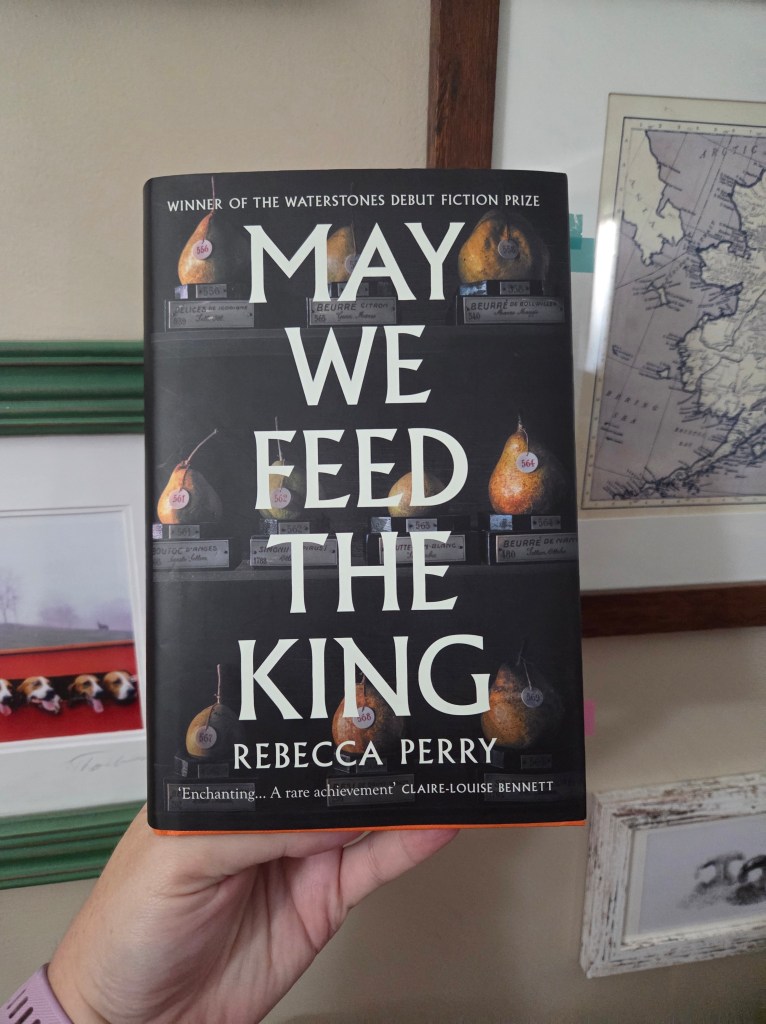
Rebecca Perry’s May We Feed the King won the Waterstones Debut Fiction Prize before being longlisted for the Booker; there is understandably a lot of hype around the novel. Is it worth the hype? I wrote before that this novel may be at least part of the reason why Martel’s Son of Nobody wasn’t listed as they are simply too similar. (Martel has a scholar translating ancient text and blurring the lines between history and present. Perry has a curator setting a historical scene and blurring the lines between history and present.) For me, I liked how Martel did it more. That said, May We Feed the King is a remarkable debut. It may possibly be slightly overhyped, but I don’t hate it on the longlist.
In this novel of dual timelines, we have a curator commissioned to set 6 scenes for the 750th anniversary of a former palace turned historic site. (The fact no one knows what the anniversary is actually for is a fantastic detail.) The unnamed narrator purchases numerous replicas, particularly food, to incorporate into the scenes. She wants to be alone in the palace, to “see” the scenes. A wee bit of a romance, one of longing looks and dreams, emerges with the archivist. The narrator is dealing with a loss. Her partner has left, the house is empty, she is unmoored. This loss combined with the longing for the archivist makes its way into her scenes.
The second timeline deals with the king who does not wish to be the king. (One review says it’s a novel of two people who are horrible at their jobs. Three if you count the author. Ha) He’s soft, more content to be with his cats or learning how to make a cinnamon cake than ordering executions and forcing his will on his subjects. There’s no heir forthcoming. The Queen is sleeping with the physician’s assistant, and the King prefers the company of his young male attendant. As his story unfolds, the reader gets glimpses of the curator. The King feels like he is being watched from windows, closed trunks, and keyholes. This is the curator. Much like Martel uses animals that are not historically accurate in his time and place, Perry references the “guava flesh” that the King “has no knowledge of;” the curator openly admits she’s not that concerned with accuracy.
It’s a novel of how the present reworks history, how the replica is never as good as the experience, how the teller inserts themselves in every story. And it’s about escape.

