WARBREAKER – Brandon Sanderson

“But time burns away behind us, leaving only ash and memory. That memory passes from mind to mind, then finally to my lips.”

After finishing The Way of Kings, someone recommended that I read Brandon Sanderson’s standalone Cosmere novel, Warbreaker (Tor 2009), before proceeding any further with The Stormlight Archives.  Color me intrigued (do you see what I did there?!?) so I ordered the book and added it to my Sanderson stack. Two Sanderson’s a month might be a little ambitious, but Warbreaker isn’t nearly the behemoth of the Stormlight epics. I would have made quick work of it, but for some general blahness (me not the book), and then when I was fully hooked, cross-legged on the bed, hungrily devouring each word, I reached the end.  Huh, I thought.  Everything stopped abruptly, and I was thoroughly confused. Then I realized I WAS MISSING THE LAST 30 OR SO PAGES. Annoyance quickly replaced confusion. Colors! What’s a girl to do?  This girl promptly ordered a new copy and waited, nose pressed to the glass, for it to arrive.  (Yes, I know the full text is available for free on his website, but I need to hold books, smell books, feel books.  It’s a me thing.)

Warbreaker is another example of excellent world and character building where the plot never dwindles while the world is built up around us.  It opens with a jail break and murder and colors, magical and fantastical powers.  And a sentient sword named Nightblood.  (Two books in, and I’ve a lot to say about Sanderson’s powerful prologues!) What follows is the tale of two princesses, one who has spent her entire life training to be sent to marry the God King as per the treaty between her homeland Idris and Hallandren, the land she is a true heir to.  And the younger sister, often disregarded as insignificant, is ultimately sent in her place. The decision by their father baffles and hurts them both.

Siri marries the God King, and her sister, Vivenna, steals away from Idris to save her sister but also to find a new purpose.  There are stunning lesser gods with witty banter and bumbling mercenaries with secrets. There are colors, powerful and magical.  There’s an army of Lifeless awaiting their commands. There are secrets.  There is political upheaval and secret passages and “awakened” disruptive rodents.  And then there’s Nightblood and the man who carries it.  There’s romance. There’s power.  And there’s Hoid, a character from The Way of Kings that I suggested (and still believe) is Sanderson putting himself in the text.

My only complaint was with Siri and Vivenna’s father.  I felt like he deserved a bit more – his treatment of his daughters was a bit unrealistic, especially after the reader was given a little glimpse into his head.

All in all, solid read. 

Read this book!

WE WILL BE JAGUARS – Nemonte Nenquimo & Mitch Anderson

“laughter was jaguar medicine.”

In 1956, Nate Saint and four other missionaries, were killed by the Waorani people of the Amazon. His sister, Rachel Saint, felt some sort of connection to the location and the people, and made it her life’s mission to “save” them.  This is the still shielded world Nemonte Nenquimo was born into in the 1980s.  We will be Jaguars: A Memoir of My People (Harry N. Abrams 2024), cowritten with her husband, Mitch Anderson, is her story, the story of her people, and the story of colonization and destruction. Every so often, I read a book that makes me long to sit cross-legged on Gay’s floor, surrounded by stacks and stacks of books, and talk about the “Three C’s” of colonization – Christianity, Colonialism, and commercialism – and how Nenquimo beautifully and brutally captures a childhood marked by all three.

When Nemonte is a little girl, all she wants is a dress.  A beautiful dress that falls past her knees and billows in the breeze.  The dresses are handed out to the children who attend church.  When her brother becomes ill, her family reaches out to Rachel Saint and the church. Nemonte gets a dress. She eventually gets a “Christian” name – becoming Inez. She craves the things of the modern world – their clothes, their teeth. Her innocence is repeatedly taken by a missionary, her voice nearly forever stuck in her throat when she realizes his wife knew. What follows is a young woman struggling with identity, forever stuck between her people and society.  In time, she finds her way back.  She hears the jaguar and finds her voice, her history.

Nemonte turns to activism, focusing on how drilling for oil has decimated her people and the land. How lands and stories and lives had routinely been stolen from the Waorani and other tribes.

We will be Jaguars prowls and pounces, never skittish.

Read this book.

CALL AND RESPONSE – Gothataone Moeng

Current installment of Tommi Reads the World – we’re still in the Bs.

Country: Botswana
Title: Call and Response
Author: Gothataone Moeng
Language: English
Translator: N/A
Publisher: Viking 2023

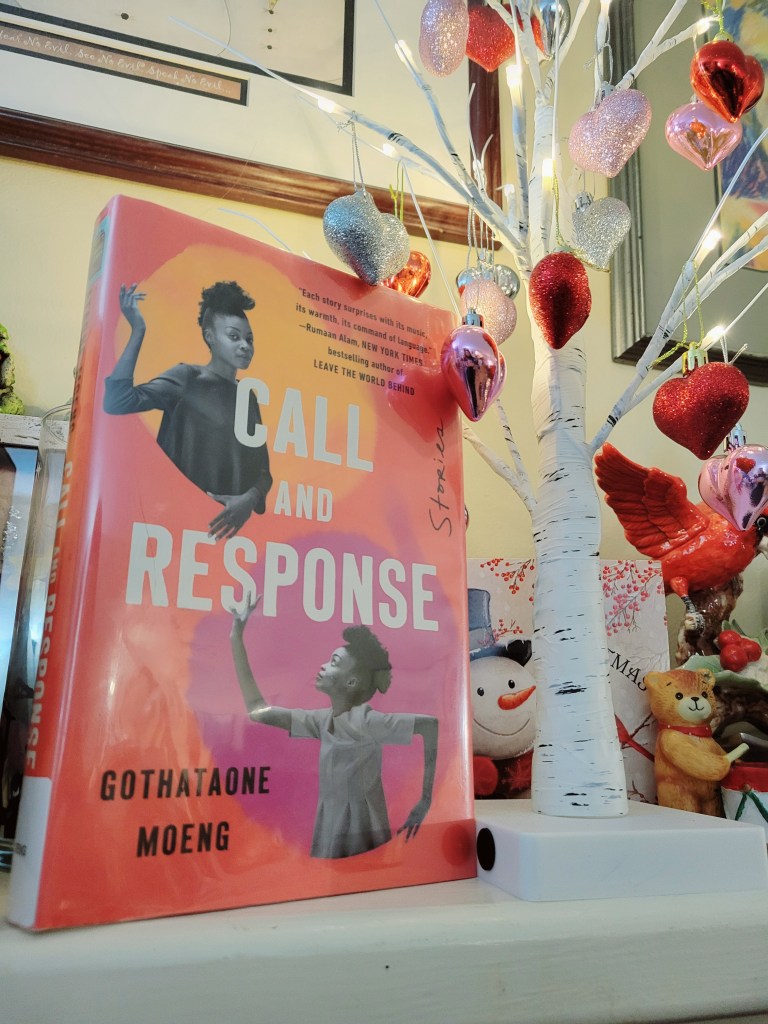
It’s been a bit since I’ve done a “Tommi Reads the World,” but I’m back and we are STILL in the Bs. Call and Response is a collection of stories that really reads more like a love letter to Botswana.  The stories feature characters who are both clinging to tradition and longing to escape, as well as those who have returned after leaving.The title of the collection comes from “Dark Matter” and evokes an almost religious experience in Nametso returning home after years in the states.  The severe HIV/Aids epidemic is touched on in Botalaote, as a young girl cares for her dying aunt, whom she just calls the “patient” while she wants to enjoy a wedding. My favorite story was likely “Small Wonders,” about a woman dealing with the untimely passing of her husband, the traditional grief process, and her continued grief.  “Early Life and Education” is the longest story in the collection, and it seems as if this was intended to be a full length novel that never got the flesh on its bones. It was my least favorite.

The collection is a powerful one of girlhood and womanhood, but also simply of “home.” 

Read this collection.

REAL AMERICANS – Rachel Khong

“Every book I’d read led me further away from her, from the life we once shared.”

Rachel Khong’s Real Americans (Knopf 2024) is a beautiful but frustrating novel, frustrating because of the missing parts. Divided into three sections, into three generations, the novel halts every time it starts to dig into the meat of the matter.  It is heavy with potential, but those story lines slam shut in favor of starting all over with someone else and some other, but related, moral dilemma. At its heart, the novel is about gene editing, including prenatal, and the bioethical issues that stem from it, but discussions of gene editing are cursory at best. The writing is beautiful, but it is fragmented and sometimes forced. Just give me May’s story.  And all of it.

Lily is the American-born daughter of two geneticists. Her parents had fled China, but they never talked about it. She was raised “American” – eating American food and speaking only English.  The novel opens with her as an unpaid intern, trying to make it in New York. Kismet has her meet Matthew, gorgeous and lucky, at a company party. In time, she learns he is Matthew Maier of Maier Pharmaceuticals.  She learns they have shared childhood experiences of living in the same area. Kismet indeed. They get married, struggle with pregnancy, and eventually welcome baby Nico. The section slams shut when we learn that not only had her parents known his before she was born; she’d been “treated” by his father.

The next section follows Nico, now Nick, in high school. Nico does not appear even a smidge Chinese.  His father, Matthew, is an unnamed and empty figure. This is one of the more unbelievable parts of this story – that with all the money and all the “scientific data” in Nico, they’d let him go. He’s been told his grandparents are dead.  A DNA test leads him to the Maiers and the truth, and they hide their relationship from Lily. Nick leaves the west coast for college on the east, hoping to study biology, seemingly the perfect heir to the Maier empire. He is the exact image of his father, who was the exact image of his father. Unlike Matthew’s other son, Nick has work ethic and a powerful drive reminiscent of his grandmother. This section hurtles forward, covering a lot of time and information in a brief space, before we find Nick reconnecting with his mother’s mother, the woman he thought was dead.

We finally then get May’s version of events, which starts in the southern basin of the Yangtze River when she’s a young girl.  Here is where the novel finds its heart in the story of young girl who advances to college, despite the cards she’s been dealt, and who ultimately flees China by making a choice of survival over love. Her passion and drive in her study of genetics secures her employment and a life in the US. Science is her first love, evidenced in everything she does. But once again, we have huge gaping holes – what happened after Lily learned what her mother did.  What happened in the years between the end of Lily’s section and the start of Nick’s? And where is the clear battle between science and maternal instincts? Whispers. Cursory statements. Missing pieces.

I wanted more.
THE WAY OF KINGS – Brandon Sanderson

“Szeth-son-son-Vallano, Truthless of Shinovar, wore white on the day he was to kill a king… White to be bold. White to not blend into the night. White to give warning. For if you were going to assassinate a man, he was entitled to see you coming.”

“They were not demons, they were just men who had too much power and not enough sense.”

“The name of someone I should have loved. Once again, this is a thing I stole. It is something thieves do.”

Confession time: I avoided Brandon Sanderson in part because of the sheer volume of his catalog, but mostly because I first knew of him when he was tapped to complete Robert Jordan’s Wheel of Time series. Here’s the confession – I didn’t like the first half of the first book of series, and I stopped my journey after book one. Second confession – I DNF’d the first book in the Game of Thrones series; I didn’t like the storytelling style or the character building, particularly the female character building, but I DNF’d simply because of one phrase. (And I don’t DNF!) All that to say, I decided male authored epic fantasy just wasn’t my thing.

When I’m wrong, I’m wrong.

Because Brandon Sanderson writes epic fantasy in a way that reminds me of finding a book in the library, dropping to crisscross apple sauce right in the aisle, and starting right then and there. Of reading while walking and eating. Of staying up late and waking up early, a book under the covers. Of becoming head over heels invested in a world and a cast of characters. Of an untethered imagination.

I started my Sanderson journey with The Stormlight Archive, and I have zero regrets.  Every word in this 1001-page novel served a purpose. The character building is phenomenal as is the world building. A lot of times in fantasy, there is an information dump that slogs everything down. I was told The Way of Kings starts off slowly but is steamrolling along by page 800ish, and I was prepared for a slog of a dump. There’s no dump. No slog. It’s not all sword-clashing action, but it is most definitely action-packed. I will admit to being least drawn to Dalinar at the beginning and more to Kal, but that shifted toward the end as we started on the so-called Sanderlanche. With Shallan, I wanted both more and less of her. And Wit, well, I have a feeling Wit is a bit of Sanderson that is going to show up in everything he writes.

There are a lot of gems in the novel – one of my favorites being the notes women write in the books they scribe to “correct” the men who are dictating the words. (Most men can’t read or write because it’s a feminine endeavor.)

There’s a lot more I can say, but since 2025 is going to be my year of Sanderson, I’m sure I’ll get to saying it eventually.  The Way of Kings is near perfect, and I’m very excited for my Cosmere journey.

Come to the Sanderson side.  It has jam.

Read this book.

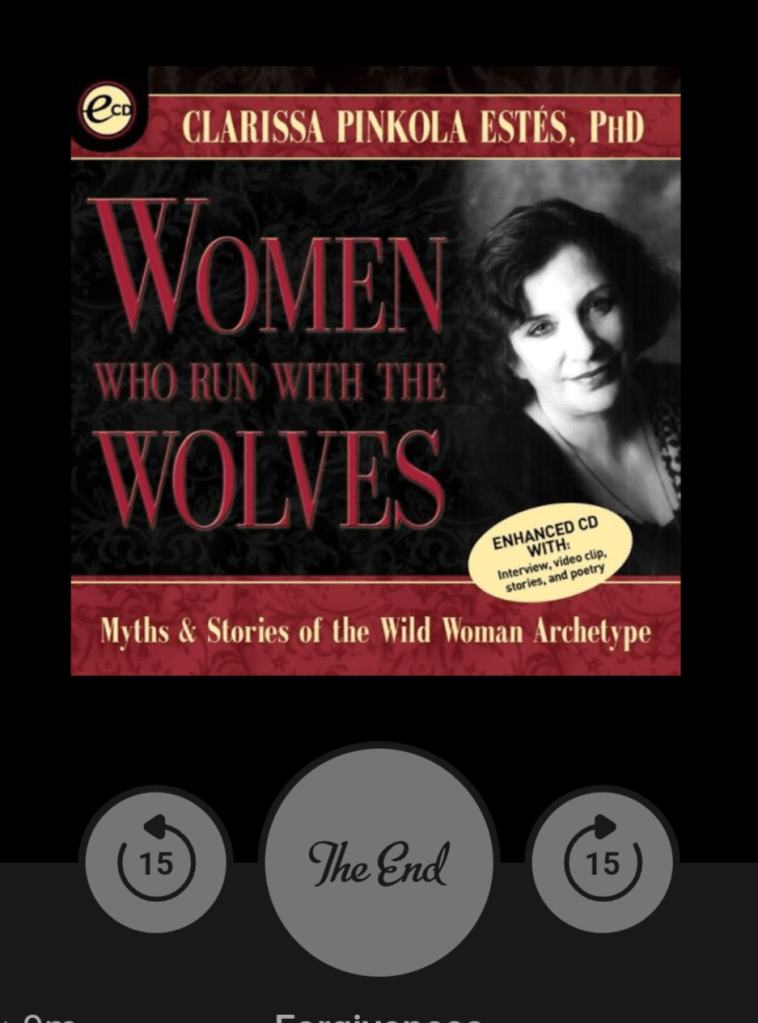
COUNTING THE COST – Jill Duggar

While doing my latest book nook, I listened to Counting the Cost, Jill Duggar’s 2023 memoir that was written with her husband, Derick Dillard, and Craig Borlase.  I had watched the Duggars with a bit of morbid fascination throughout the years, much like most reality TV, and was even more captivated when the religious house of cards came tumbling down. As truths about what the sisters endured and what their parents hid in the name of faith and the powers of TLC tumbled out in the media, I gobbled it up. Voyeuristic. I was a part of the problem.  And this memoir seems to feed that same morbid desire to peel back the skin and see how her heart beats. But, and this is the important part, this memoir is a young woman reclaiming a narrative.

Jill Duggars story was written over by her parents then by TLC then by the media. This memoir was important more so for her than for us, and I can appreciate that. I still wonder how much of the voice is her and how much is her husband’s and how much remains the echoes of her parents, but it’s undoubtedly reclaiming her narrative and taking control.

How she handles the situation with her brother and the trauma surrounding it is done delicately and with grace. She sets boundaries with what she tells and how she tells it, and I commend her for that.  I also appreciate the role faith played in her childhood and her decisions later in life. Despite everything she went through with her family and her faith, and faith seems steadfast and more determined though different that what her father had intended. It’s a growth that is refreshing to see when I think back to the early seasons of the show.

The audio book was read by Jill. As I’m trying to do more audiobooks, I am finding myself leaning into books read by the authors, and I thought she did an excellent job with some areas that have to be tough for her.  (Her brief British accent is hilarious.)

This memoir isn’t for everyone, but I think it’s an excellent closure on a chapter that exposed so much of her life to our prying, and I wish her happiness, peace, and privacy.

CONFESSIONS – Catherine Airey

When I saw Catherine Airey’s Confessions (1.14.25 Mariner Books) being compared to The Goldfinch, I groaned.  I’m serious. I audibly groaned. I think The Goldfinch is one of the more overrated novels of my time, and I still hold the opinion that the story deserved to have someone different tell it, someone with a less pretentious style and more likeable characters. I’m pleased to say other than art, terrorism and drugs factoring heavily, the comparison is unfair. It’s sweeter, softer and more I’d say it’s more Jonathan Safran Foer meets Louise Kennedy meets The Rachel Incident, and with those comparisons in mind, it’s no wonder I loved it.

The novel is unapologetically a series of puzzle pieces, working together to a satisfying though far from neat conclusion.  It opens with Cora in New York in 2001. Her father works at the World Trade Center. Her mother has died by suicide. She’s a lost teen trying to find something to ground her – whether that’s with Kyle or drugs or both, she wants to be hollow and full at the same time. She is unmoored. Then 9/11 strikes and she finds herself an orphan. She receives a letter from Roisin, an aunt she didn’t know existed.

The novel then thrusts us back to 1974 where Roisin lives in her older sister’s shadow, craving her light and affection. Maire is a talented artist, and Roisin conspires with her sister’s boyfriend to get her into an artistic residency of sorts at the old schoolhouse that had longed served as the muse for both sisters. Perhaps this moment is when everything changed.

On the heels of Roisin’s section, we return to New York in 1979 with Maire and follow along as madness and brokenness bleed on the canvas. She is unmoored. Alone. Floundering.  A blink, and we’re back in Ireland, where Roisin is trying to ground herself without her sister, to find purpose and love. The distance between the two sisters a screaming abyss.

The last third of the book brings us to 2018 with Lyca, Cora’s daughter, and takes to both Ireland and New York as the pieces of the puzzle slowly fall into place.  The broken, jagged, infected pieces of the puzzle.

It’s a beautiful novel of sisterhood and secrets, with sparks of madness and imagination. Framed by Scream School, a “choose your own adventure” computer game about two sisters trying to escape a boarding school in County Donegal, the unique novel digs deep into the relationship between Roisin and Maire and the choices neither sister could change. It’s soft and heartbreaking and raw.

Read this book.

A huge thanks to the publisher for this advanced copy.

*I did note one British-ism that showed up in a New York hospital that hopefully was corrected prior to the final version as it was entirely out of place based on location and character speaking.  (Theatre was used instead of operating room.)

BRAIDING SWEETGRASS – Robin Wall Kimmerer

One of my 2025 resolutions is to read more non-fiction and to use mundane tasks as opportunities to be more intentional with my time.  Enter audiobooks (and laundry!).  My first read of the year was Robin Wall Kimmerer’s 2013 release, Braiding Sweetgrass: Indigenous Wisdom, Scientific Knowledge, and the Teachings of Plants (Milkweed Editions). Kimmerer, a poet and scientist, uses language, personal experiences, generational trauma, science, and oral traditions to echo a call to protect nature that has resounded since man decided to destroy it. The audio was narrated by Kimmerer, the warmth of her voice pulling the listener close, like children snuggled in bed awaiting fairytales or lit by the glow of a campfire breathlessly listening to ghost stories. And Braiding Sweetgrass certainly has its share of ghosts, villains, and heroes.  The question it raises, however, is what role you will play as the future of the planet is written in the destruction and desolation of the past and the indifference and continued devastation of the present.

Never overly preachy though at times redundant, Kimmerer reminds us that we are stewards of the land and not owners, differentiates between gifts and commercialism and how gifts can impact society, and stresses the importance of a good and thankful harvest – this is an area I would like to improve upon in my life. I want to nurture the earth and grow things that in turn nurture me.  I was raised to be grateful and thankful for the deer and fish that graced my table growing up as well as the butter beans in the pot and the hands that had shelled them. I was also taught the importance of sharing the harvest. That food was always far more delicious than what came from supermarket shelves. My thankfulness and appreciation were wrapped in faith and kissed by rural NC, but the concepts have the same sweetness.

My favorite section of the collection was “Witch Hazel,” which is a recollection of one of Kimmerer’s daughters about their time in Kentucky and Kimmerer’s friendship with a woman named Hazel. The descriptions of the abandoned home, with remnants of the lives that thrived there, and the connections with the people that were nurtured for years in that unspoken give and take of community were just beautifully depicted.

This is a call. A call of salamanders, geese, maple trees, and wild berries. A call to neither be a participant in the destruction nor a passive witness.  Remember, there is no planet B.

Read this book.

SONGBIRDS – Christy Lefteri

“One day, Nisha vanished and turned to gold. She turned to gold in the eyes of the creature that stood before me. She turned to gold in the morning sky and in the music of the birds.”

I ended my 2024 having read 68 books – far less than my goal, but considering the way my apple cart was upset, I’m happy with it.  The last read of the year was a devastating beautiful read that left me a bit conflicted with my thoughts.  I should have loved Christy Lefteri’s Songbirds, and there were moments that made me remember why I love reading, but there were also moments where I thought things fell just a touch short for me. 

Short story long – this is a story of immigrant domestic workers, the lives they touch, and how unseen and undervalued they are. Set in Cyprus, the novel opens just after Nisha, a Sri Lankan domestic, has vanished. She worked for Petra, a widow, and has cared for Petra’s daughter, Aliki, since she was born – having left her own daughter in Sri Lanka in order to work. Aliki’s connection with Nisha is stronger than with her mother – the food, the warmth, the stories, the laughter – they all came from Nisha.

Nisha’s lover rents the space above them from Petra.  Petra has no idea he’s been seeing her maid.  (And would have undoubtedly forbidden it.) Only after Nisha disappears does Petra begin to see how her maid had touched those around her, and Yiannis is no exception.  Yiannis, a former banker turned forager who is actually a poacher, captures and kills songbirds during their migration, selling the illegal delicacies to restaurants and bars and down back allies.  High risk means high reward, and folks pay a killing for the small birds, but Yiannis wants out of the criminal enterprise.  It’s not that easy though.  The sections depicting poaching animals are devastatingly brutal yet exquisitely written. While I found the sections unsettling, they’re ultimately not what created conflict or fell flat – my issue lies with the character of Petra and her “woe is me. I never saw my maid as a person before now” song and dance, and the weight her voice carries in the story.  How I wish other domestics or even Aliki carried those sections.

It’s a wonderfully crafted novel and the writing is much like a songbird, gorgeously haunting in spite of the plot, but wasn’t quite that five star read.