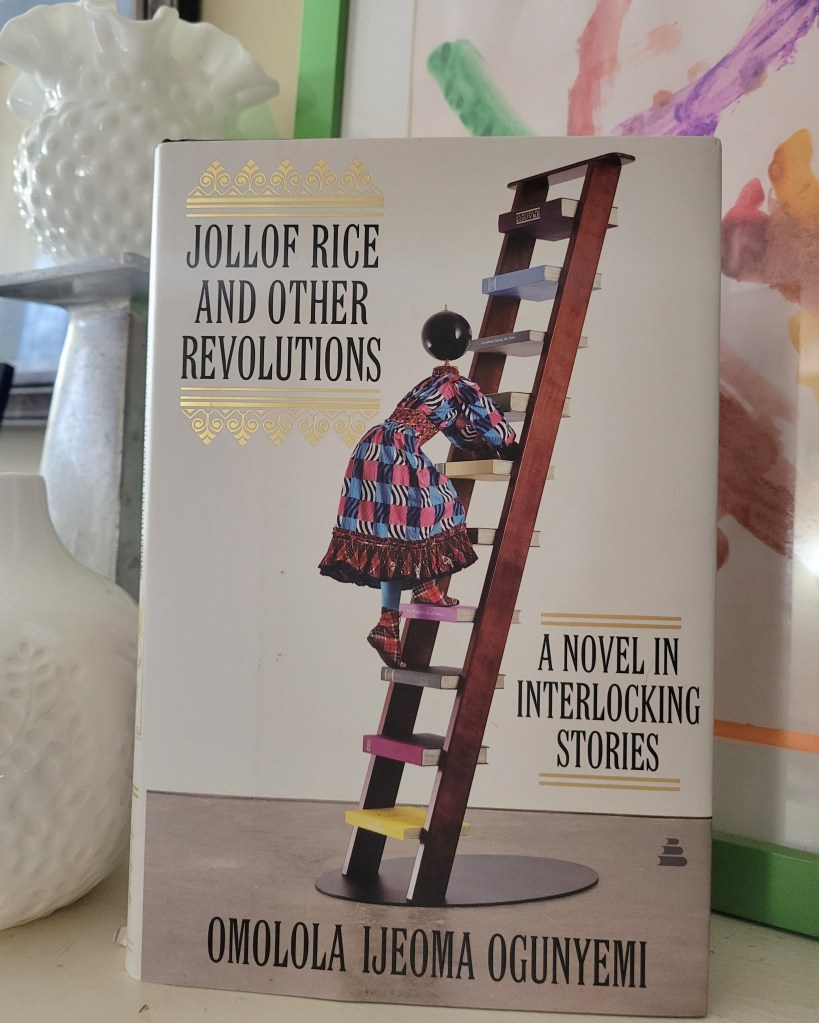
JOLLOF RICE AND OTHER REVOLUTIONS – Omolola Ijeoma Ogunyemi

“…oga dinma, oga dinma, it will be okay. Today. Tomorrow. Someday.”                

Omolola Ijeoma Ogunyemi’s Jollof Rice and Other Revolutions: A Novel in Interlocking Stories (Amistad 2022) is my favorite kind of short story collections – the kind where the stories weave in and out of each other, building the reader’s connection to a full cast of characters.  With themes of infertility and child loss through both death and distance, the collection is primarily one of women.  (With the exception of “Reflections from the Hood of a Car,” which centers on police brutality and discrimination in Nigeria and later the US.)  At its heart, are Nonso, Remi, Aisha, and Solape – four young friends in boarding school.  Two are involved in a revolution.  Two are arrested.  One dies.  Their young attempt to effectuate change at their school and the consequences that spill from it touch their lives as they grow up.

My favorite story is likely the first – “Fodo’s Better Half,” which is set years before the incident at the school and involves a beautiful and talented woman who is infertile but who greatly desires to have a family.  Her outside the box approach clashes with the Western world’s growing hold on her country, and she flees with Uchenna, a boy she considers her son who is of no blood relation.  (Uchenna is Nonso’s uncle and he appears in another story as a much older, and richer, man.)   “Goody Goody,” about a mother’s aging grief and how she holds on to the memory of her daughter is also a favorite. The last story, “Messengerna,” is an interesting departure from the other stories as it takes a rather futuristic and bleak look at America in 2050; it’s an interesting book end to the collection that starts in 1897.

I’m trying to make a better effort to read more short story collections, and interlocking remains my favorite way to go unless I’m going to piecemeal a collection.  Since, I don’t read in short bursts, that doesn’t work best for me.  I really enjoy Nigerian literature (though it will always make me hungry!), and this was a very “easy” collection.  While I’d have loved to see hundreds of pages of Nonso, Remi, Aisha, and Solape, I know that wasn’t the intent here.  For a short story collection, this was well done as is.

Read this book.

THE AS*TROBIOLOGISTS – Olga Gromyko

Next installment of Tommi Reads the World – we’re in the Bs.

Country: Belarus
Title: The As*trobiologists Volume 1
Author: Olga Gromyko
Language: Russian
Translator: Shelley Fairweather-Vega
Publisher: Cyborg Protection Union Ltd. (2021)

Kissed with the spirit of Futurama meets Firefly, Olga Gromyko’s The As*trobiologists is a hilarious space adventure.  I imagine some of the humor is lost in the translation, but this translation is still hysterical. This was the first in the series – I’m not sure how many have been translated yet, but I really need to find out what happens to these two ship crews.

One ship consists of Stanislav, a retired space commando, whose friend gets him really drunk and convinces him to buy a ship.  While intoxicated, he not only buys the ship, he signs a contract to finance it, staffs it, and winds up booking a job.  The job is to take a group of astrobiologists to a remote planet for research purposes.

The other ship consists of Roger and his motley pirate crew.  They’re looking for other treasures and subsisting off of the turquoise chickens stolen in their last attempt.  The remote planet  has the potential to be a huge pay day.

There is at least one battle cyborg (who is it?!?!), dangerous redheads, and a “big-busted blonde in a bikini” that serves as the computer program that operates the ship.  There’s also turquoise chickens, a remote controlled fox that is part of Stanislav’s ship’s entertainment (that gets lost and Roger’s crew thinks it’s real – making for some fun sections), and a navigator who eats nothing but chips and condensed milk. There’s also pot and an unauthorized (and untrained) pet that gets lost and dies in the air vents of the ship.  Did I mention that this is hilarious?

If the first volume is any indication – this is a well-written,  ridiculous and absolutely delicious candy read.

Read this book.

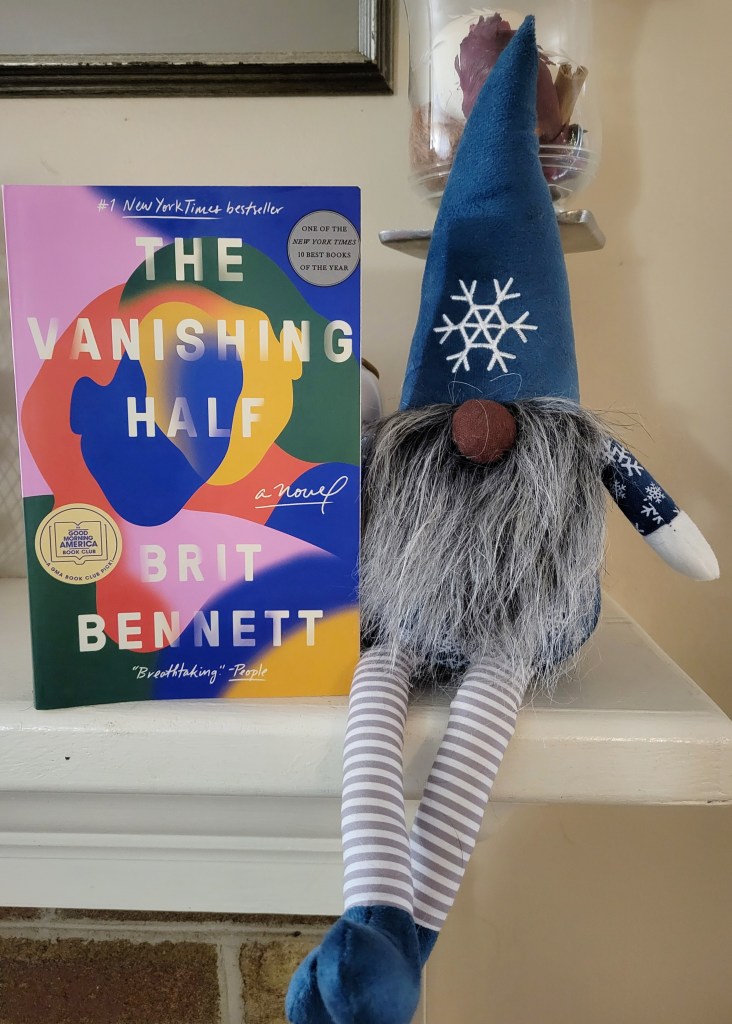
THE VANISHING HALF – Brit Bennett

“You could never know who might hurt you until it was too late.”

I finally got around to reading Brit Bennett’s The Vanishing Half (Riverhead 2020) – it was likely the most hyped on my TBR that had just been sitting there for ages, and it was on my “Must Reads” for 2024. (Yes.  I have a TBR and then I have a small “Must Reads” from that TBR.  I have a book problem.  It is what it is.) I tend to shy away from hyped books because I almost always feel let down.  Did The Vanishing Half let me down?  Yes and no.

I feel like at this point everyone knows what the novel is about – very light skinned twins from a town of nothing but light skinned folks run away – one becoming white passing and walking away from everything and everyone she’d ever known, and the other falling in love with the blackest man she could find before fleeing back to her hometown with her “blueblack” child after her husband becomes abusive.  Stella and Desiree are two parts of one whole, and this novel is how they shattered and how generational trauma and their choices affect their children.

My biggest disappointment with the novel is that every single character is a shimmery mirage of underdeveloped lives.  Desiree and Stella watched their father be dragged from his bed and lynched in the front yard by men who looked like them but who were white.  It is that moment that alters and forks the road the twins will travel. Desiree realizes that it doesn’t matter how light skinned she is, she will always be black.  Stella realizes that there is safety and “freedom” in whiteness, and she will forsake everything for it.  But the impact of that moment isn’t given much flesh, and neither Stella nor Desiree is fully developed.  Desiree has considerably more flesh, but it’s still lacking. If it was the intent for Stella to be underdeveloped and “vanishing,” she really shouldn’t have been given any sections – especially not the sections with Loretta.  There were just too many missed opportunities to build them up.

I have a similar complaint with Jude and Kennedy.  Much like her mother, Kennedy is underdeveloped but given space for development. Jude’s relationship with Reese, who is transgender, is also just a shell of what it could be.  Reese’s top surgery is a huge part of the novel and of Jude’s character, it is why she goes to med school!, but it’s just glossed over.

My favorite character is likely Early, a dark-skinned man who met the twins as a teen.  He becomes a “hunter,” working for a loan shark to find people.  He’s ultimately hired by Desiree’s husband after she runs away, and he finds himself reconnecting with this light skinned girl now a woman who had been forbidden to him as a teen and who now has a child darker than him.  His relationship with Jude, from sneakers to mystery novels, has so much heart but it’s buried in characters begging to have more flesh on their bones.

I liked the novel, I really did. I think it’s very palatable and accessible to most readers.  But I love a family saga, and I want it to be twice the size it is.

Read this book.

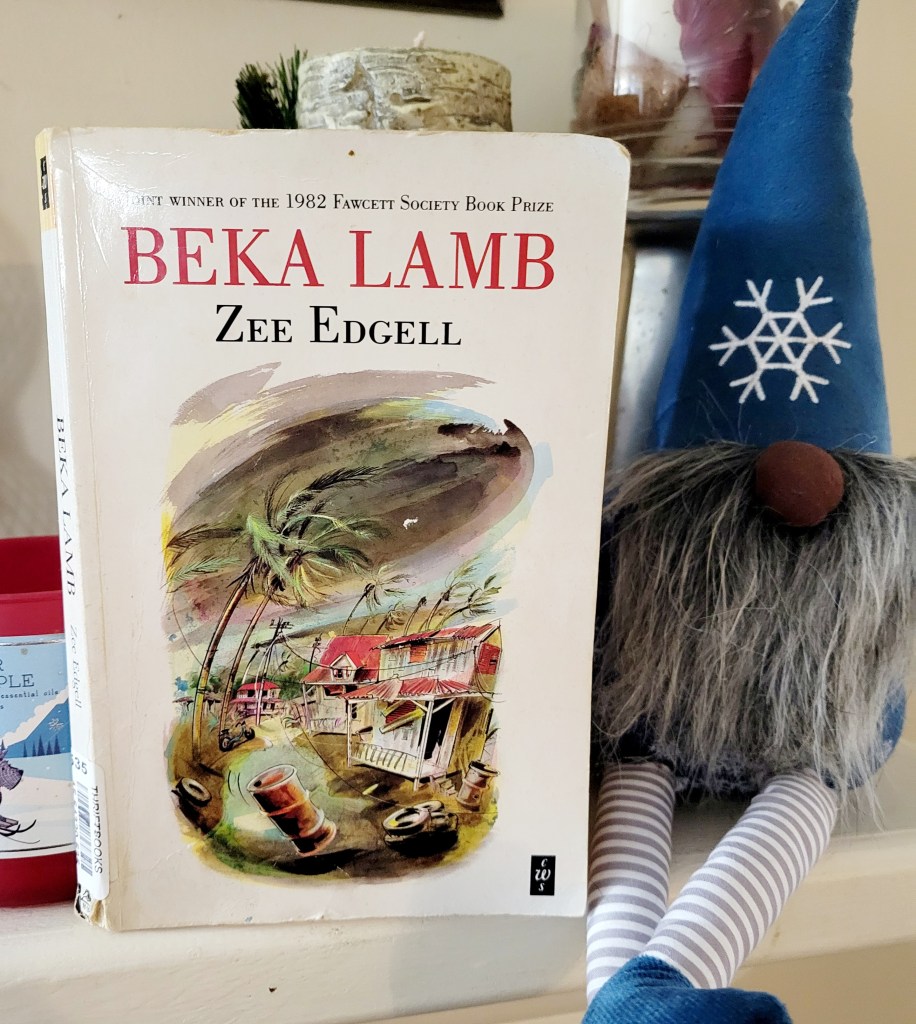
BEKA LAMB – Zee Edgell

Next installment of Tommi Reads the World – we’re in the Bs.

Country: Belize
Title: Beka Lamb
Author: Zee Edgell
Language: English
Translator: None
Publisher: Heinemann Educational Books (1982)

While published just after Belize’s independence, Zee Edgell’s Beka Lamb is set in the 1950s.  The novel covers mere months in the life of a 14-year-old girl living in a country fighting for a voice; it’s as much a political novel as it is a coming-of-age tale, and 1950s Belize was really when the fight for independence began in earnest with the formation of PUP (People’s United Party).

Beka’s grandmother attends the party meetings and marches, often bringing Beka with her, whereas Beka’s father struggles to maintain a neutrality that will best benefit his family and his people.  But it’s Beka’s mother and her silent struggle to grow roses like those found in “English gardens” that beautifully captures the impact of colonization and a changing landscape seeking freedom.

Beka’s best friend is the 17-year-old Toycie.  Toycie’s mother had left her with Miss Eila, who didn’t have children of her own, and fled to the United States.  Miss Eila didn’t have much, but she had plenty of love. Driven by that love, she somehow managed to find the funds to enroll Toycie in the convent school and to get her music lessons.  Toycie was brilliant, but she gets kicked out of school when she becomes pregnant.  The novel opens just after her death, and Beka is out of sorts that she couldn’t give her beloved friend a wake.  What follows are flashbacks or memories of the proceeding months leading up to the hurricane and Toyce’s untimely death.  These memories serve as her “wake” and a way for Beka to grieve and let Toycie go while finding a bit of her country’s voice in her own.

Read this book.

YOU DREAMED OF EMPIRES – Álvaro Enrigue

Álvaro Enrigue’s You Dreamed of Empires (translated by Natasha Wimmer – pub date 1/9/2024, Riverhead Books (thanks for the gifted advanced copy!)) is a fever dream of a reimagined meeting between Hernán Cortés and Moctezuma in 1519.  Edgar Allen Poe once wrote “all that we see or seem is but a dream within a dream,” and this novel, with a touch of madness and hefty dose of psychedelics, feels like you’re reading a novel in a dream within a dream.  Toss in the modernity of the writing, and you can’t put this story that takes place over a single day down.

Cortés is boring.  Horribly so.  But his captains, his translators, especially Malinalli, even the stable boy, Badillo, are vibrant and captivating.  (The horses and their destruction as well as Moctezuma’s fascination with them are some of my more favorite parts of the novel.  My favorite part is likely Captain Caldera trying to eat between two priests who reek of sacrificial blood and being unwashed.)  Moctezuma, much like Cortés, slips into the background with his sister (and wife) the Aztec princess, Atotoxtli, stealing scene after scene.

This is a novel of worlds colliding with a reimagined outcome. Moctezuma welcomes Cortés and his men to Tenochititlan.  They are given rooms in a palace that is a labyrinth to most of them while awaiting the actual meeting with Moctezuma, and they start to question if they are guests or prisoners.  Conquering the city becomes second to just getting out of the palace.  Enrigue takes this would-be conquest and adds a little pizzazz in the form of a hallucinogen – the end result is a heck of a unique novel.  The names make it a little bit difficult initially but stick with it.  I promise.

Read this book.

QUIXOTIQ – Ali Al Saeed

Next installment of Tommi Reads the World – ringing in 2024 with the Bs.

Country: Bahrain
Title: QuixotiQAuthor: Ali Al Saeed
Language: English
Translator: None
Publisher: iUniverse Inc. (2004)

Finding a novel in English from Bahrain was extremely difficult, and QuixotiQ was one of very few options.  Had this not been part of my reading challenge, I’d have DNF’d just a few pages in. The problem isn’t so much with the plot, which has potential to have some good bones, but with the writing itself. While it is admirable that Saeed drafted this novel entirely in English, at best a second language for him, that choice was the downfall of the work.  It is littered with grammatical errors, clunky and awkward phrasing, and a heck of a lot of telling instead of showing.

Guy Kelton and Patrick Roymint are two extremely unhappy young men.  Patrick takes a job at the urging of his girlfriend and ends up elbows deep in the seedy underbelly of Okay County as a drug runner. Guy is struggling with how his life didn’t end up how he’d hoped, and he is driven to madness and violence.  As the novel unfolds, their chaotic lives and those of Patrick’s girlfriend, Mandy, and her best friend, Christina, bleed in and out of each other as lives are lost and secrets are revealed.

The novel would have benefited from being initially written in the language that comes naturally to Saeed and translated by a talented translator.  It also would have benefited greatly from a skilled editor who has experience with works written not in the author’s primary language.  As it stands, I cannot recommend this novel.

THE BULLET SWALLOWER – Elizabeth Gonzalez James

“I think a person knows when their parents are gone for good, when the people that brought them into existence have gone out.  I think the air gets heavier or the light changes, something like that.  I haven’t seen the sun get dimmer yet.”

One of my highly anticipated 2024 releases was an early release through BOTM, and you know I snatched it up lickety-split. Elizabeth Gonzalez James’s The Bullet Swallower (Simon & Schuster 2024) is Lonesome Dove meets One Hundred Years of Solitude,and it is 249 pages of near perfect storytelling, making it my first five star read of the year.  It’s going to be hard to top this one.

When Antonio Sonora is born, his soul is marked for hell as the family is “in arrears” due to centuries of horrific acts. Death does not take him, deciding to wait and watch the baby grow up.  By 1895, Antonio has proven himself to be good with a gun and attracted to trouble, like the Sonora men who’d come before him.  But he’s a bad guy with a mostly good heart, and when he decides to rob a train in Laredo to better provide for his wife and children, you’re going to root for him.  When he is shot, Death decides yet again not to take his soul, and Antonio becomes a most wanted man – El Tragabalas, Bullet Swallower.

In 1964, a strange woman shows up at Jaime Sonora’s home with a book about the Sonora family.  Jaime, a famous actor living a relatively charmed life, is curious, and against his father’s wishes, he reads the book.  Not long after, a strange man emerges from the shadows and Jaime welcomes him like an old friend, despite his father’s insistence that the man’s presence in the home is neither safe nor wise; the Sonoras have a debt to pay, and Death will eventually collect.

This is a story of original sin, of family, of adventure, of legends and immortality.  It’s a western gilded in magical realism, and I loved it.

Read this book.

PROPHET SONG – Paul Lynch

“Something solid has begun to come loose, it is her heart sliding like gravel.”

In what has been a rather lackluster Booker longlist, I find myself a bit surprised at Paul Lynch’s Prophet Song (Atlantic Monthly Press 2023).  It’s a novel that tastes like something you’ve read before, only a little more pretentious, and one of a few I just wanted to stop reading several pages in.  And this, dear friends, is why I don’t DNF a book; as pretentious as  I think the writing is, the novel doesn’t ultimately suffer from it and the story is one that thrives in that grey area of what we believe could never happen and the fact we know too sure that it can, has and will – different faces, different places – because what happens in Lynch’s dystopian Dublin is happening and has been happening all over the world.  In short, while Western Lane will always be the winner in my heart, I get the hype here.

The novel opens with Irelands newly formed secret police showing up at Eilish’s door to question her husband.  He is ultimately taken, and the reader watches Ireland fall apart through the disbelieving eyes of a scientist, wife, daughter, and mother.

When Eilish’s husband is taken, she believes it is only temporary because she never believes that her Ireland will fall to a tyrannical rule that would deny her husband the right to an attorney.  Even after she learns they are killing children, her disbelief trails the novel like a deserted puppy.

While the fall into tyrannical rule tastes familiar, the focus on Eilish and a more domestic approach is what elevates the novel.  From dealing with a father slipping further into the shadowy arms of dementia to just trying to ensure her children have lamb and normalcy for Easter, to not wanting to leave the country until she has her husband at her side, Eilish is every daughter, mother, wife, woman.

Read this book.

Booker Count: 11 of 13

THE BEAR AND THE NIGHTINGALE – Katherine Arden

“Will you tell her?” asked the mare.

“Everything?” the demon said. “Of bears and sorcerers, spells made of sapphires and a witch that lost her daughter? No, of course not. I shall tell her as little as possible.  And hope that’s enough.”

One of my favorite courses at UNC was one devoted to Russian fairytales; there’s a familiarity and a warmth of a crackling fire in the stories that tried to bite back the cold, and I loved those stories. When I learned that Katherine Arden’s The Bear and the Nightingale (Del Rey 2017) took those fairytales, in particular that of Morozko (Frost), and breathed life into them through Vasilisa, a young girl with a second sight to see the stories aren’t just stories, I knew it would be something special. And it is.  The first of the trilogy, The Bear and the Nightingale is a gorgeously told bit of magic.

Vasilisa’s mother, Marina, lives to see her born, as she had promised, but no more. The child is cared for by her older siblings and Dunya, the nurse who’d raised Marina, but she grows up half-feral, a child of the woods touched by a magic that frightens those in the village.  Her father heads to Moscow to find a wife to help make his daughter respectable.  The choice is not his, and a political pairing is made.  The woman who becomes Vasilisa’s stepmother is a blood relative to Marina, but she has nothing of her strength and courage.  Like Vasilisa, she has the second sight.  Only she is afraid and tormented by what she sees and seeks comfort in the church.  She, along with the new priest, forbids talk and worship of the old gods.  Vasilisa watches her friends weaken and fade without the offerings.  The horses grow temperamental, the fire grows cold, the people go hungry.  Meanwhile, the Bear is gathering strength to break the binds his brother, Frost, had placed him under so many years ago.

Frost has been looking for Vasilisa for years.  He’d thought the witch’s bloodlines had ended and was delighted to learn they hadn’t. Bear is also waiting to claim her, but Frost will find her first. Together, they can stop Bear, but at what cost? 

Vasilisa is not the snow maiden from the story of Frost; she is not a bird to be kept in a cage, and she will run wild and free on a stallion named Nightingale with the blue-eyed demon by her side.

Read this book. 

THE OGRESS AND THE ORPPHANS – Kelly Barnhill

“But it’s best you know this now, at the beginning of this book. Every story has a villain, after all. And every villain has a story.”

Kelly Barnhill is an absolute gift to literature, and not just children’s lit.  She’s another one of my “heart hug” authors, but her hugs come in the form of fairytales and smell like freshly baked cookies.  I adored The Girl Who Drank the Moon and became even more smitten with her first adult offering, When Women were Dragons.  The Ogress and the Orphans (Algonquin Young Readers 2022) is geared toward 9–11-year-olds, but one is never too old for fairytales.  There are some folks who hate this book and call it “preachy” – those folks tend to be the ones who support book banning and want higher fences instead of longer tables, and this book’s message just hit a little too close to home; heaven forbid someone become a better person from reading.

The novel has an ogress, fifteen orphans, a dragon, and a town that used to be oh-so-lovely until the library burned. Stories are whispered from the oak beams used to build the homes, but people have forgotten how to listen. Stories hum from the stone from which the town derived its name, Stone-in-the-Glen, but people forgot about the stone and covered it with trash.  When the library burned, Myron, who runs the orphanage with his beloved wife, saved as many books as he could, and his body is forever marked from that night, but the orphans have books and stories and the best of hearts making each scar worth it.  The mayor is a sparkly man the whole town fell in love with.  He arrived not long after the fires and saved them from the dragon.  They didn’t know he was the dragon wearing a sparkly man suit, and under his control, the town became a miserable place with miserable people who didn’t trust each or take care of each other.  And this is story of how an ogress who just wanted to find a community, a murder of crows, a blind dog, and fifteen orphans saved the town with the magic of books and baked goods.

As beautiful as this novel is and as much as I love Barnhill’s writing style, the novel is not as tight as it could be, and it starts to drag without much action after the first half before spiraling quickly to an action-packed conclusion – I’d have loved a huge chunk removed and more flesh on that last quarter.  That said, it’s still a fantastic read about the power of stories and the hearts of those who listen to them.

Read this book.