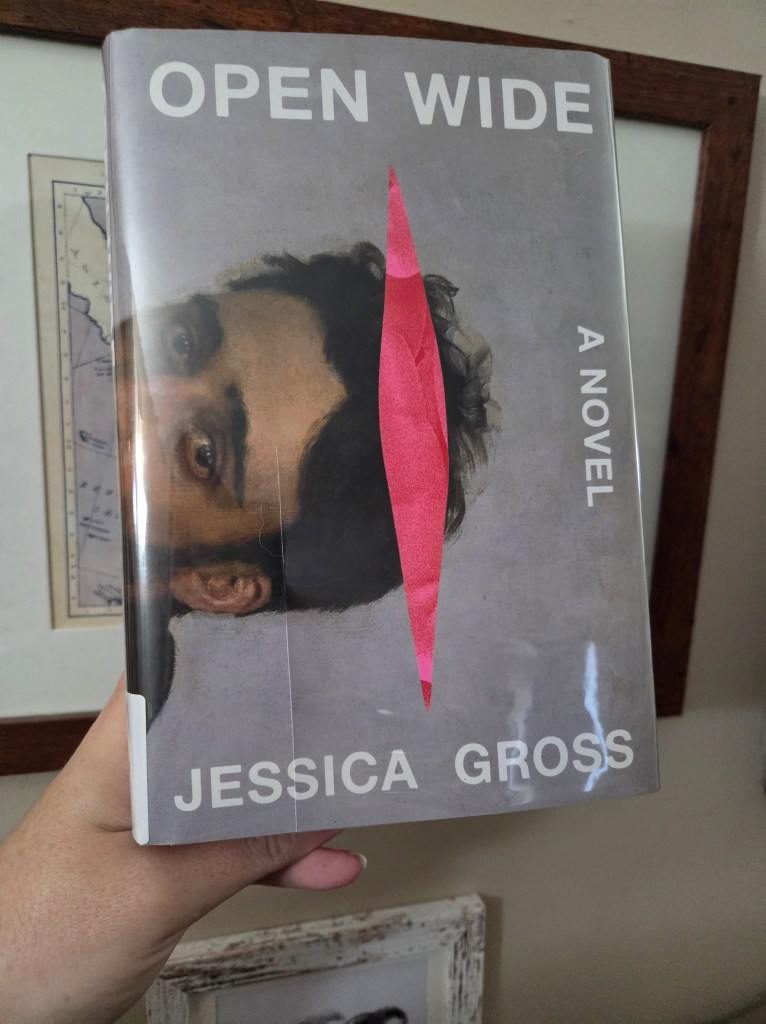
OPEN WIDE – Jessica Gross

Rarely do I DNF a book. Simply not finishing a read is something I cannot wrap my head around, at least for me. If it works for you, great. But I do not DNF.  Or rather, it is extremely rare. I dnf’d Jessica Gross’s Open Wide when I reached page twenty.  I enjoy insane first person narration.  Make her a sexual deviant?  Okay. Bring on the madness, tension, and “I could wear your skin” lust.  This?  Yeah, it’s a hard pass for me.

I imagine Gross was swinging for the fences  for shock value and really leaning into reactions like mine when she wrote the paragraph about the narrator’s sexual “ritual” involving her dog.  It was enough for me to immediately close the book and nope outta there. I will never read another book by Gross.

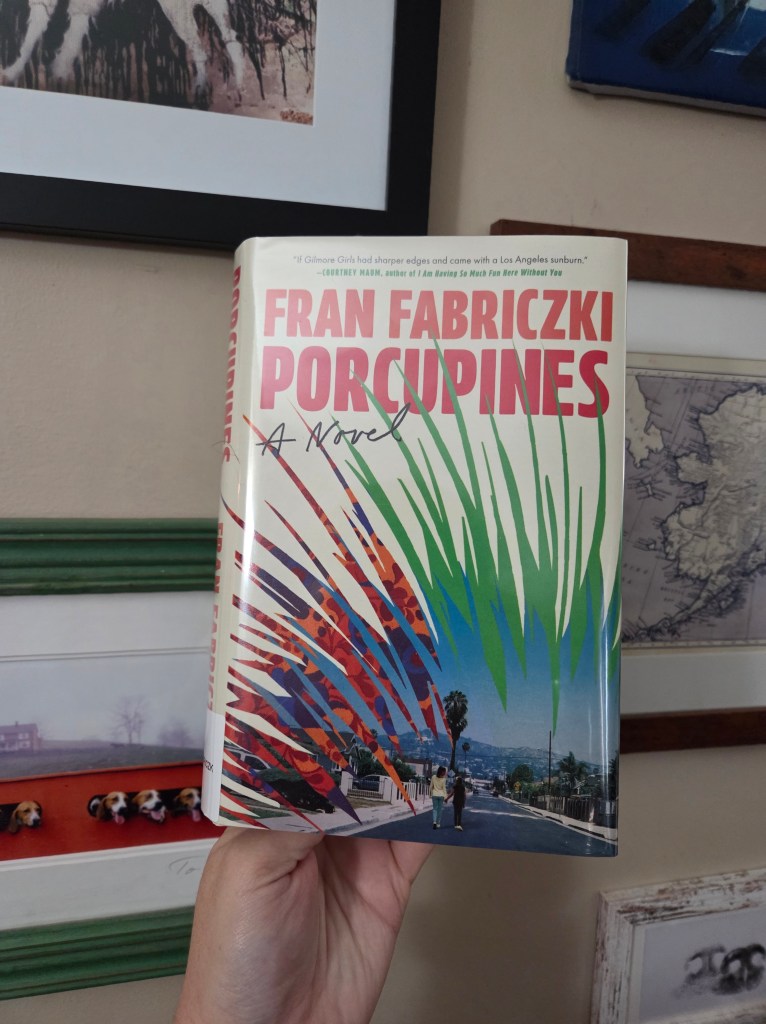
PORCUPINES – Fran Fabriczki

“And after all, every story is a manipulation in one way or another.”

Fran Fabriczki’s debut novel, Porcupines ( Summit Books 2026), shows a lot of promise but ultimately falls just short of the mark because it under-delivers in each timeline, bringing us to a rather unsatisfying conclusion. I love the idea – but I was rather disappointed.

Sonia, a Hungarian immigrant, and her daughter, Mila, do have that grittier Lorelai and Rory comparison (as mentioned in the blurb), but their relationship isn’t really that central. It’s intended to be as Mila has done some covert investigation and “Parent trap” activity to find her father, but the novel meanders so much that Mila’s voice gets lost and that framing gets forgotten. We have Sonia in all timelines.  Sonia with her parents in Hungary. Sonia as a pre-teen living in DC with her diplomat father, mother, and sister. Sonia visiting her married sister, Rina and striving to connect with the girl she once considered her best friend. Sonia getting pregnant. Sonia raising a daughter and chaperoning a school trip. Mila’s voice is limited – a tool used to just push the story in a certain direction – and the search for her father reads like an afterthought.

Despite my issues with the story itself, the title is perfect. When Sonia visits Rina, she learns her sister has become very religious. Rina and her husband determine that Sonia needs some education on how to be Jewish. During a conversation with Rabbi Raskin, he tells Rina about the German philosopher Arthur Schopenhauer and the parable of the porcupine. (In winter, they get cold and huddle together and then their quills prick each other so they spring apart – huddle together, spring apart, huddle together, spring apart.) This parable works well for Sonia’s family who have been huddling and springing for generations.

While the novel didn’t quite work for me, it did make me excited for Fabriczki’s follow-up; she’s only going to get better.

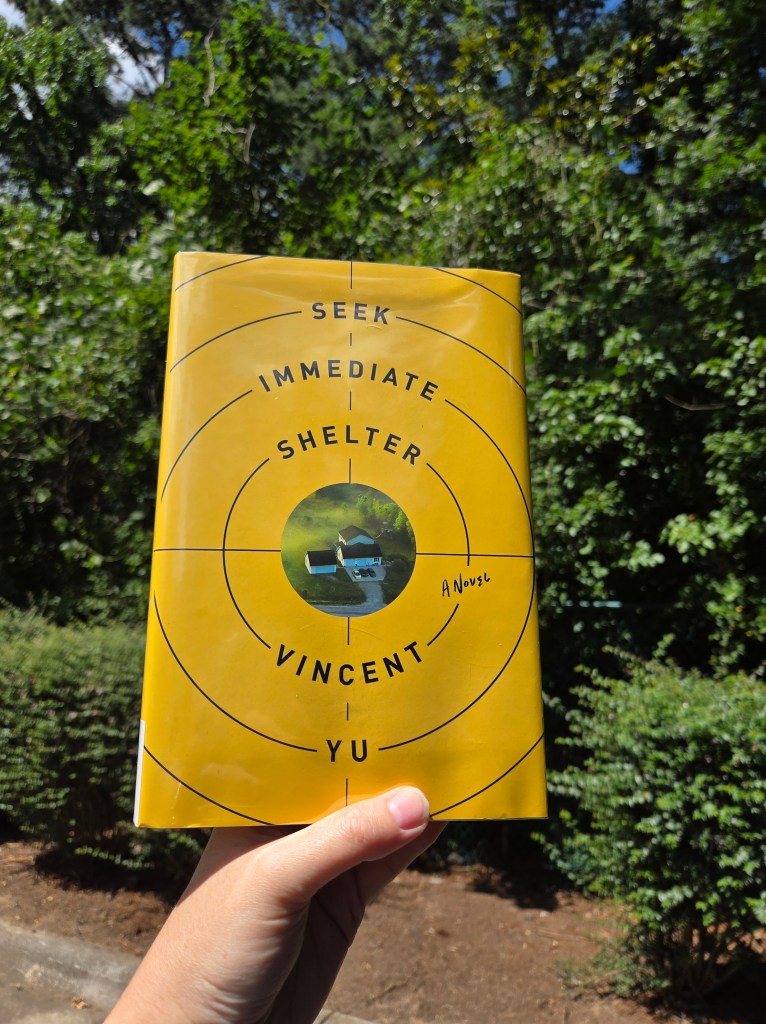
SEEK IMMEDIATE SHELTER – Vincent Yu

Seek Immediate Shelter by Vincent Yu ( Flatiron 2026) was a bit of a disappointment.  The novel is a series of interconnected short stories about residents of a small Asian-American community in Massachusetts following a false ballistic missile alert.  There is one section that takes place months after the alert and piggy-backs on an earlier section. Had these two stories served as the beginning and the end of the novel, it might have worked better because that particular family unit is central.  As organized, the story that takes place months after the alert seems out of place.

I’ve already dropped the book back at the library and can’t remember the different characters, but my favorite section dealt with the woman whose husband had a heart attack after receiving the alert.  Her sister comes to live with her.  A woman shows up and says that her husband had fathered a child with her and had been paying her child support for years and she’d like the support to continue. The use of her sister’s new hobby of birdwatching and the ending was just perfect.

Overall, I thought there were some interesting aspects here.  I really enjoy interconnected short stories that form a larger work, so I appreciated that; however, I didn’t really click with a lot of the stories.  I liked the opening story a bit and I also like what was being done with the mom/daughter relationship in the second (or third?). I do like the idea of a deep dive into multiple residents’ lives following the false alert (including the employee responsible for the false alert.) I just don’t know, some of them just seemed filler and bits cobbled from others.  (Which could have been intentional to showcase similarities within the Asian-American families – I don’t know; it was just meh for me.  BUT the stories that I liked were really good.

THE BOOK OF GOOSE – Yiyun Li

“If my geese ever dream, they alone know that the world will never be allowed even a glimpse of those dreams, and they alone know the world has no right to judge them. I live like my geese.”

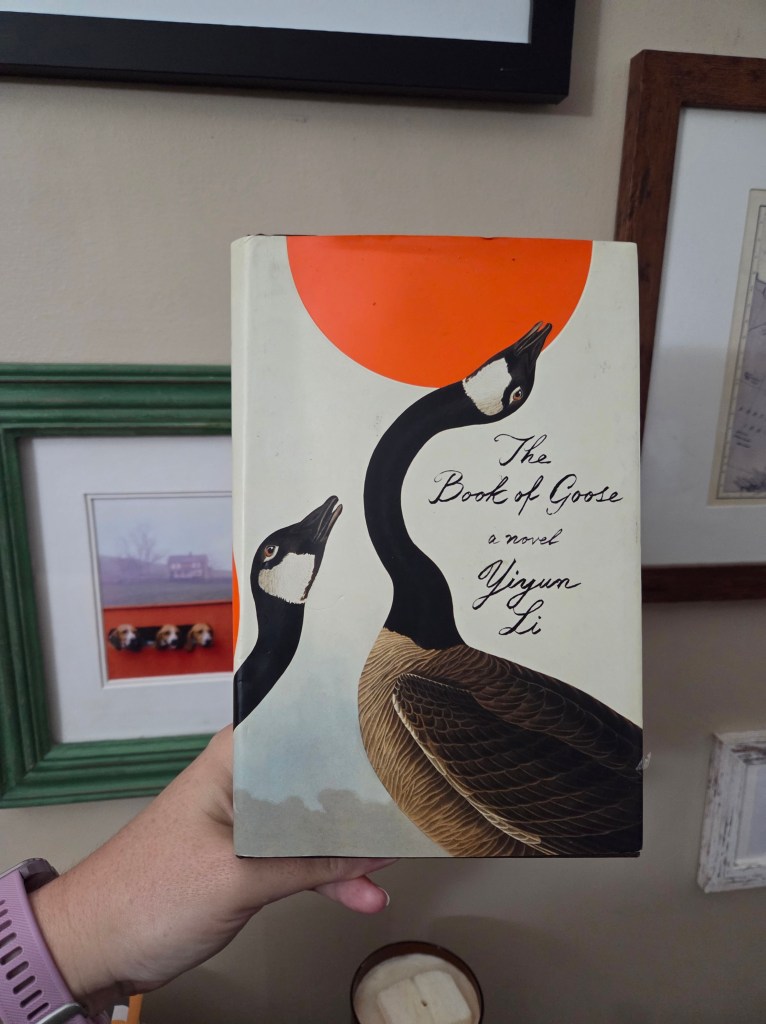
Despite this being my “library” year, I am getting to some of the books on my physical TBR when there is a lull in holds.  Yiyun Li’s The Book of Goose (Farrar, Straus and Giroux 2022) was one where the cover and blurbs first caught my attention. And while I think the novel is beautifully crafted and the writing is just exquisite, I am going to complain about the cover choice. It’s another situation where I wonder if the cover designer even read the book or just saw “goose” and said, “these Canada geese would be perfect.” Spoiler – they’re not. Again, I love the art – just not for this book.

Canada geese are not domesticated. They are also not native to France. Even though Agnes is living in America when she’s telling this story of her childhood and she is raising geese in America, she’s raising Toulouse and Chinese geese. Canada geese make no sense for the cover.  A pair of Toulouse geese would have been absolutely perfect. Or, if you want to say that Agnes is akin to a wild goose, pick a Greylag! But again, the perfect breed of goose for this book, for the story of a woman who grew up on a farm in France after the war with geese and goats and bunnies who moved to America and raises geese and is called “mother goose” by her in-laws… TOULOUSE WAS RIGHT THERE!

Now that I’ve gotten that off my chest, this story of Fabienne and Agnes, two girls growing up in rural France after WWII, best friends as different as night and day, is heartbreakingly beautiful. Fabienne, wild and unruly, leads the pair, with Agnes willingly joining in on the games she creates. When she decides to write a book, Agnes agrees. Fabienne tells the stories and Agnes writes them down. A widowed postman helps them form the book and finds a publisher. Fabienne decides that only Agnes’s name should be on it. The book is a success, and Agnes is heralded as a child prodigy for her unflinching look at postwar rural France. The “game” isn’t fun anymore, and Agnes wants out.

It’s a novel of girlhood, love, postwar France, loss, rural upbringings, poverty, escape, secrets, hunger and truth.  And geese, but I’ve already talked about that.

Read this book.
CANON – Paige Lewis

“They only bite what they don’t understand, which means, in this dream, Yara is biting everything.”

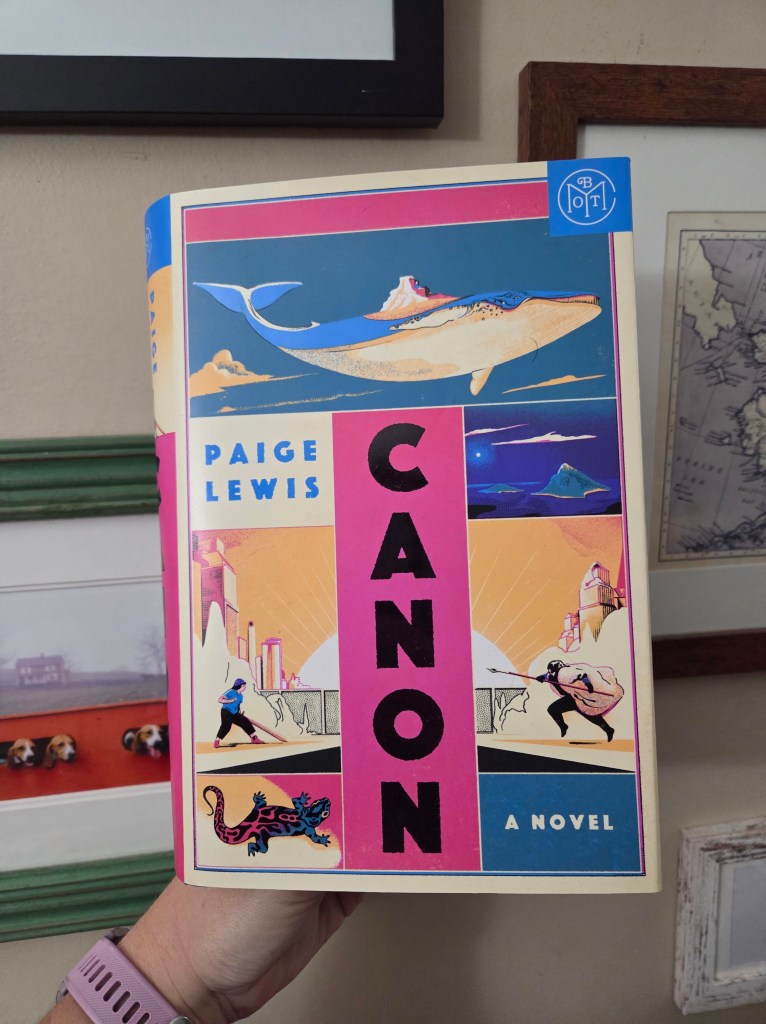
Paige Lewis’s Canon (Viking 2026) is one whackadoodle of a book. This  “nonbinary epic” will have you rolling.  The bard of this tale and the distinctive voice of the storyteller throughout the novel is fantastic.  The chapter headings are some of the best writing and all the allusions…The Waiting for Godot reference… *chef’s kiss* I want to write scholarly journal articles about this novel.  (I would love to see a lit comparison between Canon and Son of Nobody). I want this novel on my screen immediately.  That said, the dark humor as it relates to religion is not going to be for everyone. If you found Dogma or Christopher Moore’s Lamb (or Terry Pratchett) to be offensive or in bad taste, probably don’t pick this one up.  If you found them hilarious and also are a bit nostalgic for the 1990s, you need to read Canon asap – for the mall visit with Walden Books and Camelot Music alone!

The novel is insane but never once meanders.   Despite being all over the place, the writing is very tightly honed. Whether that’s Lewis or her editors or a combination, I don’t know, but that in itself is a huge accomplishment.

So, what is it about? In short, God enlists Yara, a non-binary barely adult with OCD, to defeat Dominic.  (Every hero needs a villain.) Meanwhile, Adrena, a prophet, is a bit annoyed she wasn’t tapped for the job, and misrepresents her mission to Harpo, the leader of the “Good Guys,” in hopes that she can be the one to defeat Dominic and the “Bad Guys” and get the glory. There’s also a whale named “HOWBIG!” whose father was named “WHALE.”  HOWBIG! is possibly the reincarnated Jacques Cousteau, and he is Yara’s guide.

Just read it.  It is unlike anything I’ve ever read before.  Just read it and enjoy the ride.

GLYPH – Ali Smith

I mentioned in my Ghost Town review that I’d followed that novel up with another ghost story – Ali Smith’s Glyph ( Pantheon Books 2026 – thanks to the publisher for the ARC).  Glyph released last week and is the sequel-not-sequel to the 2024 Gliff.  I’d say it’s more of a companion – each book can be read as a standalone, but you will get so much more out of Glyph if you’ve read Gliff first. I’m not providing any quotes because I don’t have the finished version to compare, not because it’s not quotable; Smith is insanely quotable.

I absolutely loved Gliff and I absolutely love how Smith incorporated Gliff into Glyph by making it a book that the two main characters and a very strong secondary character (Petra, Patch, and Bill) have all read. I particularly enjoyed the discussion of the ending of Gliff and how Glyph gives us the siblings reuniting.  The novels bleed in and out of each other, the two pairs of siblings echoing each other in an imaginative approach to storytelling, imagination, and the narratives we choose to tell that I won’t soon forget.

Smith’s writing is charming and cheeky; it has a bit of sting with a lot of heart, and I can’t recommend this duology enough.

GHOST TOWN – Tom Perrotta

“Ghosts and Orphans.

Orphans and Ghosts.

The ways we’re abandoned and never left alone.”

This quote from Tom Perrotta’s Ghost Town (Scribner 2026) could also apply to the other book I read today, Ali Smith’s Glyph.  Stay tuned for that review, but they were certainly interesting to read back-to-back.  As for Perotta’s novel, I didn’t know what to expect and was convinced it would remind me of The Rest of Our Lives (I blame it on the cover). Thank goodness I was wrong.  Perotta’s novel has a “Stand by Me” King feel, and the very short chapters work extremely well in crafting this “ghost story” of a classic coming of age.

The novel is framed with the adult Jay receiving an invitation to return to his hometown for a ribbon-cutting ceremony of a new municipal building that will bear his father’s name. These sections are told in first person, but the looking back sections, the sections about 13-year-old Jimmy, are removed from the first-person narration. This choice reminded me of Tash Aw’s The South, which also featured an adult “looking back” on a life-changing summer of his youth.

The novel is set in the 1970s in the all-white Creamwood, New Jersey, where, as Jimmy says, his family was normal until it wasn’t. His 8th grade year is coming to a close with a summer of baseball and the beach and maybe kissing his maybe girlfriend on the horizon. And then his mother dies on page nine. It’s not sudden, but it was for Jimmy who had been shielded from the seriousness of her illness. An estranged cousin interrupts a Little League game to let him know, because some messages should only come from family – estranged and strange as they may be.

These look back sections are a time capsule of being a grieving 13-year-old boy in the 1970s America.  But this is also a ghost story, with Jimmy’s mother speaking to him and another ghost shimmering in to upend Jimmy’s life in Creamwood forever.  (There’s also arguably another ghost, but I don’t want to spoil it.) Perrotta has a steady hand in crafting this story that could have easily ventured into the overly preachy and/or paranormal. He does get a bit heavy handed toward the end with one of the present-day sections, but it was an important acknowledgement that I don’t know how else he could have handled.

I would not be mad if I saw this on a longlist.  Not mad in the slightest.

Read this book.

JOHN OF JOHN – Douglas Stuart

“His hands were rough, but the fingers were long and elegant as though God had granted them for a life he had never lived.”

“I’m not going to watch you torture yourself and then come round here expecting sympathy for it.”

When I reviewed Douglas Stuart’s Shuggie Bain back in 2020, I wrote:  “This novel is wrapped in bruise, and it smells like day old beer and stale smoke.”  When I read Young Mungo in 2022, I wrote “the novel is carried, much like Shuggie, on a booze-soaked bruise that just keeps spreading.” Here we are in 2026, and I finally read John of John (Grove Press 2026). This novel is also a booze-soaked bruise, but an older one where the colors have bloomed. But for the ending, this may have beat out Shuggie as my favorite.

There have been a lot of reviews about John of John, and it’s doubtful that I can say anything new, but the tortured relationship between Cal and his father and the secrets they carry make this a hold your breath, can’t put it down, read. On top of broken but beautiful characters, you have just as jagged and beautiful a setting.  Stuart has a remarkable way of putting the reader in a story such that you can smell the air, feel the dampness and the ache  but also the beauty and the colors that are the Isle of Harris. 

I didn’t care for the ending as I felt it did a disservice to both John and Cal, but mostly Cal. I also really disliked John by the end, and I’m not entirely sure I was supposed to. I can say that John and Cal are cut from the same cloth and Stuart not only writes them that way and even made it clear via the title, he  has numerous characters remark on it almost to the point of being too much.

I didn’t really like Young Mungo – I felt it was cobbled together from Shuggie’s cutting room floor. John of John does not have that issue, and while there are some similarities between Cal and Shuggie, this is an entirely different bruise – and man, the colors will blow you away.

PERMANENCE – Sophie Mackintosh

I didn’t enjoy Erin Somers’s The Ten Year Affair, so the fact her blurb was front and center on Sophie Mackintosh’s novel about an affair caused a momentary pause; however, Permanence (Avid Reader Press) did not suffer from the same “meh” that made me indifferent to the Somers’s novel.  It’s an intimate portrayal of an affair having its shine worn off in real time with at least one character you are immediately invested in.

Clara and Francis are having an affair.  The novel opens with them awakening in what appears to be a hotel room, but they quickly realize they’re in a dreamlike place equipped with all their favorite things and where everything is sunshine and roses. The relationship that Clara has been forced to hide is suddenly permitted to be in the open. It’s never permanent – if they hurt the other (physically or emotionally), they’ll wake up in the “real world” where Francis is a husband and father and Clara is heartbroken to be in love with a man she can’t have. If they miss each other enough, they’ll wake up together in the seemingly perfect city while a pause is hit on their real lives. They continue in this limbo, with each return to the real world lasting a bit longer as their perfect city and relationship loses their allure.

SPOILER TO COME

Francis is horrible.  He is having a midlife crisis, and he is far from likable.   His pursuit of the younger Clara, his insistence on making sure there is no evidence of their affair anywhere, the way he leaves her to her own devices during an abortion that he wanted her to have, the way he treats his wife and even his daughter – he is remarkably predictable and unlikeable. I don’t think we’re meant to hate him, but he seems a bit of a caricature. But Clara… Clara is so likeable, so perfectly imperfect.  All she wants is something permanent.

The writing is beautiful, the relationship so artfully depicted, and Clara so fully formed.  I’d recommend this one.

RUINS, CHILD – Giada Scodellaro

“In our panic, we see the evidence of rural life – a paragraph on the exposed calf, on the woman’s wrist – a landscape.”

Giada Scodellaro’s Ruins, Child (New Directions 2026) was the winner of The Novel Prize, a prize which rewards novels that are innovative and imaginative in form and style. This experimental novel(?) is unlike anything I’ve ever read before.  I don’t know what the hell I read, but I liked it. There’s a rhythm and cadence of multiple voices finishing thoughts and moments and lives that sucks the reader, puzzled but along for the ride.

The novel is set maybe in the future in some urban locale in an apartment shared by two sisters that had been left to them by their father.  While the novel centers on six characters, I found Vonetta! to be the most memorable even as she lays dying (or giving birth to something she’s been carrying for 40 years) for the present time of the novel.  Like I said, I don’t know what is going on.

There’s an earthiness to this despite the urban landscape (one that Von has worked hard to make beautiful as Urban Planner).  It’s maternal, of the earth (Burle as the potter), clay to be molded and remolded, stories to be told and retold.

I’d be a fool to say I understand what is going on, but Ruins, Child is alive and probably still morphing into something else.