TRANSCRIPTION – Ben Lerner

“You call this fiction, but it is more.”

“I felt eight and eighteen and forty-five all at once, my grasp on reality was tentative, an extreme form of the effect his presence always had on me, a nightmarish form of what others so loved about him – how he seemed from the future and the past simultaneously, a gentleman time traveler…”

Ben Lerner’s Transcription (Farrar, Straus and Giroux 2026)is, without a doubt, the most “Bookery” book I’ve read in my preparation of the longlist announcement. It’s a slim volume of scholarship, technology, madness, memory, fathers & sons, and rivalries & jealousies.  It dances across timelines, both for the reader and for narrator (who shimmers into the author on occasion – “I call her Eva in this book” and “For the duration of this sentence, it was submerged.”)

The novel opens with the narrator at a hotel in Providence, Rhode Island where he is preparing to interview Thomas, his 90-year-old college mentor and father of a college classmates. He intended to record the conversation on his phone, put he dropped the phone in the sink prior to going. As such, there was no recording, only what the narrator recalled. Thomas is confused, blending the narrator with his own son, Max. Max holds the final section, detailing moments with his father wherein you realize Thomas has long been blending Max into the narrator and the narrator into Max. It is clear that both men loved Thomas, wanted his approval, and were jealous of the other.

The cover, a golden iPhone made to look like a relic of days long past, is perfect despite my initial comparison to Universality’s gold bar.

Despite this not being my favorite type of novel, I enjoyed Lerner’s prose and that shimmery break from reality that glitches throughout. It’s a smart little novel. I won’t be surprised not only if it’s longlisted, but shortlisted.

I LOVE YOU DON’T DIE – Jade Song

“It would be too painful to hold to every memory of every life we’ve ever lived.”

I would encourage anyone interested in reading Jade Song’s I Love You Don’t Die (William Morrow 2026) to first read the trigger warnings as the novel deals with depression and suicide, among others. If you need help or just someone to talk to, please dial 988 for the Suicide and Crisis Lifeline. You can also contact NAMI and The Trevor Project. Stay another day.

Vicky has been obsessed with death for as long as she can remember.  She lives above a funeral parlor, she collects zhizha (miniature paper creations that are part of a beautiful Chinese tradition for the dead), and she works for a startup company for bespoke urns. Most days she can barely get out of bed.  Her best friend, Jenny, works for a wellness company. They’ve been friends since college. She loves her. Vicky knows she loves someone when she starts dreaming they will die.

Vicky meets Kevin and Angela on a dating app. She likes dating couples because it’s less work for her. Her and Angela immediately hit it off – they’re both “sad girls.” Vicky often thinks about the death of those she loves. Angela often thinks about her own death.  You can see where this is going.

The novel was delicate and gritty at the same time. I enjoyed it, but I would never read it again. (Is “enjoy” even the right word?) Song is a talented writer, and I Love You Don’t Die is an aching portrayal of love, longing, and loneliness. Call your friends.

THIS IS NOT ABOUT US – Allegra Goodman

“The flowers depressed her, especially those already wilting. When she looked at the mums, she felt like she wasn’t dying fast enough.”

Allegra Goodman’s This is Not About Us ( The Dial Press 2026) is a sprawling family saga, beautifully highlighting the meaning of family, the ties the bind, the jealousies, the pettiness – the sheer humanness of the relationships we are born into, we marry into, and we fall into. Told through interconnected short stories, the novel follows numerous members of the Rubinstein family and quasi-family (a divorced wife and the sister to the girlfriend of one of the sons), beginning with the death of Jeanne, the youngest of the three matriarchs. While Jeanne is dying, there is falling out between her sisters, Sylvia and Helen, that is all about apple cake while also being nothing about apple cake.  The fallout splinters to the rest of the family members, who are dealing with their own sibling rivalries, disappointments, divorces, ballet, being fired, faith, college applications, custody battles, etc.  There are several dogs, two of which show up in more than one story – Max the Samoyed and Rosie the Irish setter.

I really enjoyed this book. My favorite “chapter” was likely “Ambrose,” which is from the POV Lily, the youngest Rubinstein, Sylvia’s granddaughter, who is struggling with anxiety and insomnia, followed by “Days of Awe,” which is also about Lily. “Sheba” is a bit of outlier because Jamie is on the fringe – she walks Rosie, but the story isn’t about setter. Jamie’s also Heather’s sister, but we don’t meet Heather until later.

The novel is beautifully rendered – what it does with faith, family, frustrations, failures, and fulfillment is an achievement.  If you’re expecting this to be plot driven toward a positive resolution, you’ll need to let that go.  The novel grabs human nature by the throat and lets life (and death) play out. I really enjoyed it.

HOOKED – Asako Yuzuki (translated by Polly Barton)

“the one who caves first, loses”

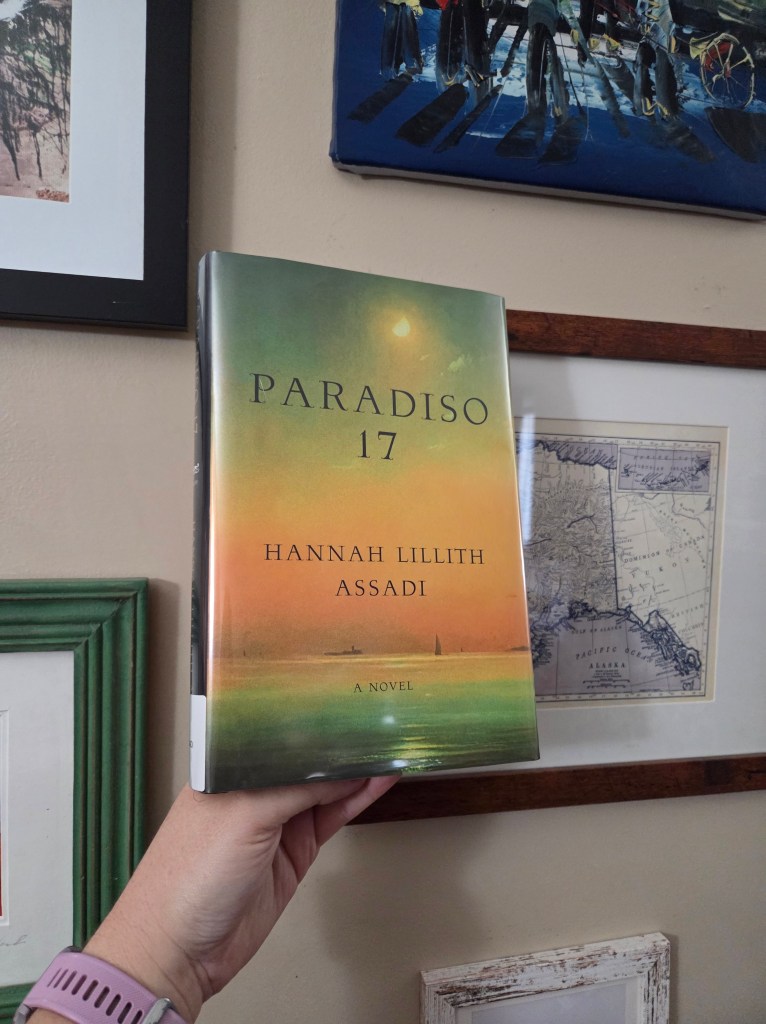
I know I’m not supposed to judge a book by its cover, but a cover can certainly get a book on my radar that may not have otherwise shown up. Such was the case with Azako Yuzuki’s Hooked (translation by Polly Barton , HarperCollins 2026). I haven’t read Butter and was unfamiliar with Yuzuki, but when I saw that cover, I immediately added it to my holds. And I’m glad I did.

Eriko’s life looks perfect. She is from an affluent family. She has a good job. She’s ambitious. She’s beautiful. But she’s lonely.  She has a hard time making friends, particularly female friends, and a track record of obsessive behavior. She’s been following a popular blog, Diary of Hallie B, the World’s Worst Wife, for two years, her morning breakfasts consisting of the pastries “Hallie” features on the blog.  She decides that Hallie and her would be the best of friends and sets out to meet her.

Hallie, Shoko, is a laidback, go-with-the-flow sort. She’s the opposite of Eriko in nearly every way. She’s fabricated a stalker to make herself seem more important. The first time she meets Eriko, she believes it happenstance. Then Eriko starts messaging her, texting and posting comments on the blog. And then Eriko shows up at  her house, having used the blog to figure out what building she lives in. Eriko is obsessed, and Shoko doesn’t know how to shake her. Eriko’s obsession with Shoko leads to a spiral for both women.

I don’t want to spoil it so I won’t tell you what happens, but this is truly a novel of obsession, female friendships, and the hunger for connection.

THE HITCH – Sara Levine

“Some part of me found it pleasurable to be, at last, out of control.”

 Sara Levine’s The Hitch (Roxane Gay Books 2026) is hilarious, outrageous, mad, quirky, and positively bizarre. And I enjoyed every bit of it. Rose Cutler, a self-described antiracist, secular Jewish feminist eco-warrior, is a bit of a lonely, know-it-all neurotic dog woman. (The best dog people tend to be neurotic.  Trust me. I would know.)  Her first-person narration in this novel is PERFECTION – with every moment perfectly in character (including word choice and internal monologue). I did get a bit concerned that Rose would change as we steamrolled toward the ending, but I shouldn’t have worried – there was no neatly packaged resolution here, just more welcomed chaos and more unapologetically Rose Rose.  It was a fun novel.

Rose convinces her nephew’s parents to let her babysit him for a week while they go on vacation to fix their marriage. Long convinced she can parent Nathan better than them, Rose is eager for the time. But the day after they dropped him off, Rose’s Newfie, Walter, kills a corgi named Hazel while Rose, Nathan, and Hazel’s owner can only watch. (Hazel was on a flexi.  This could have all been avoided had the dog been on a regular lead… perchance I saw a bit of myself in Rose. Ha) As horrific as that sounds, Hazel’s spirit jumps over into Nathan, delighting the young boy.  He is so happy with his “inside dog,” and Rose hasn’t a clue how to proceed. He starts barking, talking to himself, telling horrible knock-knock jokes, and seems to know a lot of things. Rose realizes it is Hazel coming through. She encourages him to “be the alpha” while madly researching how to banish the dog’s spirit from her beloved nephew’s body before his parents get home.

At its quirky little heart, this is a novel about loneliness and the family we make. It’s about letting go and enjoying the ride. Not everyone will enjoy this one, but I found it fantastic palate cleanser of a hoot and a half.

ERADICATION: A FABLE – Jonathan Miles

“The problem is that history leaves a slime trail, like a snail.”

Jonathan Miles’s Eradication: A Fable (Doubleday 2026) is next up on my Booker eligible reads. Even before realizing Maria Reva had written one of the blurbs, I was calling it Endling meets Seascraper meets Stone Yard Devotional. Despite some pretty graphic scenes of illegal shark hunting and killing of goats, I really enjoyed this novel and what Miles was doing with his “fable.”

Adi, a former jazz musician turned schoolteacher, answers an ad to “save the world” in an effort to deal the fact his world has crumbled, and he is barely holding on. He didn’t really know what the job would entail, but he didn’t turn it down once he learned. He applied for a five-week assignment on an isolated Pacific Island. His task was to eradicate the thousands of goats that have destroyed the flora and fauna of the island – goats humans placed there decades before that have taken over the island.

Adi has never shot a gun before.  He was asked to, but he refused, and now it’s his job. As he struggles with the task at hand, his past reveals itself with heartbreaking details and beautiful moments. (Turning the goat horn into a “clarinet” and playing the lullabies he’d played for his son for the goats? Oh, my heart._ But also, the life on the island reveals itself – life he’s been told isn’t there.  Maybe the goats aren’t the problem. The island is littered with trash that has washed up; even the foundation that hired him packs countless plastic bottles for his use and convenience.  And then he encounters the shark finners, and the job becomes a lot more dangerous.

Adi has a choice to make, and this time his finger is on the trigger.

I know my Booker “hopefuls” have a tendency to be very “American” heavy, and a part of that is easier access to those works. This is  not surprisingly another one that would make my list.  It’s weird. It’s funny. It’s quite the brilliant and urgent meditative novel.

Read this book.

VIGIL – George Saunders

Not long into George Saunders’s Vigil (Random House 2026), I remarked that it was a bit Charles Dickens meets Tom Stoppard – to be more exact, it’s A Christmas Carol meets Rosencrantz and Guildenstern Are Dead, with a strong nod to the Stoppard play. You would think that those echoes would be enough to have me LOVING this novel, but alas, I really didn’t enjoy it that much. But I know why  – the voice of Jill “Doll” Blaine annoyed the crap out of me.  Had she died younger, I could get on board with some of it.  Don’t get me wrong, 22 isn’t old by any means, and some of that naiveté born of lack of experience  works extremely well juxtaposed with her experiences as a “ghost” who has watched the world “grow up” around her.  But her childishness was off-putting, especially in word choice. I nearly expected a 6-7 joke to show up. (Also, I hope to never see “butthurt” in a book again.)  At times, Jill also spoke like someone who lived in the gangster era of the US, not the peace, love, harmony era of the early 1970s. Some of the inconsistencies in voice are intended and make sense based on the plot and her experiences, others just seem sloppy as if there was some back and forth about when Jill should have been alive.

As for the novel, a Texas oil tycoon is on his death bed and Jill comes to his side to bring him comfort as he crosses. Only he doesn’t want comfort. And he sure as shit isn’t remorseful for all the harm he’s done. Others of “her ilk” join Jill, including a Frenchman who created the engine and is hellbent on making Jill’s charge see the “light” and repent before he dies.  The nod to the Stoppard play comes in with two other ghosts who used to work for the tycoon referred to primarily as R and G.

My favorite scene involves other ghosts who have nothing to do with the tycoon and are all just hanging out where they died.  They died at different times and in different ways, but they’re all hanging out together. It reminds me a bit of the sitcom “Ghosts.”

This is my first Saunders, and I am underwhelmed enough to likely not seek out his backlog.  His Booker win came during my so-called “literary dark days” so it just passed me by, and I really don’t think I’ll loop back to it.  As for Vigil, I wish the entire novel had been like the last third, which was remarkably more enjoyable the first two thirds.

Should you read it?

Eh. It’s short. It is funny. It is well-written in many ways. I just found parts of it rather off-putting, making it not that enjoyable for me.  Maybe my expectations were too high.

THIS IS WHERE THE SERPENT LIVES – Daniyal Mueenuddin

Daniyal Mueenuddin’s This is Where the Serpent Lives  (Knopf 2026) reads like Chekhov wrote a Dickens’s plot. This highly anticipated debut novel by Mueenuddin, whose short story collection was a finalist for the National Book Award and the Pulitzer (among others), is likely to be a strong contender come awards season. Will it make the Booker longlist? I think it’s likely.

Consisting of essentially four interconnected novellas, This is Where the Serpent Lives spans 1955-2013, showcasing the feudal attitude of the elite, and the entitlement and influence they wielded while also centering the servants who run their homes, know their secrets, and clean up their messes.  Yazid, found on the streets as a small boy and raised in a tea shop, is the anchor of the four novellas, though he is not the focus.

The opening novella “The Golden Boy” is Yazid’s story, and likely my favorite. Yazid reminded me a bit of Szalay’sIstvan, particularly in how Yazid holds the reader at arm’s length and handles his emotions.  The second novella “Muscle” is my least favorite. It follows the American-educated Rustom who has to enlist his own thugs to protect his stronghold from a neighbor who has the authorities in his pocket.  “The Clean Release” is the backstory of Rustom’s cousin, Hisham, and how he stole his wife from his brother. Yazid has been “passed down” to Hisham and is his servant, though Hisham does have issues with boundaries when its convenient for him. This was likely my second favorite of the four.  The titular novella follows Saqib, the son of Hisham’s family’s gardener who has become a trusted servant and a bit of Hisham’s wife’s “pet.” As he comes more trusted, he begins to “cook the books,” siphoning off money until he’s caught and reminded that he will never be “one of them.”

The novel opens with an orphaned boy holding his shoes, a life starting over, and ends with a broken young man putting on his shoes, a life starting over. The shoes stuck with me for both.

It’s a remarkable novel, but the arm’s length approach combined with interconnected novella form kept me from being fully invested.  I admire what Mueenuddin has done, but I didn’t love the novel.

BURN DOWN MASTER’S HOUSE – Clay Cane

“Remembering is an act of brilliant opposition.”

Clay Cane’s Burn Down Master’s House (Kensington Publishing Corp.) will make you extremely uncomfortable.  Spoiler alert – it’s supposed to. No matter the attempts to erase the horrors of slavery from this country’s past, to whitewash the repeated crimes against black and brown bodies, the truth remains – and the truth is ugly. Cane isn’t hiding the ball here – he tells us exactly what this novel is and why it’s important. He breathes life into stolen lives and stories, pushing back against a narrative that folks continue to advance because it makes them “feel better” about this tainted past. Get uncomfortable.

The novel is based on true stories of enslaved peoples, and it follows their resistance and hope. As dreadful as it is, it barely scratches the surface of how horrific a life of a slave truly was.  The novel opens with Henri, a young man who is sold to Magnolia Row, a plantation in Virginia, because he is unable to “perform” and impregnant another slave.  (This concept of “breeding” slaves was common.)  What follows is a rise to resistance and an uprising long remembered.

The next section of the novel follows Josephine, a young woman who ends up at another plantation after Magnolia Row is burned down.  I think we all know how female slaves were used. She has fire in her eyes, and she spearheads another resistance.

Through Josephine, we meet Larkin, a former slave who is now a blacksmith in Gettysburg. Through him, we are introduced to Charity, a slave from Maryland who becomes his wife and tries to use PA law to advance her freedom. After years of a legal battle, Charity is “returned” to the man who claims ownership of her life and her offspring.  It is through their children that another resistance is born.

The novel ends with Nathaniel, a Black slave owner. As he faces a swift justice for his own horrific crimes, a former slave from Magnolia Row, one involved in that initial uprising, shows up with the army. 

And a fire still burns.

Read this book.

WESTWARD WOMEN – Alice Martin

“That’s how it goes, I guess. Sometimes you need to hurt first so you can finally go numb.”

I went into Alice Martin’s Westward Women ( St. Martin’s Press 2026) entirely blind, and I can’t decide if that was a help or a hindrance to my reading experience.  It’s a buzzy new release and Martin is from NC – that is all I knew going in. I certainly wasn’t expecting a genre-blending thriller with horror elements. I would say it’s When Women Were Dragons meets Charles Manson. There are some really good things going in the novel such that I was surprised it’s a debut, but it ultimately fell flat for me due to pacing.

The novel is set in the 1970s with a pandemic effecting women ages 18-35. Infected women grow listless, scratching at their skin and seeking to make their way westward. Many die. The CDC doesn’t know how it’s spread or really anything about the disease. Different women have different symptoms, with some exhibiting worse signs than others, and some recovering without issue. There is also speculation that some are carriers. A man called only the Piper drives his van from the east coast to the west coast, offering safe passage for the inflicted women.

The novel follows three women – Aimee a recent college graduate trying to find her infected friend Ginny; Teenie, a young infected girl who has joined the Piper, and who is struggling to keep her memories intact, with the memory of the last day she saw her sister before she vanished all she seems able to hold on to; and Eve, a journalist with a history of running away. There is also a second person POV, with the identity apparent pretty early on but revealed toward the end.

I don’t want to tell you what happens because this is a thriller, and the story should unfold organically for you. I will say it wasn’t for me simply because of pacing – I like a slow burn, even with a thriller, but I found myself not caring what the resolution was.  Martin is a talented writer and I’d likely read more things from her, but this didn’t work for me.