THE ROAD TO TENDER HEARTS – Annie Hartnett

PJ pet the cat in his lap. “Well, I think in his past life, Pancakes was a goat herder in Mongolia. And I believe I was one of his goats.”

“A goat?” Ollie asked, laughing. “You think you were a goat?”

“Yep. Or perhaps a yak. But Pancakes and I found each other again, in this life, which is a beautiful thing.”

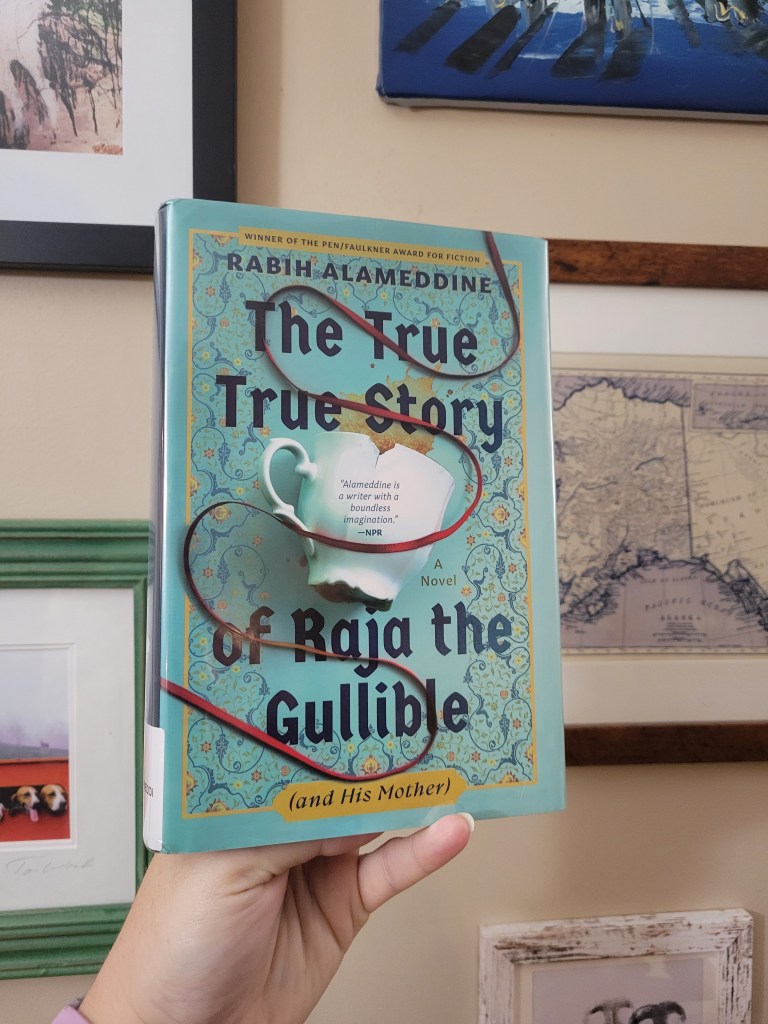
Annie Hartnett’s Unlikely Animals was one of my top reads of 2022, and I was hoping The Road to Tender Hearts (Ballantine Books 2025)  could bottle some of that same magic.  Spoiler – it can and it very much does. Hartnett’s writing is a hug with teeth – a lot like life. Unlikely Animals said something akin to the stories we like best are “both funny and sad,” and this one hits that mark.

Pancakes is an orange tabby that moonlights as the grim reaper. He was happily living at the nursing home in Pondville, Massachusetts, until the director noticed his unique talents and felt he was paying a bit too much attention to him. He took the cat to the shelter.  He still died, of course, because Pancakes doesn’t miss.

The cat ends up on a road trip with PJ, an alcoholic manchild who is struggling with a powerful grief, and Irish twin siblings, Ollie and Luna. Ollie and Luna are orphaned (pretty horrifically) and are the grandchildren of PJ’s estranged older brother. Child services figures since PJ’s a living relative right in town, he’s better than foster home. PJ was unaware they existed, but just like he couldn’t let Pancakes go back to the shelter, he can’t let them go to a foster home, so he decides to take them on his road trip to visit his recently widowed high school sweetheart who lives at the Tender Hearts Retirement Home in Arizona. His daughter, not on the best terms with her dad, joins because she’s unemployed and she knows that man cannot be trusted to watch children. Or a cat.

It’s a gritty and hard to pin down novel – one that is so full of heart and so delightfully bizarre.  There are ghosts and lollipop trees, talking cats and hats, a mermaid, vultures who sing out for two children to stay alive, near misses, Abe Lincoln’s stolen arm, and a lot of death. You’ll fall in love with this hodge podge group of misfits on a journey to love, forgiveness, second chances, and hope.  And yes, you’ll even love the harbinger of death, Pancakes.

Read this book.

WHEN THE CRANES FLY SOUTH – Lisa Ridzén

“A window opens, and I hear the cranes gathering to fly south.”

“At dinner one day, I snapped and asked what the hell the point of life was if I was too old for a dog.”

If you’ve ever had to say goodbye when death is not a thief but a friend who comes in and warms himself by the fire before leaving with a loved one, this novel will crack open your grief like a jar that holds the scarf of a loved one kept so as to maintain the smell. But what it then does with that grief is what makes this novel a heart hug.

Blurbed by Fredrik Backman, Lisa Ridzén’s debut novel, When the Cranes Fly South (English translation:  Vintage 2025, translated from the Swedish by Alice Menzies), was a bit of an anticipated novel for me; Backman has never steered be wrong, and there is something about Swedish literature that claims a part of my heart. In short, the novel exceeded my expectations – it got in my blood, the words beating in rhythm with my heart and swimming in salt water. Even now, my throat is getting tight.

Eighty-nine-year-old Bo lives alone with his elkhound, Sixten. His beloved wife, Fredrika, lives in a memory care center where dementia has stolen her memories of him. His days are broken up by visits from carers, who feed, bathe, and give him his medicine.  (The novel is broken up by their log entries.)  They also walk Sixten when they can. Bo’s son, Hans, has decided that Sixten needs to be rehomed because Bo cannot care for him and it is not the carers’s responsibility. Bo is livid over this decision, even threatening suicide should they take his dog.

The novel takes us from May 18 – October 13, and we watch Bo fading.  His memories blur with the present, and we become privy to difficult memories of his father, sweet memories of his wife, complicated memories of his relationship with his son, and the friendship with Ture.  As the novel progresses and Bo  fades, his memories become more vibrant.  While the novel is told from Bo’s POV, with the brief entries by his carers and occasionally Hans, we see so clearly Hans’s quiet desperation, fear, and anticipatory grief.

The carers know what’s coming. Hans knows what’s coming.  We know what’s coming.  That doesn’t mean it hurts any less.

Ridzén’s idea for the novel came upon discovering notes left by the carers for her grandfather during his final days; his memory and her loss sit tight to you while you read, like a hound leaning into you.

Read this book.

THE SOUTH – Tash Aw

Booker 101 Quick & Dirty Monday!

THE SOUTH: Tash Aw
Farrar, Straus and Giroux : 27 May 2025 (US) (unless otherwise noted, I’m reading the US edition)
4th Estate (Harper Imprint): 13 February 2025 (UK)
Page Count: 280

First line: Two boys walk through the scant shade of an orchard, far from the house where they are staying.

Blurbed by:

Michael Cunningham – (Winner of the Pulitzer Prize for Fiction in 1999, no Booker nominations)

Yiyun Li – (Numerous awards (including finalist for the Pulitzer), previous Man International Booker Prize Judge, 2024 Booker Prize judge)

Edouard Louis – ( Numerous awards, no Booker nominations)

Oisin McKenna – (Award-winning spoken word artist and playwright. His debut novel was published in 2024.  No Booker nominations.)

Tash Aw is the author of five novels, three of which have been longlisted for the Booker Prize. (THE SOUTH, THE HARMONY SILK FACTORY (2005),and FIVE STAR BILLIONAIRE (2013).)  THE SOUTHis the first of a planned quartet.

Don’t Judge a Book… Wednesday

I’m not sure what it is about the Booker dozen this year, but I’m finding myself liking the US covers over the UK ones, and The South follows that trend. The US version features a stunning aerial view of southern Malaysia – lush, green, and hazy with memory (and longing).  This suits the summer-long romance between Jay and Chuan. The novel, set on a farm in the south during a prolonged dry season, is about so much more than this young love between the two boys and Jay’s coming of age, and this picture somehow captures all of that with the tone of the novel.   The font is perfect. I typically don’t like the author’s name as large as the title, but it works here.

The UK version looks like a sister to FLASHLIGHT.  4th Estate opted for a bright green (dare I say garish green?) with a small photo of a man in a river. The man is standing in the water, looking away from the camera. To me, it looks more like a man than a boy.  This doesn’t bother me so much because the novel is framed with an adult Jay looking back on that summer, and the river is important to the land but also memories of the water are tied to the relationship with Chuan; I just don’t like this block single color plus photo style.

What about you?  Which one is your favorite?

“In no time. I can’t remember how long all this takes to unfold; it doesn’t matter.” (116)

“That was how memory worked; it was the opposite of recollection, never as strong as we thought it was, always relinquishing the instances that mattered most to us.”  (200)

Set in Malaysia, Tash Aw’s The South, the first of a planned quartet, is a bildungsroman that does so much more; Jay’s first love story also tackles infidelity, gender norms, geopolitics, Malay v. Chinese Malaysian, urban v. rural, and the socioeconomic struggles during the financial collapse of the 1990s.  (And like a few other Booker books, it involves a professor who can’t keep it in his pants.)

The novel is told in four alternating POVs: adult Jay (his is the only one in first person), young Jay, Sui (his mother), and Fong (his father’s half-brother and farm manager, also Chuan’s father). The connection between Sui and Fong is delicate and often unspoken; one of my favorite sections of the novel is when Fong cuts down tamarind trees following Sui making a decision that will forever change everything.  This act of anger and defiance is in quiet contrast to the depictions of Jay’s father’s violent outburst.

The relationship between Jay and Chuan is at the heart of the novel, but the pieces you get about his sisters, his parents, Fong… these slices of life, quiet moments that pass quickly, are the juicy fruits in a failing harvest. 

Chuan’s friend, Jessie, is also an interesting part of the novel.  She’s vibrant and alive, much like the sunflower print in her apartment, but Aw just drops clues without revealing too much. But it’s the whispers in the novel, the flashes of light that Jay might not notice, that a memory might not recollect, that the reader catches. We can infer what happened, but we’re not told. And that seems to be a bit of the theme with the novel – we’re getting whispers, but it seems unfinished.

As it should.  This is one of four.

Will the whispers get louder?

I am surprised they listed the first of a quartet, though it does stand seemingly well enough on its own.  Aw’s writing is beautiful and he’s been listed twice before – maybe the third time is the charm for him.

MISINTERPRETATION – Ledia Xhoga

Booker 101 Quick & Dirty Monday!

MISINTERPRETATION: Ledia Xhoga
Tin House : 3 September 2024 (US) (unless otherwise noted, I’m reading the US edition)
Daunt Books: 6 May 2025 (UK)
Page Count: 287

First line: I was fifteen minutes late and his phone number was out of service.

Blurbed by:

Jennifer Croft – (With the author Olga Tokarczuk, she was awarded the 2018 Booker International Prize for her translation of FLIGHTS)

Idra Novey – (Numerous awards, no Booker nominations.)

Maisy Card  — (Numerous awards, no Booker nominations. Her THESE GHOSTS ARE FAMILYwas my top read of 2020)

Elizabeth Gaffney – (Numerous awards, no Booker nominations.)

Tom Grimes – (Numerous awards, no Booker nominations.  I think, but could be wrong, he was Xhoga’s advisor during her MFA.)

Ledia Xhoga (pronounced Joga) was born and raised in Albania. She worked in publishing in New York prior to going to Texas for her MFA.  She currently lives in Brooklyn. This is her first novel.

Booker 101 “Don’t Judge a Book…” Wednesdays

I think we finally have one of the longlist selections where I prefer the UK cover.  The Daunt Books Publishing cover of Xhoga’s MISINTERPRETATION is more appealing than the Tin House version, though I appreciate what Tin House was trying to do.

The UK version captures the narrators paranoia and descent into madness in the font and the way it’s fall down the side of the page. (This is similar to what is attempted on the US cover, but the differences in font make all the difference.)  The shade of purple is the shade I imagine her mystery hyacinths are. Those flowers are important aspects to the novel, in particular in building the “thriller” aspect, which the rest of the cover heavily leans into with the magnifying glass over the New York skyline. As the narrator serves as both prey fleeing and the predator prowling the New York streets, this choice nails that “thriller” vibe.

The US version went an entirely different way, moving away from the “thriller” aspect and more into the gothic.  A seemingly female hand (the clothing choice a nod to the coat Billy gives the narrator that she gives to Leyla) holds an ornate, vintage mirror that is reflecting a human-looking big cat with stripes.  Per the cover art description, it’s a tiger.  Now, the Cheshire cat does show up in the text, and Alfred is seeing hybrid animals, but I think this reflection in particular references a scene near the end with a panther.  But that reflection isn’t of a panther. Panthers don’t have stripes.  Panthers also aren’t in Albania. But you know what is – the critically endangered Balkan lynx.  Is that what is supposed to be on the cover? The panther is a reflection of the narrator in the text. Was the panther in the text originally a Balkan lynx? Or is it really supposed to reflect Alfred’s fragmented hybrids? (Considering the artist being Anton Vierietin, I think that might be the point. I don’t like it – his visions are not her’s.)

I’m not sure that either cover would cause me to pick the book up for further inspection.  And while I think the Tin House version is on the right track, it falls short. Because of that, I’d likely pick the UK version.

What about you?  Which one is your favorite?

“You’re misinterpreting your emotions.” (58)

“Old ghosts were everywhere and proved more helpful than the rare street signs.” (160)

Booker loves a unnamed and unreliable narrator, and they have one in Ledia Xhoga’s Misinterpretation. (This is the Creation Lake of this longlist, I believe.)  The novel is set primarily in New York, with a brief 50-page trip to Albania. It has some thriller vibes and some gothic vibes, but it’s not squarely either. And I think that’s part of the point. There’s a lot of fragments in the novel, including Alfred’s face, caused by the narrator’s lived experiences and trauma and the stories she carries for those she translates for; she’s become a vessel for the pain and horrors of others, and it begins to flow outward.

As a former immigration attorney, the themes of the immigrant experience in America, including visa overstays, Anna saying she once thought Billy had married the unnamed narrator to get her a greencard, and the fear of being removed silencing victims, stood out to me as some of the stronger snapshots of time, place, and people. It’s likely what I appreciated the most from the novel because of how honestly it is depicted.

The unnamed narrator becomes a predator when she begins stalking Rakan, who is in turn stalking Leyla. Upon returning from Albania, the roles have reverses; she has become the prey.  Billy leaving her to her own devices during these moments was one of the many times I said “he is not the one for you.”  (I didn’t like Billy. Not in the slightest. But for what it’s worth, I don’t really like our “Clara” – the only name given to the narrator is the “joke” name bestowed upon based upon some man who had been obsessed with her mother.)

The novel deals with displacement, trauma, identity, immigration, self-preservation, domesticity, and motherhood (she doesn’t want to become a mother.  Billy wants a family.  She ignores those conversations). I think it’s an interesting novel that isn’t necessarily as polished as I would like – but I’m apt to believe that was intentional – first narration and madness? It’s not meant to be polished.

The longlist is feeling pretty global this year, and I am appreciating that.

LOVE FORMS – Claire Adam

“I’m recalling this as best I can, you understand. The truth is that I only remember impressions – images, sounds, feelings.” (9)

Claire Adam’s Love Forms started out strong – a first-person narrative with a lyricism to the storytelling that I enjoyed.  It didn’t last. On page 11, she writes: “In the darkness, the fallen coconuts all around us glimmered like skulls.” I never recovered. Was it Adam who gave me this impossibility or Dawn Bishop, our unreliable narrator trying to make her story of being smuggled to another country as a teen to give birth to the child she placed for adoption sound flowery?  And that’s a theme throughout the novel – real pretty imagery that just is just off. If intentional, Adam could have done a better job of showing that it’s Dawn who is painting the pictures that raised my eyebrows.  And if intentional, why?  What purpose would it serve? We already know we can’t trust what she’s saying.

This rambling, stumbling story takes us  from a pregnant 16-year-old in 1980 to a 58-year-old divorcee questioning her choices and thinking about her baby girl.  “She just drifts in and out of my thoughts, the way that a breeze might pass through a room.” (44) In between this search for the child she placed for adoption, is a geopolitical drama of time and place for Trinidad and Tobago that nearly fades into the backdrop of the family saga, guilt, and trauma Dawn suffered when she was smuggled into Venezuela for four months, to live with strangers, birth a child, and be sent home like nothing happened.  “You were the lion. I didn’t realize it back then,” she tells her father when she returns home as an adult. (223)

Full of emotion but with unrealized potential, Love Forms didn’t do it for me. I know some folks have already questioned its inclusion in the longlist and wonder if SJP’s involvement should have made it ineligible for consideration. As for me, I think  there are other novels that would have easily fit in this Booker slot – Mottley’s The Girls Who Grew Big being one.  (Mottley’s use of language is a thing of art.)

Right now, this sits at the bottom of my ratings.

*As part of my Booker 101, I’ve been posting on instagram three times per book. Today is the final thoughts, which I always share here. Below are the previous entries for this book.

Booker 101 “Don’t Judge a Book…” Wednesdays

The UK and US covers for Adam’s LOVE FORMS are both beautiful, but this is the year I seem to be liking the US covers more.

The UK cover features bright colors and a dated font that is reminiscent of 70s-80s romance novels.  The jungle of flowers on the ocean blue is indicative of the wildness and beauty of Trinidad and Tobago. It’s okay, but it doesn’t really do much for me.

The US cover is striking with artistic green and the corner of the ocean with the citrus fruit in the center. The citrus fruit works because the Bishop family owns and operates Bishop Fruit Juices – they are wealthy because of the fruit they grow.  Other than that, however, fruit doesn’t show up as much as I feel like it could.  Don’t get me wrong – this cover is lovely, but I’d have replaced the citrus fruit with a similarly drawn little brown dog.  Dogs, especially the knee-high brown one, are frequently on the pages.

In the spirit of full disclosure, I didn’t like this book.  I did, however, find the cover striking as a work of art, just not as the cover to this novel.

Booker 101 Quick & Dirty Monday!

LOVE FORMS: Claire Adam
Hogarth : 29 July 2025 (US)
Faber & Faber: 19 June 2025 (UK)
Page Count: 271

First line: It was my father who made the arrangements.

Blurbed by:

Charmaine Wilkerson – (No Booker nominations – I’m a huge fan though)

Sara Collins – (No Booker nominations – 2024 Booker judge)

Monique Roffey – (Numerous literary awards – no Booker nominations)

Claire Kilroy – (Numerous literary awards – no Booker nominations)

Romesh Gunesekera – (Shortlisted for the 1994 Booker Prize for REEF – 2024 International Booker Prize judge)

Maria Keyes – (Numerous literary awards – no Booker nominations)

Denis deCaires Narain – ( Senior Lecturer and reader in postcolonial studies – not an author)

LOVE FORMS is Claire Adam’s second novel.  Her first, GOLDEN CHILD, was published by current Booker judge Sarah Jessica Parker’s SJP for Hogarth. Adam was born and raised in Trinidad and Tobago and currently lives in London.

PEOPLE LIKE US – Jason Mott

“Even love has been known to decimate.”

“Yes sir, yes ma’am, my daughter’s birth made everyone in that room into better storytellers.”

“Fuck the red, the white, and the goddamned blue. Fuck it all. I need air. And fuck anybody that wants me to stay in a place that does nothing but suffocate me. I have no home, when you get down to it.”

“I’m trying to get Stephen King to blurb one of my debut authors’ books, and anytime you’re dealing with the Stephen King Industrial Complex, it requires three blood oaths, a fatted calf, an altar, and everything else I’ve got. The Obamas don’t ask for as much blood as SKIC!”

I think that the comparison between Percival Everett and Jason Mott is an easy one because of shared themes of Black trauma in America and the surprising humor that emerges in the sharp and clever writing. I loved The Trees, and Mott’s People Like Us (Dutton 2025) is in that same vein, though Mott and Everett are very different in their storytelling.

People Like Us is metafiction. Despite redacting his name throughout the novel, Mott does name himself at the end. (The various redactions cracked me up. As did the Not Toni Morrison character.) The author’s note at the beginning, which may be one of the best author notes in existence, lets the reader know that a lot of what happens in People Like Us actually happened.  Throughout the novel, Mott blends fiction with reality – centered around gun violence in America, Black trauma, and his own daughter’s death by suicide.  And all the while, a man named Remus is stalking him with intentions of murder. It’s intimate and playful, cheeky and devastating.

The novel is written in blood and tears – you can taste the salt and iron on the pages.  You can hear the thud thud of a heartbeat, the bang of a gun, the soft sounds of someone inhaling and exhaling, and laughter.  Above all, the laughter. People Like Us reads like a fever dream, and it is almost voyeuristic the way he lets readers in.  But I’m glad he did.

Read this book.

FLESH – David Szalay

“The first daffodils arrive in a hostile world.” (162)

If Camus’s The Stranger had a baby with Melville’s Bartleby, you’d get Szalay’s Istvan. Unlike Bartleby, who prefers not to, Istvan’s response is “okay.” He goes through life letting things happen to him, around him, with him. The novel opens with a bang – a 42-year-old woman sexually assaults a fifteen-year-old. (Though it’s not how it is written, Istvan is a victim.) We’re not even 40 pages in before he’s fallen in love with her, there’s a titty fuck (something I never thought I’d see detailed in a Booker book), her husband’s dead and Istvan has been arrested.

What Szalay does with time is dizzying, thrusting the reader ahead without a road map and leaving it up to the reader to piece together when and where we are. “Fuck you. Figure it out,” is how it comes off. Honestly, that’s the best part of the novel – Szalay isn’t going to hold your hand.

Istvan is entirely unlikable, but he’s supposed to be. The novel is entirely from his POV.  Until it isn’t.  That’s where the novel fails. When Helen and Thomas get POVS, it gets sloppy and loses its punch. It’s clearly not unintentional, but the result diminishes what Szalay had been building.

Things worth mentioning:

How many cigarettes are smoked in this novel. It’s almost every page.
Tommy playing Horatio – the loyal friend and scholar – in a play that no one gives a damn about.
The fact a fox causes the accident – a nod to tricksters/shapeshifters?
 Istvan collecting expensive watches – especially considering how Szalay thrusts us around without a timepiece.


The role seasons play when it comes to Istvan’s emotions, particularly fall.

Are the increased blank pages after the accident intentional or a publishing error/necessity? It showed the most emotion we’d gotten from Istvan, and the blank pages read like the emotions/moment were deleted. I can appreciate it for what it is and how it’s done, but it’s not my favorite.

SLANTING TOWARDS THE SEA – Lidija Hilje

Current installment of Tommi Reads the World – we’re still in the C’s!!!

Country: Croatia
Title: Slanting Towards the Sea
Author: Lidija Hilge
Language: English
Translator: N/A
Publisher: Simon & Schuster 2025

“Back home, all things slant towards the sea.”

“I can’t remember the last time someone said I had potential. But the thing about potential is that it doesn’t go away. If you fail to realize it, you don’t simply lose it. Instead, it sediments inside you, like tar or asbestos, slowly releasing its poison.”

“Now it’s just a relic of old times, a forgotten little figurine on a shelf. It’s just a doll, within a doll, but there should be two more dolls instead her. I lost them, somewhere, sometime. Now, it’s as hollow as I am, and we stare at each other in mutual understanding.”

Slanting Towards the Sea is a love story in a world where love doesn’t win, where love hurts, where you don’t ride off into the sunset. Ivona divorced her husband, Vlaho, nine years ago. She’s remained stagnant since. He marries her friend, has two kids, and they have a triangle of a relationship. She takes what she can get from this man who is her world and his wife and kids.

The novel alternates between the past and present, showing the reader what caused the break. Who caused the break. And what secrets remain hidden. Since the divorce, she’s lived with her father, a man she’s had a complicated relationship with. She cares for him and is trying to save his dream for him.  But it’s not her dream. She doesn’t want it. And it doesn’t make financial sense. She loves Lovorun, the family estate, the olive trees are a part of her, but she doesn’t want to open a hotel, doesn’t want to run a hotel, and they don’t have the money to open it. Pushing back against her father and brother nearly tears her apart, but she’s already shelved the life she wanted when she learned she couldn’t have children.  She manages to stand firm and convinces them they have to sell.  Enter Asier – the investor looking to buy Lovorun. She thinks maybe after nine years, she can move on, find another love, be touched. She thinks the triangle can become a square, and all hell breaks loose.

Slanting Towards the Sea is heavy with ache. I couldn’t put it down because I needed it to break, to give way, to find release. It does, by the end, but it’s not satisfying. I wanted Ivona to choose herself, and she does, but not fully. Never fully. Both Croatia and Vlaho have a hold on her that won’t quit.

Read this book.

THE CONVENIENCE STORE BY THE SEA – Sonoko Machida

I recently read The Second Chance Convenience Store, and that library hold came in with The Convenience Store by the Sea by Sonoko Machida (translated by Bruno Navasky, Putnam 2025). The first was a Korean convenience store that served as the setting to unfold a story about a mysterious man as told through several interconnected stories centered around the convenience store.  The Convenience Store by the Sea is set in Tenderness, a convenience store in the tourist town of Mojiko, Japan. Through several interconnected stories, a story about the enigmatic brothers unfolds. It’s hard not to compare the two works.

The Convenience Store by the Sea seems more geared to young adults – as reflected in the writing style and subject matters of the stories. My favorite story is “A Soft Egg Porridge for a Hard Old Man.” It’s about a man struggling with his wife seemingly not wanting to spend time with him.  He’s lonely and feels unmoored. He ends up agreeing to serve as a boy’s grandfather so they can compete in a three-legged competition at field day.  The miscommunication is cleared up with his wife, and the boy and his family become part of theirs. “A Melancholy Strawberry Parfait” is my second favorite. It deals with mean teenage girls, overbearing mothers, dreams, making new friends, cancer, and sweet treats.

It’s a cute book, but it lacks some of the warmth of The Second Chance Convenience Store. Both are heartwarming and quick reads, and beyond the framework, they are very different.  I would recommend them both, but if you only want to read one story about a convenience store, I’d recommend The Second Chance Convenience Store.

THE GIRLS WHO GREW BIG – Leila Mottley

“Momma raised me right till she refused to raise me at all.” 

“They wanted us to be anything but what we were.”

“’Cause hundreds  of years ago, some pirate ship sunk and spilled treasures all over the bottom of our sea and now the water shines emerald green for us and if that don’t make us treasures too, I don’t know what does. So even when we havin’ a hard time, you just remember the world gon’ send you some treasures when you need it most, even if it takes hundreds of years to see ‘em shine.”

Leila Mottley was longlisted for the 2022 Booker Prize with Nightcrawling, and her 2025 release, The Girls Who Grew Big (Knopf 2025) made my prediction list but didn’t make the actual long list.  (It should have. Swap Love Forms for this. What Mottley does with language is such a gift.)

Much like Nightcrawling, The Girls Who Grew Big deals with an unsavory subject matter – teenage pregnancy and teens who choose to get pregnant and choose to raise their children.  Their choices are not “socially acceptable,” and the book is not a teachable moment against childhood pregnancy; it’s raw and jagged, this story of near feral girls not yet women, but it’s one of the most beautiful books about sisterhood and found families I’ve read. These girls are pushed to the outskirts of society; shunned, judged, and abandoned by their families, they find support and strength in each other.

Sectioned in trimesters and told from the POV of Simone (leader of the Girls), Emory (raised by her racist grandparents and Simone’s brother’s baby mama), and Adela (rich, biracial girl from Indiana with aspirations of being on the Olympic swim team sent to Florida to stay with her paternal grandmother, have the baby, and return like nothing happened – her mother wouldn’t let her have an abortion).  It’s Adela who breaks the Girls. Adela who gets broken. Adela who helps put pieces back together.

The sandy grit from the Florida beach is in the pages, in the words, in your mouth.  The Girls Who Grew Big is something special.  And so is Mottley.

Read this book.