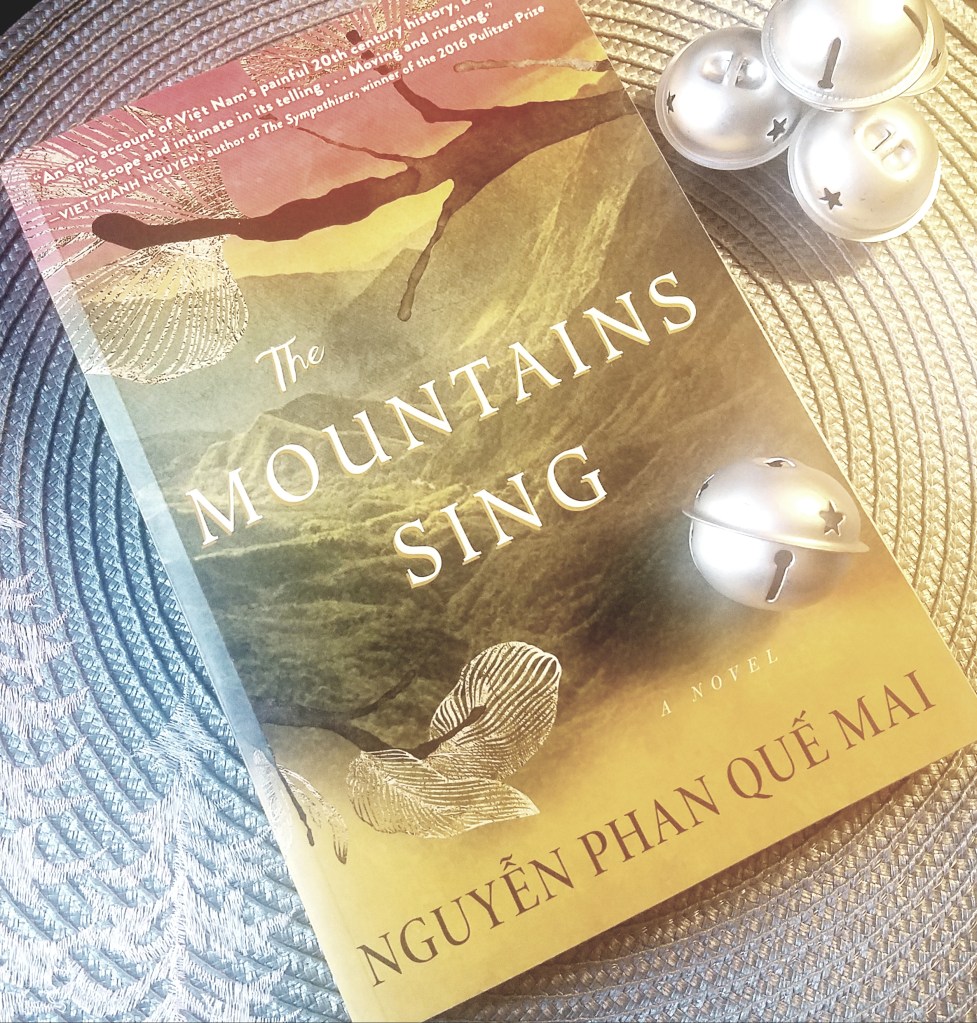
THE MOUNTAINS SING – Nguyễn Phan Quế Mai

It truly has been the season of “women at war” books for this booknerd.  After I left Korea, I went to Vietnam and a family saga that spans decades of turmoil.  The Mountains Sing (Algonquin Books of Chapel Hill, 2020) is Nguyễn Phan Quế Mai’s first novel in English.  A celebrated poet, Mai’s language purrs on each and every page of this beautiful novel.  (I have posted previously about the questionable manner in which I found myself with an ARC of this novel.  For these purposes, I’ll just reiterate that one should not sell ARCs, and I should have paid better attention to my purchase.)

The Mountains Sing is a complicated story set in a complicated country.  Set primarily against a backdrop of the Việt Nam War, the novel of the Trân family also touches on the Japanese invasion of Vietnam, which was followed by the Great Hunger and the Land Reform – a tumultuous history that defined every member of the Trân family.

Despite jumping around in the chronology, the novel centers around young Huong.  Both of Huong’s parents have joined the war effort – her father as a soldier and her mother as a doctor.  She lives with her maternal grandmother, Grandma Dieu Lan, a teacher by trade, in a beautiful house in Ha Noi.  Within pages of the novel opening, the sirens alert the residents that the American bombers are approaching and they must take shelter.  Huong’s grandmother yells at the mothers and children who are trying to find unoccupied bomb shelters to go to the school because they certainly wouldn’t bomb a school.  Huong and her grandmother survive the bombing, but bodies and parts of bodies litter the streets as they hurry home.  After months of quiet and relative peace, war has returned to Ha Noi.

As the story unfolds, we learn more about Huong’s grandmother, the daughter of wealthy landowners, and the deaths of her parents in the wake of the Japanese invasion followed by the Great Hunger.  Through her stories told to Huong, we learn of Wicked Ghost and the horrors he inflicted on her family.  We learn of the difficult choices Dieu Lan makes when she is forced to flee her home with all but one of her children during the Land Reform.  And we see the lasting impacts of those choices on her now grown children.

The Mountains Sing is about mothers and the ties that bind.  It’s about home and family.  The writing is poetic and beautiful, and that gorgeous writing style is what allows the light and hope to glitter in this story that is so full of war, death, and destruction.  I did find the pacing in the last fourth of the novel to be unpleasantly rushed as Mai attempted to tie up any loose ends.  It was a disservice to an otherwise gorgeous novel to vomit out the ending in such a hurried and uncontrolled way; however, I still strongly recommend this novel.  I can’t emphasis enough the importance of books like this and voices like Mai’s.

Read this book.

RIOT BABY – Tochi Onyebuchi

“If you hear the dogs, keep going. If you see torches in the woods, keep going.  If there’s shouting after you, keep going. Don’t ever stop. Keep going. If you want a taste of freedom, keep going.” 

Riot Baby, 124

Tochi Onyebuchi’s Riot Baby (2020) perfectly illustrates how successful science fiction can be at providing social commentary on the injustices of the world.  In this case, it’s the centuries of repeated aggression and violations on black and brown bodies.  Clocking in at under 200 pages, this novella is a light weight that packs one hell of a wallop.

Ella has a Thing, and by Thing, I mean a special power.  She can control the atmosphere.  She can walk through the past and the future.   She can kill with but a look. It’s a destructive, untamed fire that rages within her, and she cannot control it.  She leaves her young brother and her mother to protect them because she’s afraid of what she will do.

Ella’s brother, Kevin, was born during the Rodney King riots.  He’s a smart kid, good with computers and numbers.  Under the protective shield of Ella’s powers, he thrives in a city that eats its youth.  But then she leaves, and he is no longer protected.  Kevin becomes just another boy of the streets just struggling to stay alive.  An attempted robbery lands him at Rikers.  Anger ignites in his soul, his body electric with hate.

Ella’s powers allow her to visit with her brother, and some of the power sticks to his skin – allowing him to see the things she’s seen, to walk through history and see the burning crosses, white faces contorted in hate, the broken and bloated brown and black bodies tossed in rivers, dragged behind trucks, and hung from trees.  It’s enough to suck all hope from a person.  It also allows him to walk in the shoes of his fellow inmates and prison guards.  Neither is an ability he wants.

Kevin is eventually paroled to Watts, a self-contained community of people just like him.  (And a place history remembers for its own riots.) A chip is implanted in his thumb that monitors his location as well as his vitals.  It also operates a key card to allow him access to his home.  He is happy here.  Or so he thinks.  But things aren’t always what they seem.  The fire still rages in Ella, fully under control and command, and he is the Riot Baby.

I have never read something quite so angry and full of despair as Riot Baby, but what is most striking is the hope that sparks just beneath the surface like a recently lit match.  Keep going.

Read this book.

A GOOD NEIGHBORHOOD – Therese Anne Fowler

I seldom say that I hated a book because I can usually find something redeeming about it, but I hated Therese Anne Fowler’s A Good Neighborhood (2020).  This review will be quite brief and in a slightly different format because I don’t want to launch into a tirade about my visceral reaction to this novel.

Things I liked

  • The writing isn’t awful – it’s quite strong.  Fowler knows how to tell a story.
  • The novel is told from multiple narrators, and one narrator is the “neighborhood” – I’ve always enjoyed place as a character and collective voices as one.  It works well in this novel and probably should have been used exclusively.
  • The civil lawsuit based on the builder and homeowner getting a variance that should never have been approved based on the proximity of Valerie’s ancient and glorious tree.  (This really should have been the plot.)
  • The cover.

Things I disliked

  • The attempt to provide POVs of Valerie and Zay.  I’m not saying a white person cannot write the POV of black person, I just don’t think Fowler was successful.  She addresses this criticism in the author’s note, which, unlike most novels, appears at the beginning of the novel.  Fowler attempts to justify writing those POVs, which leads me to believe she knew it was bad idea and not properly executed. 
  • The character development was severely hampered by Fowler’s attempts to make this novel something that it’s just not. Valerie and Zay never seemly fully developed or well-thought out.
  • Valerie is a kick-ass and wicked smart ecologist.  Her fight for the tree should have triggered her to compare herself to other wicked smart ecologists – Rachel Carson quickly springs to mind – however, Fowler has Valerie compare her fight for the tree to Rosa Parks and MLK.  The constant dropping of names like Parks and King and John Lewis seem more like the author attempting to let the reader know she knows who they are.
  • The stepdaughter/stepfather trope.  This could have been done quite differently if Juniper’s POV is anti-Brad.  Instead, Fowler nods to Lolita and paints her the temptress.  This is supported by Juniper’s own sections, not just Brad’s sections.  This should never be a plot point used to propel the narrative.  Never.  Fowler attempts to walk it back after putting it out there, but it’s too late.
  • The ending is one of the worst endings I’ve ever read.  It’s not just unsatisfying because of how it ends, it’s disappointing in that Zay’s and Valerie’s actions are entirely uncharacteristic based on the development, however limited, Fowler gives them.

There are a lot of people who love this book.  People who think that it perfectly captures the plight of Black Americans in the South and that by reading it, they’ve broadened their horizons. While I applaud Therese Anne Fowler’s attempt at casting a light on racial disparities in North Carolina, this book will not diversify your shelves and I cannot recommend it.

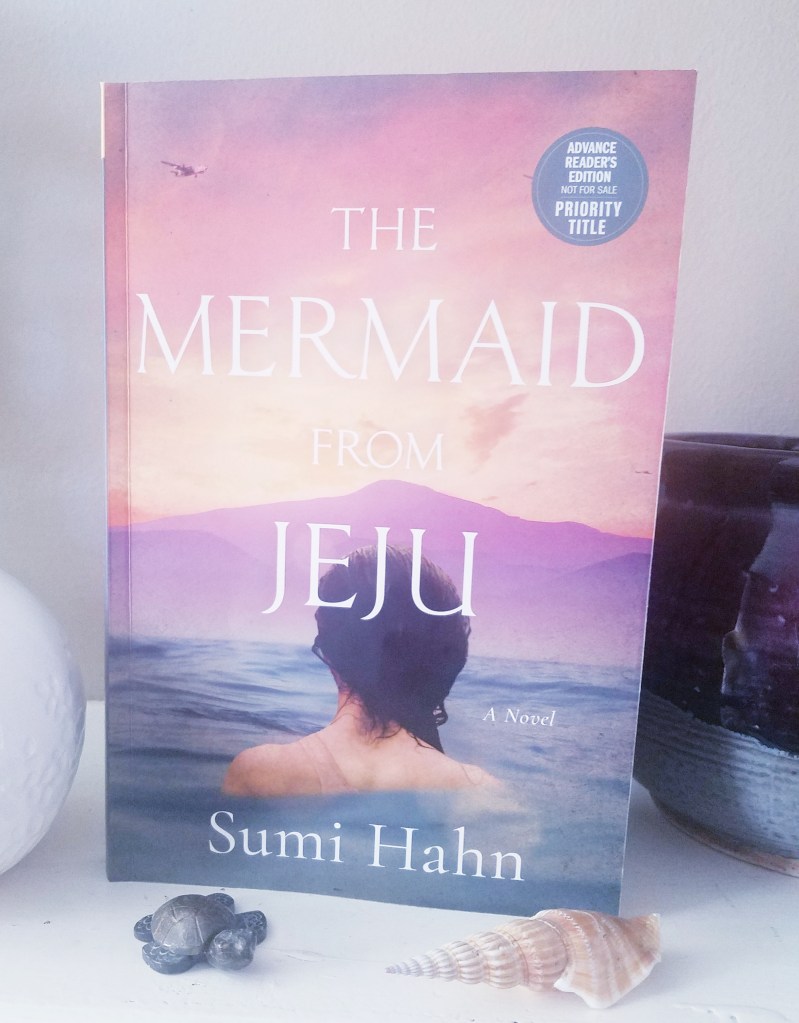
THE MERMAID FROM JEJU – Sumi Hahn

From the battle torn France of World War II, to the women warriors of Ethiopia during the Second Italo-Ethiopian War, and now to the haenyeo in post-WWII Korea, I’ve been on a bit of a “women at war” kick.  The Nightingale, The Shadow King, and The Mermaid from Jeju are all three written by women and primarily about women during armed conflicts in their homelands.

The Mermaid from Jeju (December 2020) is Sumi Hahn’s first novel, and what a brilliant first novel it is.  It is a love story of family, heart, and home.  It is a story of resistance and choices.  It is a story of magic and appeasing the Sea King, because he will always take back what is his.  It is a story of mermaids.

The haenyeo are deep-sea divers, exclusively women since the 1600s, from the island of Jeju.  While there are only a few thousand left today, these mermaids have been diving to feed their families for centuries.  Many of the divers that caught the attention of the American soldiers following World War II were grandmothers, their bent bodies barely able to move on land but are like fish in the water.  These women passed their knowledge to their children and their children’s children – a matriarchal tradition born of necessity that is dying; the majority of the divers today are over fifty. 

This beautifully crafted tale is set just following the Japanese occupation of Korea during World War II, and it follows Junja, a young girl who dives along side her mother and her grandmother.  Her mother is considered one of it not the best diver on the island.  Junja is the oldest of three children, and she’s trained her whole life to be a haenyeo.  Her father, a mainlander who’d been unable to come to terms with his beautiful wife being the breadwinner, had abandoned them all years ago.

Desperate to prove herself and show independence, Junja begs her mother to let her take the annual trip to the mountains to trade the gifts from the sea for a piglet.  Her mother relents, and the young girl begins the trip that will forever change her life.  She’s enchanted by the mountains almost as much as she is by Yan Suwol, the wealthy pig farmer’s firstborn son who is equally smitten by her.

Junja has been warned to keep her wits about her and watch for any trouble, be it wild animals or soldiers on the road.  She’s also been warned never to talk politics, to remain always neutral.  But no one has told her that her country remains in a tenuous position; the Japanese may have left, but what is coming may be worse.

She returns home from the journey with the flushed cheeks of someone who breathed mountain air and love for the first time.  She just in time to see her mother succumb to injuries Junja been told were from a diving expedition, despite her mother being an excellent diver.  Junja blames herself.  If she hadn’t begged her mother to let her take the trip, her mother wouldn’t have been near the water that day.  Junja’s grandmother blames herself because she knows the truth.  She knows the secrets that must remain buried.

As the conflict intensifies, Junja finds herself and her grandmother in the thick of it.  Suwol, the poet and scholar who has her heart, is hellbent on fighting the Nationalists.  Her grandmother has taken to cooking for a Nationalist soldier, speaking in hushed tones to him over the meals he praises.  Junja does not trust him, and neither does Suwol.  But Junja quickly learns that things are not what they appear, and people aren’t always who they pretend to be.  A carefully orchestrated ruse to rescue her beloved Suwol starts a series of events that Junja’s grandmother would insist were always meant to be – a series of events that will shatter you.

I wanted more of the haenyeo.  Hahn hints the ways in which they protected their families and homes, from whoring to spying, but those stories are just quick little teases.  I also wanted more of Junja’s grandmother, a woman who, unlike Junja’s mother, refused to stay neutral.  The things she did and the ways she fought during the Japanese occupation deserved more than a passing glance.  But this is the story of one mermaid, a mermaid who is forced to become a woman during a volatile time for her country, and like a mermaid, the novel is absolutely enchanting.

Sumi Hahn’s lovely debut, The Mermaid from Jeju, will be released on 08 December 2020.  Thank you to Alcove Press and Crooked Lane Books for getting this gorgeous ARC in my hands.  For those still doing their Christmas shopping, if you’ve a bookworm on your list who loves historical women’s fiction or women’s fiction in general, this will be published just in time and will look lovely under a tree.
THE SHADOW KING – Maaza Mengiste

But tell me who you are, she says.  Tell me slowly and repeat it three times, and I will make sure you are known. I will make a remembrance worthy of this fall. Say your name to me now. Say your name as you are photographed. Say it as you leap into the air and learn to fly. Do not let them forget who they have killed.”

(290)

The Shadow King (2019) by Maaza Mengiste deserves every bit of praise that has been bestowed upon it.   This lyrical work of historical fiction is bold and beautiful, fierce and fantastic, weighty and wonderful.  The second Italian invasion of Ethiopia is not a conflict that’s made my history books, and if it has, it was little more than a footnote.  As such, I want to give the briefest of history lesson.

Ethiopia was one of the few independent countries in a heavily European-controlled Africa, and Italy wanted to claim it for Italy and Italian landowners.  Following a failed attempt in the 1890s, Mussolini spearheaded the second invasion on October 3, 1935.  The children during the first attempt became the warriors in the second, following in their parents’ footsteps in fighting for their home.  Despite their best efforts, the Ethiopian army suffered blow after blow.  Emperor Haile Selassie fled the country and abandoned his people, going into exile.  Mussolini proclaimed Italy’s king emperor of Ethiopia.  Italy’s tentative control lasted until 1941.  Despite the Italian occupation, Ethiopia is largely considered to be one of two African countries that were never colonized.

That little taste of history provides just a hint of the setting for this remarkable novel that showcases the role of women during the conflict.

Hirut, a young servant, is at the heart of this novel. Following the deaths of her beloved parents, she is “taken in” by Kidane and his wife, Aster.  Her mother had served Kidane’s father, and she was violated repeatedly by him. While not stated with any certainty, it is hinted that Hirut is possibly Kidane’s half-sister.  Like her mother before her, Hirut is expected to serve the family.  Her only memento from her father is an old rifle, a Wujigra, and a single bullet. The Italians aren’t the only monsters who inflict pain upon her, and she grows hard and hellbent on vengeance – a warrior who understands the Italians aren’t the only enemy.

Aster is beautiful but broken.  After being forced into a marriage she tried so desperately to escape and losing her infant son, she has gone quite mad. She is filled with a rage that she redirects as jealousy toward Hirut.  When the Italians invade, she finds a new way to channel her rage and find herself.  She becomes the face of a movement.

The unnamed cook is a part of the land, and her knowledge of how to use plants to heal and kill, to make life and to expel it, are her weapons. The maternal role she played for not only Aster and Hirut, but Fifi and so many other unnamed women, men and children showcased is indicative of yet another way women found to fight the Italians as well as the enemy within.

Fifi is a woman of many names.  A true chameleon, she is a whore and a spy, a lover and a fighter.  Like women have done for centuries in conflicts all across the world, she feigns illiteracy and ignorance while taking top dollar from the Italian officers.  All the while, she’s taking note of telegrams and maps, orders and plans, and passing the information to Kidane’s army.

The women feed the men, heal the sick, and weld their weapons with certainty.  They stand tall, as their mothers did before them, and fight for their home.  They are the mothers and daughters, the sisters and wives, of a country that refused to submit.  The ground is soaked with their blood just as frequently as it is their tears.  History would have you forget them, would have you focus on the men who led charges, who became shadow kings for a coward emperor, who roared in battle.  While the novel gives a lot of insight into Ettore, the Jewish Italian soldier who photographed the war and the prisoners as commanded, and the Colonello Fucelli, who is Kidane’s perfect foil, it always comes back to the women, the true shadow kings of war.

Read this novel.

THE NIGHTINGALE – Kristin Hannah

It always surprises people that I’ve never read anything by attorney-turned-author Kristin Hannah before now.  It’s even more surprising that she only seriously crossed my radar when I read a blurb for her 2021 release, The Four Winds.  I decided I needed to read something by her before this anticipated  release, and here we are.  While I currently have three Hannah novels on my shelves, I selected her highly lauded and “soon to be a major motion picture” novel, The Nightingale (2015), as my introduction to the author.

Hello, indeed.

The writing style of this novel is simple and comforting; it’s not trying too hard to be something it’s not.  And it’s in this familiar simplicity that Hannah has the ability to destroy her reader.  I was positively gutted a couple of times in this novel.  (If you’ve read it, you’re likely equally haunted by one heartbreaking scene in particular involving a young girl.)

The novel, set primarily in France, opens just as WWII is beginning and tells the story of two very different sisters, Vianne and Isabelle.  The sisters have a rather tortured relationship, marred by a dead mother and an absent (and bitter and broken when not absent) father.  After their father sends them away, Vianne quickly abandons her younger sister for the handsome young man who holds her heart.  She marries young after becoming pregnant, but their love story is a true one.  Isabelle spent much of her childhood struggling with being abandoned and longing to be loved.  She’s grown up to be a wild one, with an untamed spirit.  In her heart beats the constant fear that no one has loved her and no one ever will.

Vianne’s buried more babies than she’s nursed, but Sophie is her bright light and Antoine the love of her life.  Her life is near perfect, but then her beloved gets called to war.  Vianne is naïve and afraid; she remembers what the war did to her own father, how it broke him and left him empty with nothing more to give.  Surely war wouldn’t come to sleepy Carriveau.  Surely the line would hold.  In the blink of an eye, the Germans arrive.  A young (and handsome) captain chooses her home as his.  He is kind to her, which proves both a blessing and a curse.

Their father sends Isabelle to Carriveau under the guise that Paris is no longer safe.  She arrives, battered and dehydrated, having been forced to join the throngs of those fleeing Paris on foot and running from attacks.  It is during this journey that she meets Gaetan, the man who will change the course of her destiny.

The sisters are night and day.  Vianne pleads with Isabelle not to be so hot headed, to do as she is told and keep her head down.  But Isabelle is untamed; she will cause ripples.  She will cause waves.  She will be a tsunami upon them. 

In the two sisters, Hannah captures a woman’s war.  Vianne fights as she can, her priorities are to family and home.  She will do anything for her daughter.  Anything.  Vianne is the mother, and her rebellions have the quiet strength of a woman who has loved and lost and who knows she’ll do both for the rest of her days.  Isabelle is daring and fearless.  Emboldened by years of being treated like a pretty, empty thing, she is hellbent on proving herself to her sister, her father, Gaet, and even herself.  She joins the fight – her code name is “Nightingale.”  Isabelle may be a fictional character, but her heroic efforts in shepherding shot-down pilots safely across the Pyrenees are well-rooted in history.

While the novel flowed with relative ease, I did take issue with the inconsistent and unnecessary usage of French; the reader knows the dialogue is taking place in French even though written in English, so constantly throwing a “oui” or a “Mon Dieu” just seemed unwarranted and a bit annoying.  That said, this tale of two sisters, the choices they made and the secrets they buried, was simply and exquisitely told.    

BESTIARY – K-Ming Chang

Jie says she once saw two girl ghosts kissing in the creek. I mishear her and think she means they were cleaning the creek. Why? I say.  Jie says, Because a god made them want but didn’t give them a word for it.

Bestiary (One World, a Random House imprint, 2020)is K-Ming Chang’s gritty and magical debut novel.  It’s ugly and foul.  It’s vulgar and disgusting. It’s covered in mud and bodily fluids.  Blood.  Sweat.  Tears. Semen.  It breathes.  It pulses.  It snarls.  It’s one of the most remarkable things I’ve read this year.

If you’ve followed me for any amount of time, you’ve likely realized that I have a special place in my booklovin’ heart for magical realism and the cultural significance of storytelling.  As such, it doesn’t come as a shock that I’d pick up this novel of three generations of Taiwanese American mothers and daughters.  Wrapped in Taiwanese folklore and mythology, Bestiary embraces and exposes family secrets, childhood scars, blatant discrimination, and queer desires with no apologies and no warnings.

It’s difficult to formulate a review of a book like this, because it’s so different.  I heard echoes of Jamaica Kincaid’s “Girl” that can’t be denied, but this novel is more raw, more crude, more visceral.  It may not find its way on my list of favorites and it’s not one I would recommend to everyone, but it certainly is a remarkable piece of literature, history, and storytelling.

THE BUTTERFLY EFFECT -Rachel Mans McKenny

The Butterfly Effect, Rachel Mans McKenney (Alcove Press, Dec 08, 2020)

I recently received an advanced reader’s edition of Rachel Mans McKenney’s upcoming release The Butterfly Effect.  This debut novel is quite remarkable, settling about the reader like a comforting hug or a blanket made by your grandmother.  It’s not artificially sweet, but rather naturally sweet, like the nectar the butterflies that flit about the novel feed upon.

Greta Oto prefers bugs to people, data to drama, and Lepidoptera to love.  In her world, things are black and white – there is no room for any grey.  The only person she’s really let in is her twin, Danny, and they’re not exactly on the best of terms.  With nothing holding her back, she heads to Costa Rica to research her beloved butterflies and avoid an Iowan winter.  But somewhere, a butterfly alighted on a flower, and Danny suffered an aneurysm.  And Danny, the good twin, the popular twin, the twin who could see colors in sound, was in serious condition.  Greta, full of regrets from past decisions, hurries to his side.

Socially awkward and matter of fact, Greta makes no attempt to play nice with Danny’s fiancée, Meg.  She is growly and disagreeable, showing her teeth whenever Meg tries to get too close.  Her ex-boyfriend Brandon is a different story entirely.  She had let him in.  His passion for butterflies had become her passion, and now she had to beg him for a job at the butterfly conservatory so she can get off Meg’s couch and keep her academic career from derailing after being removed from the Costa Rica research project.  It’s easy with him, easy to remind her how easy it was.  And with his pretty new girlfriend, being easy is dangerous.  Max is different.    One of Greta’s closest friends, Max understands her better than most.  Things with him are nice and uncomplicated, until they aren’t.  Add a mother who abandoned Greta and Danny after falling for a man other than their father, and you’ve got the perfect recipe for a research project into families and what ‘home’ actually means.

Greta Oto’s prickly personality and the warmth of the novel make it a rather easy comparison to A Man Called Ove, but it has a distinct heartbeat as fragile and powerful as the wings of glasswing or a swallowtail.  This well-written and feel-good story of science, facts, family, and healing should certainly find a home on your shelves, because we all need a hug, whether we realize it or not.

THE ONCE AND FUTURE WITCHES – Alix E. Harrow

“One witch you can laugh at.  Three you can burn.  But what do you do with a hundred?” (469)

After a fun vampire read and a delicious deal with devil, I wanted to round out October with a witch story.  Alix Harrow’s highly anticipated The Once and Future Witches with its witches and suffragettes was an easy choice.  While the suffrage movement waged for decades, Harrow’s novel is set primarily in 1893.  And while the right to vote serves as a backdrop, plot device, and often a foil, the heart of the story remains with the witches that once were and will be again.

Admittedly, I was initially rather disappointed in the novel.  Descriptions and phrasings that were brilliant bursts of light dulled and became mundane when repeated again and again, regurgitated in the same and similar fashions.  While some of the repetition was undoubtedly intentional mirroring between the three sisters, it was too frequently utilized to have the intended effect.  Any disappointment I’d initially felt, however, vanished by the final third of the novel.

Alternating between the three Eastwood sisters, James Juniper, Agnes Amaranth, and Beatrice Belladonna, the novel details how witching returned and the power of women was realized.  Harrow weaves in some traditional European folklore and nursery rhymes that most readers would be familiar with.  (Hansel and Gretel, Rapunzel, Humpty Dumpty, Ring around the Rosie, and Sleeping Beauty are just some examples.)  Hidden in the words of bedtime stories and children’s songs were the witching ways; and what are the witching ways but the will, the way, and the words.

The three sisters are the maiden, the mother, and the crone necessary for the spell to succeed in bringing back magic, but they are also the will, the way, and the words, and that’s the power that hums steadily beneath the pages.  Early on in the novel, when they’re trying to build their numbers, they request those women who have joined the Sisters to write down the stories and the magic they know.  Some of the women, those from other backgrounds and cultures, refuse.  Juniper, in particular, is very upset, but one of the women patiently explains “not every word and way belongs to you.”  Harrow’s treatment of racial and class disparities in the right to vote movement (and witch movement) is worth noting and applauding, as is the love story between Cleo and Bella.  (Jennie, however, seems an afterthought.  While I appreciate the character, that storyline needed more flesh on its bones or to be removed.)

In time, the women stand together, joining their voices and their wands to create a brilliant ball of light and drive away the shadows.  The message is clear – we must stand together.  Sure, this is a fantasy novel with witches and familiars, but we are the daughters and the granddaughters of women who were indeed burned.  We are the phoenix.  And that is not fantasy.

I wept at the close of this novel.  I wept for the Eastwood sisters, but my tears were mostly for the women who are like the sisters’s mother – the women who think if they make themselves small enough and quiet enough, he won’t hurt them anymore.  The women who have lost their way and their will.  The women who have forgotten the words. 

Once upon a time…

THIS MOURNABLE BODY – Tsitsi Dangarembga

In 2004, I met a woman whose impact on my life has proven immeasurable beyond belief.  Not long after I met Gay, she was diagnosed with Lou Gehrig’s disease, and I watched as she began to lose control over her muscles. One of the first things to go was her voice; she walked the halls with a dry erase board around her neck. I’d sit cross-legged at her feet, stacks of books surrounding us, and we’d talk in our disjointed way.  In class, she’d use my voice.  I can still feel her hand squeezing mine and see her nod in my direction – “You tell it.” In early 2006, she went to her Belizean home to die.

I miss her – never more so than when I read a book like Tsitsi Dangarembga’s This Mournable Body (2018).  Gay put Nervous Conditions (1988) in my hands, and the continued story of Tambudzai was bound to bring her to mind.  I wish I could talk to her about it.  To sit cross-legged at her feet.  To listen.  To learn.  To love.  I guess I will have to “tell it” on my own.

Tsitsi Dangarembga is well-deserving of being on the 2020 Booker Prize shortlist.  This Mournable Body continues many of the themes found in Nervous Conditions, and it showcases how little has changed in Zimbabwe.  In my reaction to Nervous Conditions, I wrote:

“Dangarembga’s women deserve a little respect for the fight they are waging against a patriarchal society that denies them education, freedom, and happiness.  Hybridity creates for a nervous condition, but so does being a woman in a world of men.” 

Decades later, the sentiment is the same as this novel continues to explore the interplay of gender, race, and class, with a prominent focus on the women.

Tambu is highly educated, but she has to fight tooth and nail for each rung she climbs toward her success.  Her ideas are discredited and later stolen by white and/or male coworkers.  She knows it’s a dog eat dog world, and she will do anything to untether her past and succeed.  An early scene in the novel has her preparing to join a mob stoning a young woman whom she knows.  The attack is prompted by the young woman’s age and attire.  She ends up not only humiliated, but seriously injured.  Tambu is only the slightest bit remorseful.

Tambu ends up renting a room at a widow’s home.  She thinks she will have to marry one of the widow’s sons if she is to succeed, but she manages to get her feet back under her and secures a position teaching biology.  But the unruly teenagers, so flagrant with their transgressions, are enough to drive her mad.  Tambu has a nervous breakdown while teaching, and nearly kills a student.  Having proven herself a threat to others, she is committed to a psychiatric ward. 

Upon her release, Tambu moves in with her cousin Nyasha, my favorite character in Nervous Conditions.  Nyasha still straddles the worlds that caused that nervous condition of her youth, having even married a white man, but she knows who she is and what she is fighting for.  Unlike Tambu, she’d rather lift up her sisters than step on their necks to advance herself.

The tides turn for Tambu and she finds herself in another well-paying position in ecotourism.  When she leaves Nyasha to begin her new life, a horrific scene is unfolding.  But Tambu has no time to be bothered with the dead baby and bloodied help; Avondale awaits.  Success awaits.

Tambu is good at her job, but there is a constant pressure to bring new ideas to the table.  She suggests bringing tourists to the villages.  To her village.  It is only on the heels of this idea that she returns to the village she had once called home; she has to get her mother on board to help sell the idea.  It’s a new low, even for Tambu; she’s willing to sell her family, heritage, and traditions for the right price. 

Tsitsi Dangarembga’s title for this novel was inspired by Teju Cole’s 2015 essay in the New Yorker, titled “Unmournable Bodies.”  That essay deals with the disparities in how the world mourns the loss of different lives based on race, gender, national origin, and social class.  Tsitsi Dangarembga’s title sends its own social and political message: the women of Zimbabwe are important, valued, worthy.  They are mournable.

It’s a brilliant, raw novel full of bitterness and resentment.  It’s beautiful.