THE GIRLS WHO GREW BIG – Leila Mottley

“Momma raised me right till she refused to raise me at all.” 

“They wanted us to be anything but what we were.”

“’Cause hundreds  of years ago, some pirate ship sunk and spilled treasures all over the bottom of our sea and now the water shines emerald green for us and if that don’t make us treasures too, I don’t know what does. So even when we havin’ a hard time, you just remember the world gon’ send you some treasures when you need it most, even if it takes hundreds of years to see ‘em shine.”

Leila Mottley was longlisted for the 2022 Booker Prize with Nightcrawling, and her 2025 release, The Girls Who Grew Big (Knopf 2025) made my prediction list but didn’t make the actual long list.  (It should have. Swap Love Forms for this. What Mottley does with language is such a gift.)

Much like Nightcrawling, The Girls Who Grew Big deals with an unsavory subject matter – teenage pregnancy and teens who choose to get pregnant and choose to raise their children.  Their choices are not “socially acceptable,” and the book is not a teachable moment against childhood pregnancy; it’s raw and jagged, this story of near feral girls not yet women, but it’s one of the most beautiful books about sisterhood and found families I’ve read. These girls are pushed to the outskirts of society; shunned, judged, and abandoned by their families, they find support and strength in each other.

Sectioned in trimesters and told from the POV of Simone (leader of the Girls), Emory (raised by her racist grandparents and Simone’s brother’s baby mama), and Adela (rich, biracial girl from Indiana with aspirations of being on the Olympic swim team sent to Florida to stay with her paternal grandmother, have the baby, and return like nothing happened – her mother wouldn’t let her have an abortion).  It’s Adela who breaks the Girls. Adela who gets broken. Adela who helps put pieces back together.

The sandy grit from the Florida beach is in the pages, in the words, in your mouth.  The Girls Who Grew Big is something special.  And so is Mottley.

Read this book.
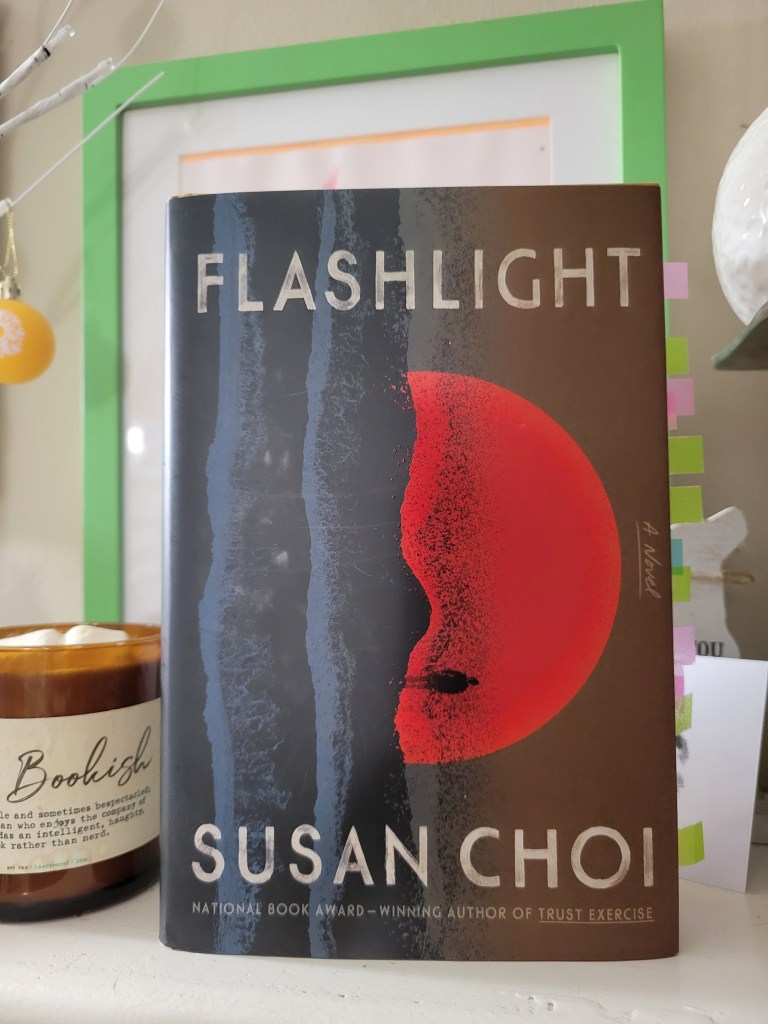
FLASHLIGHT – Susan Choi

“In one hand he holds a flashlight which is not necessary, in the other hand he holds Louisa’s hand which is also not necessary.” (3)

“Up and down with their flashlights: one carries the flashlight, the other carries the gun.” (378)

Susan Choi’s Flashlight (Farrar, Straus and Giroux 2025) is next up in the Booker longlist. This novel, a family saga laced with trauma, identity, geopolitical drama, mystery and slices of history, ticks a lot of boxes for what I enjoy in a story. Add Choi’s storytelling talent, and it’s likely this will be my favorite of the longlist. (I do so love a slow burn of a family saga!)

The novel opens when Louisa is 9. She and her Japanese-born Korean father are in Japan where he is teaching. They are walking the shore. Her mother is sick and did not join them. This is the last time she sees her father, and her memories of what happened that night, on the shore, are locked up tight. The reader then gets her father’s back story (Seok turned Hiroshi turned Serk turned The Crab), which is heavy on the conflict between being a Korean in Japan, calling his Japanese name something he only puts on when he’s outside “like a coat.” We also get Anne’s backstory. The youngest of seven and just eager to get out, she winds up becoming involved with a married professor. He and his wife adopt the child she carries, and she continues on a solitude path. Anne and Serk eventually meet when he comes to the US. They get married and Louisa is born. It’s a pretty volatile marriage, and there remains a lot of disconnect between the couple.

Anne’s sections are beautiful and achingly crafted. She’s a woman at odds with her choices and her body.  And Louisa is positively awful to her, just like Serk had been.  Justice for Anne.  Lousia’s sections are equally well defined and powerful. She’s marked by the trauma of losing her father that night and an inability to address the loss in a healthy, productive way. Generational trauma from both of her parents taint her choices throughout her life.

Serk’s sections are less formed, just as much a shell of the man as he is at those points. With Choi’s talents, I imagine this is intentional and not just hollow writing. The pain and trauma he endures, the loss of time and memory, is captured in these stripped-down, seemingly underdeveloped sections.

Tobias, the son Anne had at 19, and Ji-hoon (AKA The Fisherman) have sections that serve clear and exact purposes – they serve as info dumps and provide context, especially as it relates to the geopolitical climate and the “based on actual events” abductions of Japanese by North Korea.

Some things worth further discussion – Holden, Lousia’s cat and her reaction to learning it had disappeared, the pronunciation of Kang (oh man even at the end, I hated Louisa who seemed she could only show her mother love by being dismissive and angry), and of course, the many uses of flashlights throughout (Serk’s EVERREADY we open with that shows up again, the child psychologist’s flashlight that Lousia steals, the flashlights searching for Louisa and Serk, the red plastic flashlight at the hostel used to summon a ghost, the flashlight at Daniel’s worksite, and the flashlight (and gun) carried by security agents patrolling. (Did I miss any!?!?)  The line that made me cry? “They threw me out of the boat, and I swam.”  IYKYK.  Justice for Anne.

Read this book!

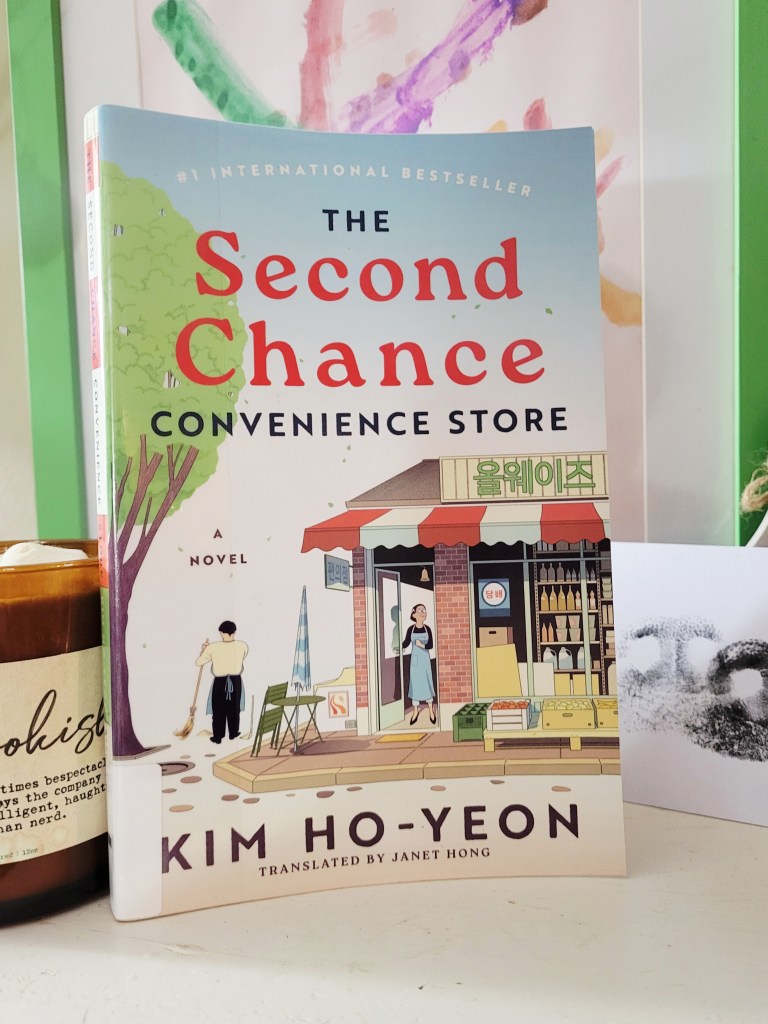
THE SECOND CHANCE CONVENIENCE STORE – Kim Ho-Yeon

If you’re looking for a slim, comfortable little novella that is reminiscent of the heart hug I get from Backman, try Kim Ho-Yeon’s The Second Chance Convenience Store. (Translated by Janet Hong, Originally published in South Korea 2021; English translation published by Harper Perennial 2025). It’s full of warmth and humor, found families, and second chances. The story unfolds in a series of interlocking chapters with different POVs, and it’s delightful.

The novel opens with Mrs. Yeom Yeong-sook, the owner of a convenience store that her son wants her to sell, realizing she’s lost her wallet. A man calls her because he’s found the wallet at Seoul Station, and she goes to meet him. Dokgo is homeless, unkempt, smells bad, and stutters. To thank him for finding her wallet, Mrs. Yeong-sook offers for him to come by her store whenever he wants and get a lunch box.  He starts coming every day, eventually winning over the staff and the customers.  She eventually hires him to work the night shift.

As the stories unfold and Dokgo helps every he encounters, he starts to get better and his memory starts to return. From failed careers to alcoholism to writer’s block and family drama, Dokgo is a listening ear and a voice of reason. He heralds in second chances, wiping the dust off so folks can see it was always there.

Then Mrs. Yeong-sook’s greedy son hires a detective to find out who Dokgo really is and what his loss of memory is really hiding.  Will Dokgo also get a second chance?

The Second Chance Convenience Store is a quick and sweet read.

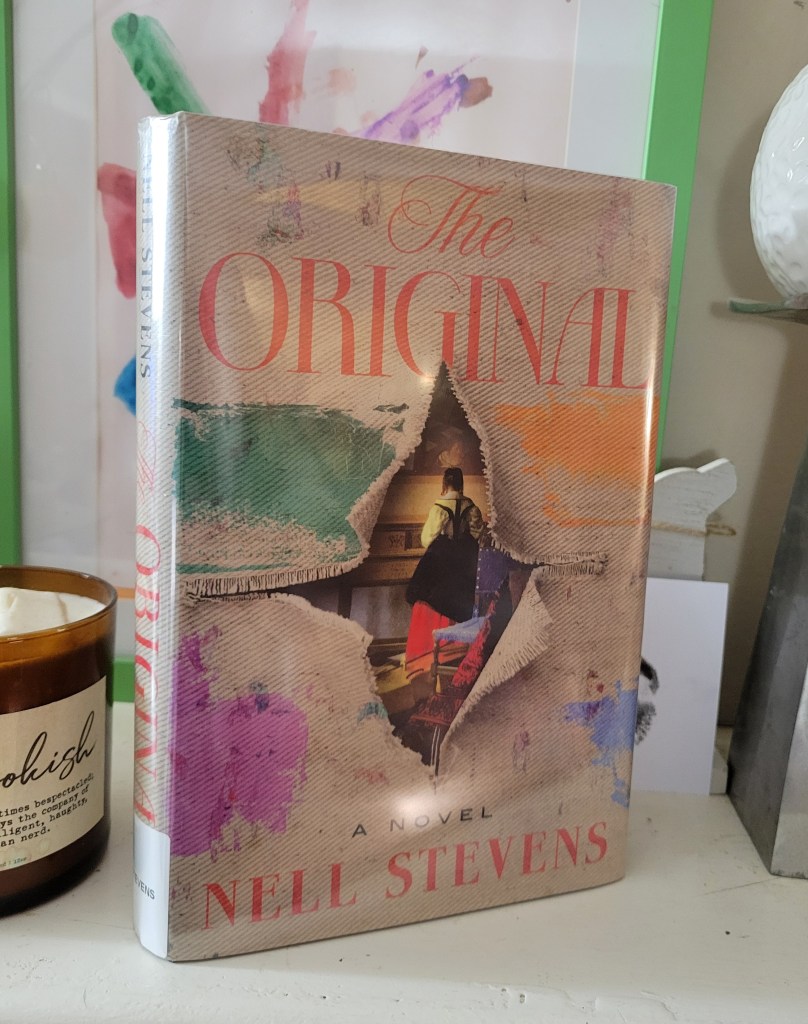
THE ORIGINAL – Nell Stevens

“Everything done for the second time is a copy of when it was done for the first time, and an attempt to bring back something lost.”

Nell Stevens The Original (W.W. Norton & Company 2025) is a delicious, queer historical fiction, laced in a Victorian gothic tradition that rendered it un-put-down-able.

As a young girl, Grace is sent to her uncle’s sprawling estate where much of her time is spent keeping out of the way and waiting for madness to come. As both her parents were committed (the final straw was fornicating in public), she assumes her madness could reveal itself at any time. The family has been cursed by a long dead relative, and the heirs are dying. After twelve years and presumed lost at sea, her cousin returns after her uncle’s death for his inheritance. But is it really Charles or an imposter?

Graces knows a lot about imposters. She’s a fraudster herself, painting copies of notable works and turning them for a profit. Cursed with prosopagnosia, Grace is unable to recognize and/or remember faces, even of those she loves. She, therefore, cannot look at Charles to determine if he is real or a “copy.” One thing is certain, he knows things that only Charles, or someone extremely close to him, would know.

An investigation into the potential fraud is launched, with Grace believing him to be her cousin at times and an imposter at times. Sometimes he proves himself an ally, sometimes an enemy. He certainly keeps her on her toes. He is the only one who knows that she loves women, much like he loves men. He also knows about the paintings – Charles has known about the paintings since the first replica she made. (A replica that tossed the family on its head as the original had been burned and then it showed back up, like a ghost.)

While a bit predictable as it unfolds, this is certainly worth a read.

AUDITION – Katie Kitamura

“There are always two stories taking place at once, the narrative inside the play and the narrative around it, and the boundary between the two is more porous that you might think, that is both the danger and the excitement of the performance.” (38)

First up in the 2025 Booker 101 is a slim slice of metafiction in Katie Kitamura’s Audition. Understandably divisive, the novel with its unnamed 49-year-old actress of a narrator, presents two different realities along the same timeline with not gap or repetition; the only significant change is motherhood. There’s a lot of discussion, and a lot more room for it, regarding the two sections and how they work together toward the endgame. There’s also a lot of room for discussion about what the endgame actually is. Spoiler – the endgame is whatever the reader walks away with.

Actual spoilers will follow.

For me, part two signifies the narrator assuming the role of “mother” for purposes of “bridging the gap” in the play she’s acting in; it’s method acting, but she’s been playing a part for so long, she isn’t quite sure where she starts and the role ends. A deeper dive would say this type of method acting is also her way of dealing with her husband’s possible infidelity and absolute unhappiness, (of note, he’s unhappy in both “realities”), and her own varied emotions regarding both the abortion and miscarriage. (How she describes the miscarriage – “I had briefly borne death in my body…” is both a quiet moment and a visceral scream of writing that truly marks the writing style of the novel as a whole.)

Two things that solidify in my mind that Part Two is intended to be essentially “role play” – the gaps in the narrator’s memory (she only remembers what is necessary to move the “action” forward or build her character) and the change of the play’s title. In part one, the play is “The Opposite Shore” and it is “Rivers” in part two.  One is terra firma and the other is flowing, inconsistent and unpredictable waters – just like the sections.

Some continued threads that I enjoyed – the scarf she wears in part one that becomes Xavier’s in part two, and the continued use of pastries albeit with different motives.

I think Kitamura wrote herself into the novel not as the narrator but as Max, who got bored with a character and wrote an entirely new scene with a new character where the narrator has to “bridge the gap” between the two. 

Short story long, all the world is a stage and Audition drips with Booker-type.

Booker 1 of 13

*There is additional content on Instagram for each of the longlisted books if you want to check that out! My final thoughts will be posted here as well, but if you want to see the cover discussion or some quick and dirty facts, head over there!

THAT’S ALL I KNOW – Elisa Levi

“Look, sir, here’s your dog. I told you dog weren’t like me, dogs stick around.”

“And they’d tell me that if I was going to be so distrustful of the outsiders, I’d end up hating them, and in small towns hatred is more dangerous than guns, the forest, or illness.”

With perhaps the most perfect cover, the unassuming That’s All I Know, by Elisa Levi (2021) (translated from the Spanish by Christina Macsweeney – 2025) is likely going to be in my top reads of the year.  Coming in at 154 pages, the novel is a monologue, and I sat right still and listened to Little Lea’s story.

The novel opens with 19-year-old  Lea encountering a stranger hellbent on entering the woods to retrieve his dog. She stops him, cautioning that people don’t come back from the forest, and says she will wait with him for his dog to return. So, they wait. And Lea, quite the chatterbox, smokes a little pot and tells him her life story, focusing on the events of the past year that revolve around a new couple moving into the small town of ~200 folks and the rumored end of the world.

Lea is preparing to the leave the small town – a preparation that has been in the works for years, but she’s reached the point of no return. She talks about her family, especially her sister, Nora. Nora is special needs – confined to a wheelchair and nonverbal. She cries when she is in pain and when Lea is overcome with emotion, she’ll pinch or poke her to make her cry.

Lea’s best friends are Javiar, born on the same day as Nora and the person Lea most wants to love her, Marco, the rough and tumble man who loves Lea but has anger issues, and Catalina, the girl who loves love and is always crying.  The town is all they know, all Lea knows, and she has to get out.

It’s a trapped story, a life anchored in place and unfulfilled, and a desire laced with guilt and fear to escape it.

THE ORIGINAL DAUGHTER – Jemimah Wei

“Irrevocably dispersed throughout the land he abandoned, the land where he belonged.”

Until page 150, I thought Jemimah Wei’s The Original Daughter (Doubleday 2025) was easily going to be a 4-star read. I enjoyed the storytelling style and, more importantly for me, I enjoyed the story.  At page 150, there is a marked shift in our leading lady and what follows is a spiral into unreasonableness and unlikableness. What happened to the smart girl who flushed her grandfather’s ashes to release her new sister from the bonds of guilt? What happened to her parents who found so much strength and certainty in their love for each other until they didn’t? (I know what happened on the page, but the entire novel shifted and never regrouped.)

Genevieve isn’t a likable adult.  Not even close.  And the events that severed her relationship with her adopted sister are relatively miniscule (not the attack itself but how Arin uses the attack) but made massive due to jealousy, pride, guilt, and shame. I get that they are all human emotions, but the jealousy and anger that clouds Genevieve’s POV without flesh on those monsters makes the novel a bit hollow for me.

I just didn’t care.  Maybe that’s the point as neither does Gen.

The concept of a secret family and a cousin-of-a-stranger turned sister is great – Arin’s struggles as seen through Gen are well done and articulated. The building of the rivalry, the sudden and out of the blue desire to be a Youtube star, the academic pressure, the unreliableness of Gen as narrator, the dying mother and absentee father, each with their own twisted, broken motives… it all reads as tired.

But those first 150 pages.

JAMAICA ROAD – Lisa Smith

“I’ve missed you too.  I’ve been missing you for ages.”

Lisa Smith’s Jamaica Road  (Knopf 2025) is a heartbreaking debut of a love story that is very much time and place. Set primarily in South London, Jamaica Road opens in 1981 with a  young Daphne.  Daphne is the only Black girl in her class, and her goal is to be as unnoticed as possible. She does not want to call attention to herself now that the name calling has pretty much stopped.  Enter Connie Small, a tall boy from Jamaica that the teachers pair with Daphne because she is of Jamaican descent.  He becomes a target for her classmates’s racism.

What follows is the slowest burn of a friends to lovers. But it’s that friendship and the struggles the two face that build the foundation of their relationship. Connie and his mother have overstayed their visas and are subject to removal from the country. His mother is in a relationship with an abusive man who promises to marry her and get their citizenship. With each bruise, they hang on that promise. Daphne struggles with her finding her father, and Connie helps.

During this time period of the ‘80s, London runs rampant with racism, attacks, and the rounding up of people who don’t have current legal status. Smith captures the shift in young children to young adults clinging to the hatred of their family with portrayals of Daphne’s classmates, particularly Mark, who is modeling his older brother while still struggling with his own beliefs and attraction to Daphne. It also captures Daphne’s struggles of wanting to fit in with her English classmates and her attraction to Mark.

Connie and Daphne grow up, grow apart because of a decision she makes, and grow back together.  When Connie returns to Jamaica for a funeral, she joins him. I wish there’d been more to that section as it was beautiful, and its beauty made what follows even more heartbreaking.

This is fantastic debut. I may have hated the ending, but the ending is the ending it needed.

Read this book.

VERA, OR FAITH

It’s been a hot minute since I’ve read Gary Shteyngart, but thoughts of Absurdistan still make me chuckle nearly two decades later.  While that filthy funny novel followed the adventures of Misha Vainberg, the 325-pound son of the 1,238th richest man in Russia, Vera, or Faith (Random House 2025) gives us ten-year-old Vera – a Russian, Jewish, Korean bundle of anxiety and facts.  While she’s less raunchy than Misha, she is just as memorable.

After overhearing a conversation between her dad and Anne Mom, Vera believes that her Mom Mom has cancer and is dying. She becomes determined to meet her before she dies. With her classmate, a girl Vera wants desperately to be her friend, an automated car named “Stella,” and a sentient AI chessboard named Kaspie, she sets out to find her real mother.

There’s also the domestic struggle between her father and stepmother, the “March of the Hated (MOTH) and the Five-Three movement (a political movement claiming an unequal voice is equitable and white folks should have more of a say), a school debate where Vera is pro Five-Three, her younger half-brother Dylan, a blonde pest who like to show off his penis, and the possibility her father is a traitor to his country and his own half-Korean daughter. Let’s just say, Vera has A LOT of her plate.

Vera, or Faith is a quick, one-sitting read that’s full of heart, humor and substance. While I didn’t love it as much as Absurdistan, it’s still a fun read.  (One of my favorite parts is that Vera’s dad is a “manfluencer” for expensive pens.)

THE DREAM HOTEL – Laila Lalami

“Freedom isn’t a blank slate, she wants to tell them. Freedom is teeming and complicated and, yes, risky, and it can only be written in the company of others.”

My attempt to “get a jump” on the Booker longlist by reading predictions continues with Laila Lalami’s The Dream Hotel (Penguin Random House 2025). I’m not sure if it’ll make the list, but I certainly think it belongs there. It’s timely and terrifying, an absolute mindfuck of Chain Gang All-Stars meets Orange is the New Black meets a 2025 Orwell. The reality of the novel is so far removed from present day, and so devastatingly plausible – it’s unsettling and disturbing – a novel I read on edge, with a knot in my stomach.

In the not-so-distant future, in an America that could be, Sara Hussein is detained after landing in LAX following a work trip.  While she deals with Risk Assessment Administration agents, her husband circles the airport with their infant twins to pick her up. She is detained because her risk score is high. She’s not committed a crime, she’s not even suspected of committing a crime.  But her risk score is too high. She’s detained because data pulled from her dreams has indicated she is an imminent threat to her husband.

It’s not a detention center.  But it is.  She is not detained. But she is.  They are not prisoners. But they can’t leave. Sara and the other dreamers are monitored daily for any changes to their risk scores. Get snarky with an officer? Watch your score go up.  Refuse to work? Increase in your score. Hair and uniform messy? You guessed it – your risk score will go up.  You will not be released until your score is under acceptable levels, yet you have done nothing wrong but dream.  (And Uncle Sam is going to use those dreams to make a profit.)

By the end of the novel, Sara’s paranoia and isolation gets into the reader’s mind.  Pacing like a caged animal beside her, the reader also can’t tell what’s real or what’s a dream. I held my breath, waiting for a freedom, the last page, release.

Read this book.