CHILDREN OF BLOOD AND BONE – Tomi Adeyemi
You’ve read Harry Potter, right? Or at least seen the movies? Do you remember when they began training to fight? Dumbledore’s Army, they called themselves. Led by Harry, Ron, and Hermione, students learned how to defend themselves against the dark arts. They learned how to fight. A war was coming, and they all knew it. Which side of right would they stand on? Which side of justice would they claim as theirs?The Conquest – Yxta Maya Murray
Harry Potter and the Cursed Child – A Play by Jack Thorne
Isabel Allende – Maya’s Notebook
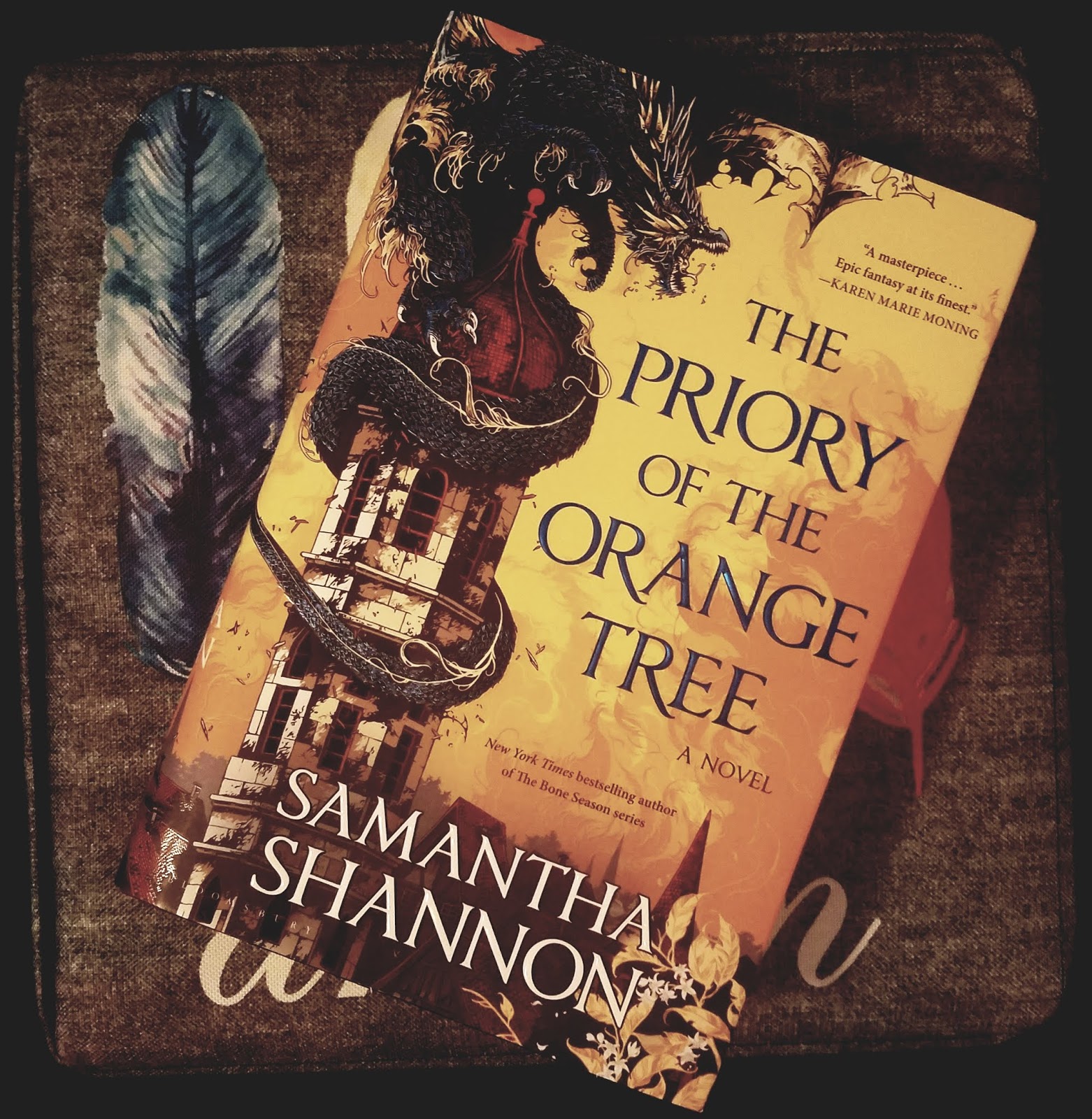
The Mime Order – Samantha Shannon
Back in October, I reviewed Samantha Shannon’s first published novel and the first in a proposed seven book series. You may remember that I was head-over heals in love with both the story and the writer. (Literary crush and all that jazz with a touch of jealousy.) The Bone Season was brilliant – I have not changed my mind. And Shannon can spin one hell of a yarn.
I am always wary of sophomore attempts, especially in series, and I can be quite harsh in my reviews of them. Contracts, agents, demanding publishing companies, etc. can all work together to push a work out before its time, so I was a little worried about The Mime Order. My concerns didn’t stop me, however, from placing my order and eagerly awaiting the mailman to drop that large hardback with its red cover in my paws.
It was beautiful. Heavy. Stunning cover. Smelled of a fresh printing. I couldn’t wait to open it up and through myself head and heart first back in Scion. But life and work got in the way until that gorgeous book was collecting dust on my nightstand. A few months ago, I dusted it off and snuggled up to it, pulling a near all-nighter. I have no regrets.
The Mime Order is just as beautifully crafted, though grittier/uglier, as The Bone Season. Paige continues to grow as an independent woman who literally battles her demons. She spends much of the novel covered in blood and/or bruises, but shows herself to be extremely resourceful and one badass woman. (Can Ronda Rousey play her in the movie, please?!?)
The love connection with the Warden (yes, he’s BACK!!!) and Nick’s relationship can seem a bit off-putting, especially when juxtaposed to “to the death” fight scenes, but that’s part of what makes this fantastical novel relatable. Life doesn’t stop or hit pause for love – you squeeze in it when and where you can.
Much like The Bone Season‘s review, I don’t want to say too much because this book is simply too delicious to spoil.
Divergent Trilogy – Veronica Roth
I wanted to finish the series before putting pen to paper on this one. Conclusion: it’s not a poorly written dystopian YA set. (Interestingly enough, why is so much YA lit these days dystopian in nature? Does it indicate a dissatisfaction among our youth with how the world is working? Do they fear the decline in society that is ever apparent in dystopian works?) It certainly is an active-paced edge of your seat read. And it didn’t make me angry. That’s always a plus.
The first of the trilogy, Divergent, was published in 2011. It readily sets up the world of factions: Dauntless – the bad-ass, thrill seeking lot who use brute strength and fear to maintain power and control. Abnegation – the selfless bunch who govern. Candor – those that hold truth above all else. Erudite – the intellectuals. Amity – the peace-loving hippies who grow the natural resources (and have a peace serum that is fed to the folks daily – yep. they are drugged.) And then there are the factionless, people who couldn’t neatly fit in a box or did not pass the initiation into their chosen factions. (Yes, you get to choose your faction – it does not choose you.) The factionless are the lowest of the low, destined to do the “dirty jobs” no one else wants. Being factionless isn’t exactly what people strive toward.
While you get to chose your faction, individuals are given an aptitude test when they are 16. The test is destined to indicate what faction they are best suited for. Those that do not neatly fit in a faction-box are considered “Divergent.” A word that’s whispered in hushed tones. Those who are Divergent, if they are lucky, find someone in their lives who tells them that they must hide the fact they are Divergent. Those that aren’t lucky, are killed (or extracted, but more on that later.)
One of the many tasks of Dauntless is to patrol the fence. To keep the residents in or something else out seems to be the question that’s touched on very early on in the trilogy, but for the most part, the “outside” does not factor into the first book, which focuses on Beatrice Prior, Abnegation-born, who chooses Dauntless after learning she is Divergent. This choice means she abandons her family. Her brother similarly abandons the family by choosing Erudite, leaving Beatrice initially confused as her brother had seemed annoyingly selfless his entire life. (Little tidbits of memories reveal the clues of his thirst for knowledge and makes Beatrice realize she should have known.)
Beatrice changes her name to Tris. With a serious chip on her shoulder, she sets out to prove that she is Dauntless through and through. But Dauntless isn’t just power and brute force – they are cruel, selfish, and much like rabid dogs. Eat or be eaten. A large number don’t survive the initiation – both by choice and design. Tris is almost killed by her “new” family. Another guy loses an eye. Yet a third commits suicide. And that’s just her initiation class.
Of course she falls in love with the Dauntless eye-candy who is tasked with assisting in the initiation. He too was Abnegation-born. He too changed his name. He too had something to prove. Tobias became Four, a nickname born of the fact he only has four fears. His father beat the hell out of him and his mother when he was a child. When his mother “died,” he took the brunt of his father’s anger – an anger that was well-hidden from the rest of the world – what goes on behind picket fences and all. He fled his father. (His father and his father’s fists were one of the four fears.) His relationship with his parents and his relationship Tris span all three books. The romantic relationship has all the growing pain of a normal relationship – they fight over lies, trust, and jealousy. And let’s just say this is no Bella and Edward relationship (thank goodness!) The relationship with his parents is perhaps more interesting.
Long story short – the Dauntless are put under a “serum” that makes them mindless killing machines. They attack Abnegation, as they are ordered to do. Those who are Divergent are immune. Tris and Tobias seek to thwart the attack. They are unsuccessful and Tobias is captured. Tris has to save him. And the world. Talk about an ass-kicking girl. She does. She breaks the simulation. The attack stops. The world of factions is forever shattered.
Insurgent shows a world where trust is rare, even between Tris and Four. More fighting. More people dying. More physical intimacy between Tris and Four. (Is it sex? Is it not sex?) Betrayal. Faction before blood and all that jazz. A video is played, a video Erudite sought to hide and Abnegation sought to reveal, showing that they were purposely placed there and that the Divergent are the key to saving the world. (Cue dramatic music.) Tris gets to be a hero again. (I really stopped liking her much in this novel.)
Allegiant is written from both Tris and Four’s POVs, in an alternating fashion. I found this unacceptable and jarring – their voices are simply to similar. Had the other books been drafted that way or had the voices been different, maybe I wouldn’t have been as annoyed. (I’m convinced she only did this so she could detail the death scene and the aftermath.) Tris, Four and the rest of their motley crew make it outside the fence. More dead people end up being alive. (Neat little trick!) They learn they were but a science experiment. The battle isn’t between the factions, the battle is between the “genetically pure” and the “genetically damaged.” (Plot twist: Tris is GP while Four is GD.) There are some interesting things going in this book – of note is how the GP have been convinced that wars are only the product of GDs, even though GPs created the GDs. History has been erased. (Oklahoma and the AP history debacle anyone?) More people die. Tris learns her mother had been born in the Fringe and “planted” into the factions to “fix” the problem of Erudite killing Divergents. She learns about the big bad world. She flies in a plane. And she decides to play hero again. Her actions may make her character appear to come full circle – the selfless acts of Abnegation in sacrificing herself instead of her brother (who did some pretty crappy things), but it wasn’t selflessness. It was pride. Tris wanted to be the hero. And Tris knew the death serum couldn’t kill her. She wanted the world to think she was a hero, that her acts were selfless, and maybe Roth wanted that as well. But she came across as a teenager with a chip on her shoulder who had to always be right, always had to know better than everyone else, regardless of the consequences. Death really was the only proper outcome.
As a whole, I applaud the trilogy. Unlike The Hunger Games, I didn’t feel like the subsequent books in the trilogy fell off in the writing or in the plot. And while many hated the ending, I felt it was a necessary conclusion – but maybe that’s because I really had no mushy feelings for Tris. And can I just say – Tris is BLONDE. Roth tells us this every fourth line it seems. Why couldn’t they make certain her hair color was correct in the movie!?!?!?!?!?!?!
The Tiger’s Wife – Tea Obreht
It has been over a year since my last post, but not over a year since I’ve read a novel!! Time and life have gotten away from me. But the book I stayed up last night to finish has forced me to take some time out of my holiday in order to share the sheer beauty of an artfully crafted tale.
Tea Obreht was born in the former Yugoslavia, but spent her childhood in Cyprus and Egypt. She immigrated to the US in her teens. The Tiger’s Wife, published in 2011, is her debut novel. (As of yet, a sophomore attempt has not been published.) For a young writer, Obreht has scores of accolades already and, based on The Tiger’s Wife alone, she is well-deserving of every bit of praise.
The Tiger’s Wife sparkles with a magic that an author cannot learn – it has to be in your soul, and Obreht’s soul was pulsating. The relationship she crafts between Natalia and her grandfather creates an easy pathway between family lore, magic, and the present.
“In my earliest memory, my grandfather is bald as a stone and he takes me to see the tigers. He puts on his hat, his big-buttoned raincoat, and I wear my lacquered shoes and velvet dress. It is autumn, and I am four years old. The certainty of this process: my grandfather’s hand, the bright hiss of the trolley, the dampness of the morning, the crowded walk up the hill to the citadel park. Always in my grandfather’s breastpocket: The Jungle Book, with its gold-leaf cover and yellow pages. I am not allowed to hold it, but it will stay open on his knee all afternoon while he recites passages to me.”
And so begins a story that is just as much Natalia’s as it is her grandfather’s. Obreht cleverly weaves in and out of the present, juxtaposing stories passed down by Natalia’s grandfather with the present – stories that are full of magic and horror, love and loss. The tiger’s wife, the deaf-mute who earned her rightful place as the namesake for the novel, has a story most beautiful and tragic. Natalia’s grandfather’s memory of her, a memory of his youth, is as heartbreaking as it is beautiful. A talented man whose closeted homosexuality and family obligations create a monster of a husband when all his hopes and dreams are shattered by his father. A lost tiger in the war who finds love and sanctuary with a deaf-mute who was never the intended. Cowards of men who fear the tiger and so seek to destroy. A man made bear by legend. A man, the nephew of Death, who could not die and travels throughout the story without aging, taking souls to his uncle in the hopes that he will one day be free. An elephant led through the city in the magic of the night. The breaking of a coffee cup. Cheating death. The magic of The Jungle Book. A war torn zoo. Animals turning on themselves and each other under the wail of sirens during air raids. Teenage rebellion during a war. Stolen skulls and lungs. Forty days. A war torn country where neighbors, family members suddenly become “the other” and sides must be chosen. A tiger who hasn’t been seen in years, but who is always there.
Natalia is defined by her grandfather’s life and stories, as such, the tiger’s wife is just as much a part of her. Even after her grandfather goes to meet Death like the old friend he is, the tiger is still there.